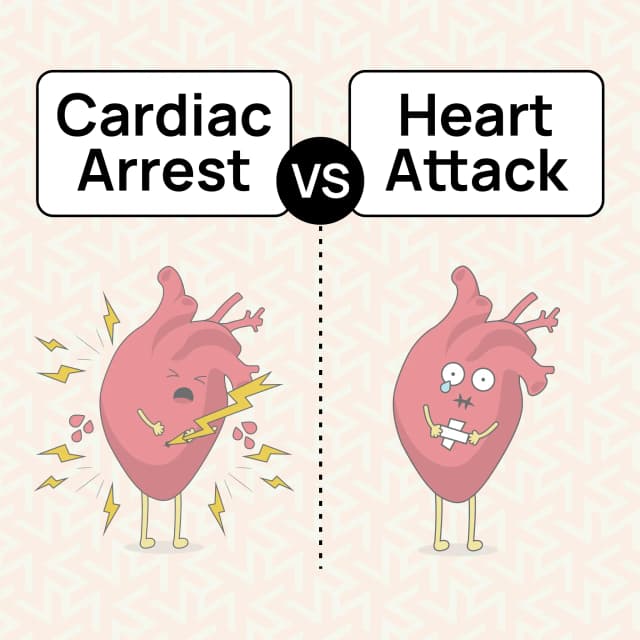
Heart attack and cardiac arrest might sound similar, but they are different heart conditions. Both are serious and life-threatening, but their causes and treatments differ.A heart attack is a "plumbing problem" caused by a blockage in the arteries. Cardiac arrest is an "electrical problem" caused by the heart�s rhythm malfunctioning.What is a Cardiac Arrest?Cardiac arrest happens when the heart suddenly stops beating. This stops blood flow to the brain and other vital organs, leading to unconsciousness and, if untreated, death within minutes.Cardiac arrest is often caused by an electrical problem in the heart, like an irregular heartbeat (arrhythmia). It can happen suddenly without warning, even in someone who seems healthy.What is a Heart Attack?A heart attack, also called a myocardial infarction (MI), occurs when blood flow to a part of the heart is blocked. This blockage is usually caused by a buildup of fat, cholesterol, or plaque in the arteries.During a heart attack, the affected part of the heart doesn't get enough oxygen, which can damage the heart muscle. Unlike cardiac arrest, the heart usually continues to beat during a heart attack.Is Cardiac Arrest a Heart Attack?No, cardiac arrest is not the same as a heart attack. However, a heart attack can sometimes lead to cardiac arrest. In this case, the damage caused by the heart attack triggers the heart to stop beating.What is the Difference Between Heart Attack and Cardiac Arrest?The main difference is what causes each condition and how it affects the heart. A heart attack, also known as a myocardial infarction (MI), occurs when a blockage prevents oxygen-rich blood from reaching the heart. Cardiac arrest, on the other hand, happens when the heart suddenly stops working. In this case, the heart stops beating and pumping blood to vital organs.Although one results from a blockage and the other from an electrical malfunction in the heart, you can reduce the risk of both. Focus on improving your overall heart health by maintaining a healthy weight, managing blood pressure, and keeping cholesterol levels in check.Heart Attack Vs Cardiac ArrestFeatureHeart AttackCardiac ArrestCauseBlockage in blood flow to the heartElectrical malfunction in the heartSymptomsChest pain, shortness of breath, nauseaSudden collapse, no pulse, no breathingHeart FunctionThe heart keeps beating, though damagedThe heart stops beating completelyOnsetGradual, with warning signsSudden, often without warningTreatmentEmergency medication, surgery (like stents)CPR, and defibrillation (AED) are needed immediately�How to Reduce Your Risk of Heart Attack and Cardiac ArrestTo lower your chances of experiencing either a heart attack or cardiac arrest:Eat a heart-healthy diet with fruits, vegetables, and whole grains.Exercise regularly to maintain a healthy weight.Monitor your blood pressure and cholesterol levels.Avoid smoking and limit alcohol consumption.Understanding the difference between heart attack and cardiac arrest can save lives. Knowing the symptoms and getting immediate help is the key to better outcomes.FAQsCan a heart attack lead to cardiac arrest?Yes, a severe heart attack can sometimes cause cardiac arrest. The damage from a heart attack can disrupt the heart's electrical system, leading to sudden cardiac arrest.What should I do if I see someone experiencing cardiac arrest?Call emergency services immediately. Start CPR (chest compressions) and use an automated external defibrillator (AED) if one is available. Quick action can save a life.How can I tell the difference between a heart attack and cardiac arrest?A heart attack usually involves symptoms like chest pain, shortness of breath, and nausea, and the person is often awake. Cardiac arrest happens suddenly, causing the person to collapse, lose consciousness, and stop breathing.Are heart attacks and cardiac arrests preventable?While the risk cannot be eliminated, it can be significantly reduced by maintaining a healthy lifestyle, managing blood pressure and cholesterol, and avoiding smoking.Who is at higher risk of cardiac arrest?People with a history of heart disease, arrhythmias, or previous heart attacks are at higher risk. However, cardiac arrest can also occur in people without any known heart problems.Which is more dangerous, heart attack or cardiac arrest?Cardiac arrest is more dangerous than a heart attack as it stops the heart completely, risking immediate death without prompt treatment. .main{ border:3px solid #0f7c90; border-radius:20px; position: relative; font-family:roboto; font-weight: 400; color: #000; } .main-two{ position: absolute; top:-25px; left:45px; background-color:white; } .img-div{ border-radius : 100%; padding:2px 7px; background-color:#0f7c90; margin-right:5px; width: 50px; height: 50px; } .img{ width:30px; object-fit:contain; height:auto; border-radius : 100%; } @media only screen and (max-width: 600px) { .heading{ font-size:20px; } .img{ width:20px; object-fit:contain; height:auto; border-radius : 100%; } .img-div{ width: 40px; height: 40px; } .main-two{ left:25px; } } How To Administer CPR ? Knowing the difference between cardiac arrest and heart attack is important in emergencies, but there's more to first aid. Our First Aid courses offer complete training to help you handle critical situations. Whether you want to improve your skills or workplace safety, these courses help build confidence and expertise. View our Emergency First Aid at Work (EFAW) and Level 3 First Aid at Work courses. These courses meet the UK legal requirements and help you keep people safe. ConclusionUnderstanding the difference between heart attack and cardiac arrest is important for recognising and responding to these emergencies. A heart attack involves a blockage in blood flow, while cardiac arrest is a sudden stoppage of the heart�s function. Both conditions require immediate medical attention.By learning the symptoms, knowing how to act in emergencies, and improving your heart health, you can help save lives and reduce risk. Remember, awareness is the first step toward prevention and better heart health.

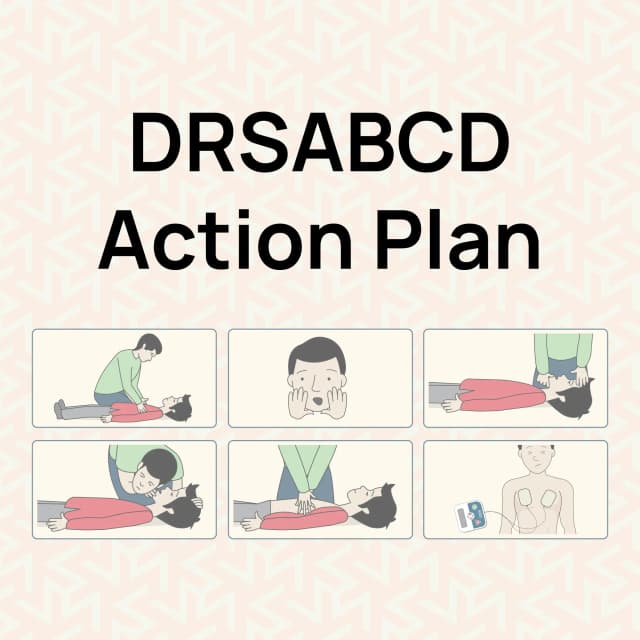
Learning basic first aid skills can make a significant difference in saving a life during an emergency. A 2021 survey in the UK revealed that over 30% of adults lacked knowledge of CPR or chest compressions and had never participated in any basic first-aid training.Fortunately, anyone can enrol in first aid courses to learn these life-saving techniques. Learning these skills allows you to respond effectively in emergencies by applying pressure to a wound or performing other procedures. For this reason, first aid training is often included in school curricula and workplace safety programs.One critical framework in first aid is the DRSABCD action plan. It helps you assess a situation and provide appropriate care, from reducing pain and covering wounds to administering CPR.DRSABCD Meaning: What Does DRSABCD Stand For?DRSABCD is an acronym that outlines the steps to follow in an emergency first aid situation. Each letter stands for a specific action:AcronymStepShort DescriptionDDangerCheck the area for dangers to yourself, the casualty, or others. Ensure the environment is safe.RResponseCheck if the casualty is responsive by speaking to them or gently shaking their shoulders.SSend for HelpCall emergency services (e.g., 999) and provide clear information about the situation.AAirwayEnsure the airway is clear by tilting the head back and lifting the chin to remove obstructions.BBreathingLook, listen, and feel for breathing. If not breathing, prepare to perform CPR.CCPR (Cardiopulmonary Resuscitation)Perform 30 chest compressions followed by two rescue breaths. Repeat until help arrives.DDefibrillationUse an Automated External Defibrillator (AED) if available, following its instructions.The DRSABCD framework helps you take systematic and effective steps to aid someone in a critical situation.DRSABCD Action Plan in First AidThe DRSABCD action plan outlines a step-by-step approach to managing emergencies effectively. It helps assess danger, provide immediate assistance, and determine the best action. Following are the DRSABCD steps included in the primary survey of first aid:DangerStart by ensuring the area is safe for both you and the casualty. For example, if the incident occurs on a road, ensure the area is traffic-free. Avoid moving the casualty if trapped or badly injured, as this could cause further harm. Instead, call for professional help or ask others nearby to assist.ResponseCheck if the casualty is responsive. Shake their shoulders gently and ask simple questions like their name or how many fingers you hold up.Outcomes:If responsive: Assess their condition, pain level, and immediate needs.If unresponsive: Call for professional help immediately and begin CPR if necessary.Send for HelpCall emergency services regardless of the casualty's responsiveness (e.g. 999). Place the phone on speaker mode and provide basic first aid until help arrives.AirwayEnsure the casualty's airway is clear. Look for obstructions in the throat or nose. Gently tilt their head back and lift their chin. If you can safely remove the blockage, do so. Otherwise, wait for professional assistance.BreathingCheck if the casualty is breathing. Get close to their face to listen and feel for breath or observe chest movements.If not breathing: Begin CPR immediately.If breathing but unconscious: Place them in the recovery position by rolling them onto their side while keeping their spine, head, and neck aligned. Continue monitoring their breathing until help arrives.CPR (Cardiopulmonary Resuscitation)If the casualty isn�t breathing, perform CPR to circulate oxygen and blood:Place both hands on the lower half of their breastbone, at the centre of their chest.Press down firmly to 1/3 of the chest�s depth, giving 30 compressions.Open their airway, pinch their nose, and provide two rescue breaths by blowing steadily for one second each.Repeat the cycle (30 compressions, two breaths) at around 120 compressions per minute.Continue until professional help arrives or the casualty starts breathing.DefibrillationIf an Automated External Defibrillator (AED) is available, use it immediately after CPR if the casualty remains unresponsive. Modern AEDs provide clear step-by-step instructions. Follow these instructions carefully while waiting for medical professionals to take over.By following the DRSABCD plan, you can provide effective first aid during critical emergencies. .main{ border:3px solid #0f7c90; border-radius:20px; position: relative; font-family:roboto; font-weight: 400; color: #000; } .main-two{ position: absolute; top:-25px; left:45px; background-color:white; } .img-div{ border-radius : 100%; padding:2px 7px; background-color:#0f7c90; margin-right:5px; width: 50px; height: 50px; } .img{ width:30px; object-fit:contain; height:auto; border-radius : 100%; } @media only screen and (max-width: 600px) { .heading{ font-size:20px; } .img{ width:20px; object-fit:contain; height:auto; border-radius : 100%; } .img-div{ width: 40px; height: 40px; } .main-two{ left:25px; } } Put your knowledge of the DRSABCD steps into practice by enrolling in a course today! Our First Aid courses offer complete training to help you handle critical situations. Whether you want to improve your skills or workplace safety, these courses help build confidence and expertise. View our Emergency First Aid at Work (EFAW) and Level 3 First Aid at Work courses. These courses meet the UK legal requirements and help you keep people safe. ConclusionIn conclusion, the DRSABCD action plan is a simple and effective guide to handling emergencies and saving lives. By following its steps�checking for danger, assessing responsiveness, calling for help, clearing the airway, checking breathing, performing CPR, and using a defibrillator�you can provide crucial first aid until help arrives. Practising these steps regularly helps you stay calm and confident, giving the casualty the best chance of recovery.

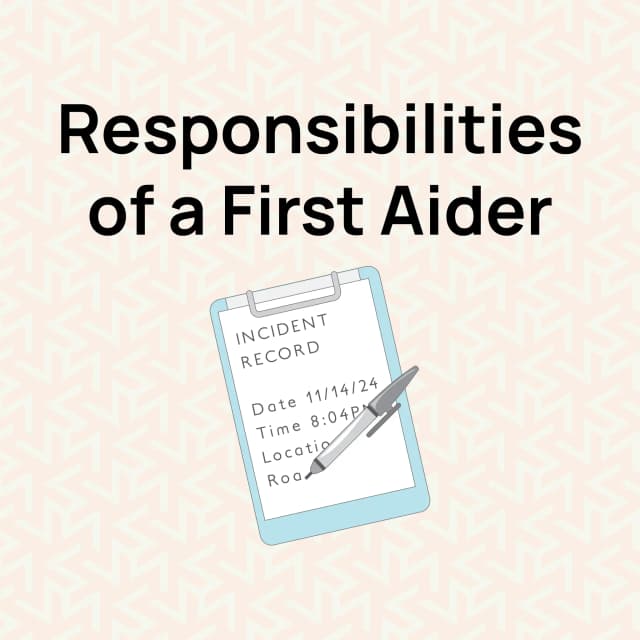
First aiders are common in most businesses, playing a key role as first responders in medical situations. They provide immediate, stabilising help when someone needs urgent care until professional medical assistance arrives. The role of a first aider can vary greatly depending on the person and workplace, which can make it confusing to understand the responsibilities if you�re new to it.While the main goal of first aid is to save lives, there are many other duties involved. In emergencies, they must provide proper care to anyone who is sick or injured. They also need to keep their first aid training up-to-date and be aware of any risks or hazards specific to their workplace.What is a First Aider?A first aider is trained to help sick or injured people until professional medical help arrives. They know basic skills like how to stop bleeding, help someone who is choking, or do CPR. First aiders are usually the first to respond in an emergency, keeping people safe and calm until more help comes.Anyone can be a first aider if they learn the right skills. I can be a first aider because I want to help others in emergencies and make my workplace or community safer.Qualified first aiders usually complete one of two main types of training:Emergency First Aid at Work (EFAW)This Level 3 course is for people designated as first aiders in lower-risk workplaces. The one-day training covers CPR, handling bleeding and wounds, managing choking incidents, treating minor injuries, and knowing what to do in emergencies. Upon successful completion, participants receive a certificate valid for three years.First Aid at Work (FAW)This is a more detailed Level 3 course for first-aiders in higher-risk workplaces. It covers additional topics like helping someone having a seizure, heart attack, diabetic emergency, or severe allergic reaction. FAW training lasts three days, and the certification is valid for three years.First aiders can also take specialist courses, like Paediatric First Aid. Health and Safety regulations do not require a trained first aider in some small businesses. Instead, they may appoint a responsible person for first aid, though this person does not need formal training. They may choose to take a basic first aid course for appointed persons.What are the Key Responsibilities of a First Aider A first aider�s main job is to help someone injured, sick, or having a medical emergency. The care provided depends on the severity of the situation and can range from simple tasks, like removing a splinter, to more complex emergency actions. Assess the SituationQuickly evaluate the scene to ensure it is safe for you and the injured person. Look for any hazards and try to remove or minimise them before giving assistance.Provide Initial CareOffer appropriate first aid to stabilise the injured person and prevent further harm. This might include CPR, stopping bleeding, or helping with choking. Only perform techniques you are trained in to avoid causing more harm.Call for Professional HelpCall emergency services or ask someone else to do so, especially in serious situations. It may be best to call NHS 111 for advice or refer the person to their GP for minor injuries.Communicate CalmlyStay calm and speak clearly with the injured person and anyone else. If the person is conscious, introduce yourself and explain your plan. Let bystanders know how they can assist, like calling an ambulance or keeping a respectful distance for the person�s privacy.Monitor the Injured PersonKeep an eye on their condition, checking breathing, pulse, and temperature. If they become unconscious, ensure their airway is open and start CPR if needed.Record the IncidentDocument the incident details, such as date, time, location, and the treatment given. Accurate records may be needed for legal reasons and are useful for improving future first-aid practices. Always protect personal data when keeping these records.Other Duties of a First AiderA first aider�s duties go beyond giving immediate help. They also include:Keeping First Aid Skills UpdatedAfter completing Emergency First Aid at Work (EFAW) or First Aid at Work (FAW) training, you receive a certificate valid for three years. You�ll need to renew your training after that, but taking a half-day skills refresher course each year is helpful, either in person or online. Although you may not be responsible for keeping your training records, some workplaces assign this to a specific team or person in charge of learning, development, or health and safety.Staying Aware of Workplace RisksKnowing about potential risks and hazards in your workplace helps you better prepare to handle emergencies. If your previous training does not cover the hazards you encounter, you may want to ask for extra training. If your workplace has a first aid needs assessment, review it.Familiarising Yourself with First Aid EquipmentKnow where to find first-aid kits and devices like AEDs (defibrillators). If you�re not trained to use certain equipment, ask for training to ensure you�re prepared.Note: First aiders must stay within the scope of their training to avoid causing unintentional harm.Responsibilities of a Workplace First AiderThe Health and Safety (First Aid) Regulations 1981 require employers to provide adequate first aid equipment, facilities, and trained people to assist employees who become ill or injured at work. The type and level of first aid provided should match the needs of the specific workplace.At a minimum, every workplace must have:A properly stocked first-aid kitAn �appointed person� responsible for first aid arrangementsBeing appointed for first aid is a serious role. It is recommended that this person complete at least a basic first aid course, like the one-day Emergency First Aid at Work qualification. The qualification is valid for three years, with annual refreshers encouraged.The Health and Safety Executive (HSE) advises that each employer conduct a First Aid Hazard Assessment to determine the resources needed based on their workplace�s specific risks.It�s also important to have first aid available whenever employees work, whether on-site, driving, or working off-site. The HSE expects each vehicle used for work purposes, whether personal or company-owned, to carry a first aid kit.Responsibilities of a Mental Health First AiderWhile first aid is often considered physical health, employers increasingly consider mental health support for their employees. The Health and Safety Executive (HSE) encourages employers to include mental health first aid in workplace care.To support this, consider our Mental Health First Aid course, which aligns with this new HSE guidance. This training prepares mental health first aiders to recognise signs of mental health issues and provide initial support.FAQsWhat is a first aider, and what do they do in the workplace?A first aider is trained to assist someone injured, sick, or having a medical emergency until professional help arrives. In the workplace, first aiders respond quickly to provide immediate support, helping to stabilise the person and keep the situation under control.What type of training does a first aider need?First aiders complete either the Emergency First Aid at Work (EFAW) course, a one-day training for lower-risk workplaces, or the First Aid at Work (FAW) course, a more in-depth, three-day training for higher-risk workplaces. Each certificate is valid for three years, and annual refreshers are recommended.What are the key responsibilities of a first aider?The main responsibilities include assessing the situation, providing initial care (like CPR or bleeding control), calling for professional help if necessary, communicating calmly, monitoring the injured person�s condition, and recording the details of the incident.Do first aiders need to keep their skills and training updated?Yes, it�s important for first aiders to keep their skills up to date. While certifications are valid for three years, taking an annual refresher course is beneficial to stay current with first aid practices.How should first aiders prepare for specific risks in their workplace?First aiders should review any workplace first aid needs assessment and become familiar with potential hazards specific to their environment. They should also know where to locate first aid kits and AEDs and request additional training for their workplace risks.Are employers required to have a designated first aider and first aid equipment?Yes, according to Health and Safety regulations, employers must provide adequate first aid equipment and appoint a person to manage first aid arrangements.What is a mental health first aider, and is this role important?A mental health first aider is trained to provide initial support for mental health concerns in the workplace. As mental health becomes a priority, the Health and Safety Executive encourages employers to offer mental health first aid.ConclusionIn conclusion, a first aider in the workplace is important for ensuring a safe and responsive environment. From providing immediate help in emergencies to staying prepared through regular training, first aiders play a role in safeguarding the well-being of their colleagues. By understanding and fulfilling these duties, first aiders help prevent minor incidents from becoming severe and contribute to a supportive, health-conscious workplace culture.

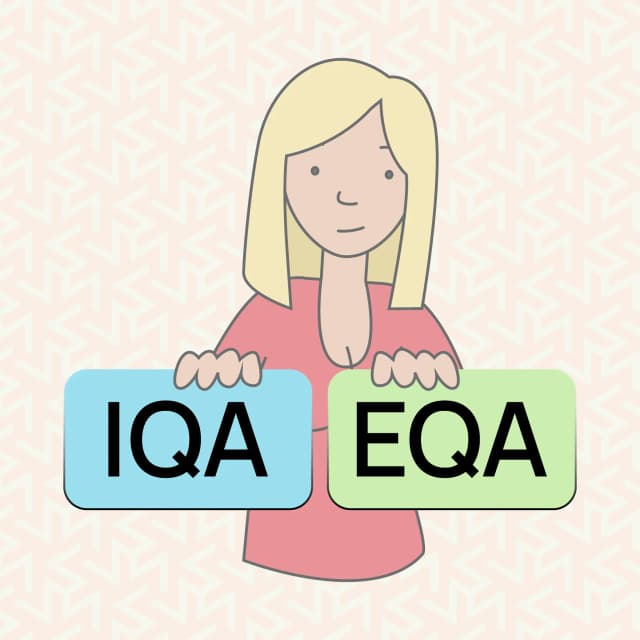
Quality assurance is important for addressing quality-related issues within organisations. Problems like biased assessments can harm an organisation's reputation, making early detection important to avoid costly corrections of systemic errors. To become a quality assurer, one must complete the appropriate qualifications, which come in two types: internal and external. It is important for learners to carefully review course guidelines to select the right qualification.Internal Quality Assurance (IQA)Internal Quality Assurance (IQA) is fundamental to maintaining high standards in products or services. IQAs ensure that assessments are fair and of high quality. They oversee assessors' activities and verify that evaluations are conducted impartially.External Quality Assurance (EQA)External Quality Assurers (EQAs) operate independently from the organisations or assessment centres they oversee. They provide guidance, support, and assistance to the centre�s Internal Quality Assurers (IQAs). EQAs also work with assessors and other personnel involved in the qualification process to ensure that all candidates are treated fairly. They ensure that qualifications are delivered in adherence to regulatory standards, such as those established by OFQUAL. This includes measures to prevent cheating or unethical conduct, including plagiarism or impersonation during assessments.Which EQA Qualification Do I Need?The primary qualification in this field is the Level 4 Award in External Quality Assurance of Assessment Processes and Practice.It covers the theoretical understanding of the EQA role and the practical aspects of conducting visits, checks, and monitoring. It is suitable for individuals who oversee assessment quality externally.The Level 4 Award in Understanding the External Quality Assurance of Assessment Processes and Practice is for EQA beginners who want to understand the principles and methods of external quality assurance without needing practical application.This qualification aims to train individuals for roles in the workplace where they are responsible for upholding assessment quality standards. .banner-blue { border-radius: 10px; overflow: hidden; border: 2px solid #ccc; box-shadow: 0 4px 8px rgba(0, 0, 0, 0.2); background-color: #fdf9ee; } .book-now { color: white; background-color: #DF3D52; border: none; padding: 15px 60px; border-radius: 5px; cursor: pointer; font-size: 20px; text-decoration: none; } .book-now:hover { /*text-decoration: none;*/ color: white; background-color: #c33f50; } Get Certified with our TQUK Assessor Courses Regulated by OFQUAL Assessor Courses Book Now Trustpilot What is the Difference Between Internal and External Quality Assurance QualificationsWhile IQA and EQA focus on maintaining quality standards, they differ in objectives and operational levels.Internal Quality Assurance�External Quality Assurance�Administrative authority�Legislative authority�Focuses on improvement within an organisationFocuses on accountability & compliance of an organisationTypically follow local regulations�Typically follow global regulationsInstitutional level of operationThe national level of operation�The end report is private�The end report is public�

An effective food safety management system includes the principles of HACCP, TACCP, and VACCP. Generally, food safety is maintained through HACCP (Hazard Analysis Critical Control Points), which manages potential hazards arising from processing errors or human mistakes.However, there has been a rise in threats involving deliberate tampering or contamination of food for malicious or financial reasons, which are not specifically addressed by HACCP.As an ethical and legal strategy to fulfil high food safety and hygiene standards, TACCP and VACCP complement HACCP in maintaining food safety across the entire supply chain. Both strategies focus on preventing food adulteration.What Does TACCP Stand For?TACCP stands for "Threat Assessment and Critical Control Point." It is a food safety management approach used to identify and assess potential food safety threats not covered by traditional HACCP (Hazard Analysis Critical Control Point) systems.What is TACCP? While HACCP focuses on managing known hazards, TACCP addresses more specific and often less predictable threats, such as deliberate contamination or sabotage. By including TACCP, food businesses can better safeguard their products from unintentional and intentional risks.What are the TACCP PrinciplesThe principles of TACCP (Threat Assessment and Critical Control Point) are:Identify Threats: Find out what intentional harm could happen to food, like sabotage or fraud.Find Weak Spots: Examine the production process and supply chain to see where these threats could enter.Evaluate Risks: Consider how likely these threats will be used and how easily they can exploit the weak spots.Set Control Points: Choose key areas where you can implement measures to prevent or stop the threats.Implement Controls: Put security measures in place to address the threats, such as better storage or surveillance, and train staff to spot problems.Monitor and Check: Regularly check if the controls are working and update them as needed based on new information or changes in risks.Prepare for Incidents: Prepare a plan for responding to an intentional contamination incident, including who to contact and what actions to take.What is an Example of TACCP?To explain how TACCP works in food safety, we can use the example of a small-town bakery.The bakery's team starts the TACCP process by checking for possible threats, such as contamination of ingredients like flour. They then identify vulnerable points in the production process and assess how likely these vulnerabilities will be exploited. The bakery implements security measures to reduce these risks, such as secure ingredient storage and surveillance. The staff is trained to detect and respond to suspicious activities. By proactively addressing potential threats, the bakery successfully prevents deliberate contamination.What does VACCP Stand For?VACCP stands for "Vulnerability Assessment and Critical Control Points." It is a food safety approach focused on identifying and managing vulnerabilities in the food supply chain that could lead to food fraud and financial loss.What is VACCP?VACCP is a type of risk assessment that helps find and manage weaknesses in the food supply chain that could lead to food fraud for financial gain. VACCP aims to prevent intentional fraud, where food is deliberately tampered with during production for economic reasons.In a VACCP assessment, a food business examines its processes and supply chain to identify potential food fraud. This helps the business understand and address specific types of fraud.Food fraud involves tricking customers or consumers for financial benefit. VACCP focuses on preventing two key types:Adulteration: Adding something not listed on the label to reduce costs or fake a higher quality.Substitution: Replacing a food or ingredient with a similar but lower-quality substance. .second-cta-block .main-heading { font-weight: bold; font-size: 22px; } .second-cta-block .book-now { background: #DF3D52; color: #FFFFFF !important; border-radius: 8px; } .second-cta-block .second-heading { font-size: 17px; } .second-cta-block .card { border: 0 !important; } .second-cta-block .card-body { border: 1px solid #909090; box-shadow: rgba(0, 0, 0, 0.16) 0px 1px 4px; border-top-right-radius: 100px; border-bottom-right-radius: 100px; background: #fdf9ee; } .second-cta-block .image-wrapper { height: 330px; position: absolute; right: -60px; top: calc(50% - 210px); /* Center the image vertically */ } .second-cta-block .image-wrapper img { height: 100%; } .second-cta-block .trustpilot-widget { width: 256px; } .cta-heading-section { width: 75%; } @media screen and (max-width:991px) { .second-cta-block { padding-top: 100px; } .second-cta-block .card-body { border: 1px solid #909090; box-shadow: rgba(0, 0, 0, 0.16) 0px 1px 4px; border-radius: 19px; border-radius: 14px; background: #fdf9ee; } .cta-heading-section { width: 100%; padding-top: 50px; } .second-cta-block .image-wrapper { height: 270px; right: 0; position: absolute; left: calc(50% - 90px); top: calc(50% - 315px); } } Get Online Food Safety Courses Food Hygiene And Safety Check the Course Rated Excellent on major review sites What are the VACCP Principles?The principles of VACCP (Vulnerability Assessment and Critical Control Points) are:Identify Vulnerabilities: Recognise production and supply chain areas where food fraud could occur.Assess Risks: Evaluate how likely these vulnerabilities could be targeted and the potential impact of such fraud.Determine Critical Control Points: Identify key stages where controls can be applied to prevent or detect food fraud.Implement Controls: Put in place measures to address the identified vulnerabilities and risks.Monitor and Review: Regularly check the effectiveness of the controls and review the vulnerability assessment.Respond to Incidents: Have a clear plan for addressing food fraud incidents, including investigation procedures and corrective actions to prevent recurrence.What is an Example of VACCP?We can use a juice manufacturing company as an example to explain how VACCP works in the food industry.In a juice manufacturing company, VACCP is used to combat food fraud by focusing on supply chain vulnerabilities and production processes. The company identifies risks such as the potential substitution of high-quality fruit concentrates with cheaper alternatives and the threat of counterfeit packaging. They implement controls like quality checks on ingredients and tamper-evident packaging. Regular monitoring and audits are conducted to ensure these measures are effective. If fraud is detected, the company follows a response plan to trace the source, notify affected parties, and prevent future incidents. This approach helps maintain the integrity and authenticity of their products.What is the Difference between TACCP & VACCPTACCP and VACCP aim to prevent intentional food contamination, unlike HACCP, which deals with unintentional contamination. VACCP targets system vulnerabilities, focusing on where weaknesses could be exploited for fraud.In contrast, TACCP identifies specific threats, concentrating on what could happen. Essentially, TACCP is concerned with the nature of the threats, while VACCP addresses the timing and opportunity for fraud.TACCP and VACCP focus on identifying and preventing potential adulteration in the food supply chain but address different threats. TACCP aims to prevent malicious threats such as sabotage or extortion. In contrast, VACCP focuses on preventing food fraud driven by economic motives, like substituting ingredients or falsifying product information for financial gain.What are the Benefits of TACCP and VACCP?Using TACCP and VACCP in a food business offers several advantages:Shows your commitment to food safetyLowers the risk of intentional attacks or fraudEnsures reasonable precautions are taken to protect the supply chainAssures stakeholders and customers that risks are managed properlyMinimises the impact of any attack on your businessProtects and improves your brand and reputationConclusionTACCP and VACCP are strong defences against food fraud and contamination. When used correctly, they help reduce the chances of attacks and lessen the damage if they occur. Together with HACCP, they confirm food safety and protection from intentional and unintentional contamination.

Assessors' core responsibility is to evaluate learners. To do so effectively, they must use assessment methods they will most likely learn and apply during the assessor course.What are Assessment Methods in Education and Training?Assessment methods check learners' skills and knowledge needed to pass a qualification.A qualification or assessment strategy specifies which methods to use. Learners must answer questions or write assignments if the qualification needs evidence of knowledge. A learner can be evaluated using the following assessment approaches:QuestionsAssignmentsDiscussionsWitness testimonySimulationRoleplayReflective accounts, where learners talk or write about what they did in a real situation .banner-blue { border-radius: 10px; overflow: hidden; border: 2px solid #ccc; box-shadow: 0 4px 8px rgba(0, 0, 0, 0.2); background-color: #fdf9ee; } .book-now { color: white; background-color: #DF3D52; border: none; padding: 15px 60px; border-radius: 5px; cursor: pointer; font-size: 20px; text-decoration: none; } .book-now:hover { /*text-decoration: none;*/ color: white; background-color: #c33f50; } Get Certified with our TQUK Assessor Courses Regulated by OFQUAL Assessor Courses Book Now Trustpilot What are the Types of Assessment MethodsObservationObservation is a natural way to gather evidence of a learner�s skills. If assessing a group, each learner�s observation should be recorded individually, noting how each one acted, spoke, or performed.ObservationObserving learner�s performing skills either in the workplace or a learning environment. This includes job roles or skills during apprenticeships.�Strengths of Observations- Allows direct view of learner�s skills in action- Enables assessment of how learners perform tasks and correct mistakes- Multiple criteria can be assessed simultaneously- Motivates by addressing many criteria in a single observationLimitations of Observations- Timing issues, especially if observation needs to be done in person and the learner works unconventional hours (e.g., night shifts).- In settings where recording is not feasible (e.g., nurseries), reliance on notes and�memory may be challenging.QuestioningQ&A can be an oral or in-writing assessment method, and it can also include quizzes or exams. Questioning helps you see what the candidate understands and where they need to improve. It is a useful approach to identify areas for growth and plan the next steps.QuestioningA popular method for assessing a learner�s understanding and stimulating their thinking. It involves asking questions to assess knowledge and encourage deeper thought.Strengths- Can include various types: multiple-choice, short answers, or essays- Questions can be personalised or drawn from a question bank- Challenges learners and promotes their potential- Can target critical thinking and skill recognition- Oral questions may be better for learners with dyslexia or visual impairmentsLimitations- Closed questions (yes/no) limit the ability to demonstrate knowledge- Writing questions can be time-consuming- Written responses may be copied or plagiarized- Essay-style questions may be challenging for some learners, so various question types are neededProjectsProjects and assignments help you see what a candidate knows by gathering all their work in one place. This can include reports, essays, or research tasks. Mistakes or missing information in their work show where their knowledge needs improvement. You can help them learn more and cover gaps before the final assessment.ProjectsProjects are useful for collecting a lot of information at once. They can include reports, essays, or research tasks.Strengths of Projects- Reveals gaps in the learner�s knowledge for targeted extra training- Provides real-world experience in a professional or vocational setting- Structured with a clear beginning, middle, and end, allowing for formative feedback and reflectionLimitations of Projects- Keeping the learner engaged can be challenging, especially if projects last several weeks or months- Maintaining motivation throughout the entire project duration is necessaryRecognition of Prior Learning (RPL)RPL, or Recognition of Prior Learning, looks at any previous qualifications, awards, or certificates the candidate has earned. As an assessor, you compare this prior work with the current criteria to see if the candidate has met them. This method is favoured by candidates because it might reduce their workload if they have already covered the material.RPL (Recognition of Prior Learning)RPL involves considering any previous qualifications the learner has that show they already know or understand parts of their current qualification.Strengths of RPL- Helps learners avoid repeating work they have already completed- Saves time by allowing learners to progress faster- Previous work history is valued and not wastedLimitations of RPL- Requires assessing if previous learning aligns with current qualification criteria- Learners may need to demonstrate their knowledge with a brief assignment- Sometimes, it may be easier to observe the learner cover the criteria againWitness TestimonyWitness Testimony relies on having a trustworthy candidate. For this method, you need a qualified professional who works with the candidate to write a report on when they saw the candidate perform a task or skill and confirm their competence.The candidate must also write a report about the same task or skill. As the assessor, you compare both reports. If they match well, the testimony is likely valid and can be used to meet certain assessment criteria.Witness TestimonyTo get a valid witness testimony, you need a qualified professional who works with the candidate, like a line manager, to write a report on when they saw the candidate perform a task or skill to confirm their competence.Strengths of Witness Testimony- The witness can confirm the candidate�s competence or achievements if they know the assessment criteria- Useful for practical skills; videos can support this but have their limitationsLimitations of Witness Testimony- The assessor must validate the suitability of the witness and verify the authenticity of their statements- There is a risk of fraud if learners sign statements themselves or if managers falsely act as witnesses to sign off on tasks they have not observedWork ProductIf your candidate is working in a job related to their qualification, like an apprenticeship, they are likely doing tasks every day that could count as evidence for their criteria. Since they are already doing the work that meets the criteria, it might not make sense to ask them to repeat it in an assignment. This method is often popular with candidates because it lets them achieve two goals at once.For example, a business administration student might take screenshots of emails to show their work. Depending on what the criteria require, if a screenshot can prove they have the needed skills, it is a good option.Work ProductWork products involve assessing a candidate�s performance through their job-related tasks, often seen in Apprenticeships where candidates produce work relevant to their qualification.Strengths of� � � Work ProductThe finished product can provide high-quality evidence of the learner�s understanding and competence in a unit. It also serves as a tangible example of the learner�s skills.Weaknesses ofWork ProductThe end product can be challenging to assess. A portfolio is often needed to show both the understanding and the process, which can be time-consuming and unclear in terms of criteria benchmarks.VASCR Principles of Assessment MethodsThe VASCR principles�Valid, Authentic, Sufficient, Current, and Reliable�help ensure assessment fairness and accuracy. They make sure that:The assessments are genuinely created by learners.They stay relevant.They cover all the required learning outcomes.They show consistent results over time.What Qualifications Do You Need to Become a Qualified Assessor?To become a qualified assessor, you need a relevant qualification, like the Level 3 CAVA Certificate. This certification allows you to conduct assessments in educational settings and train to assess skills in various job environments.Once you complete this certification, you can assess learners working towards National Vocational Qualifications (NVQs) and apprenticeships.

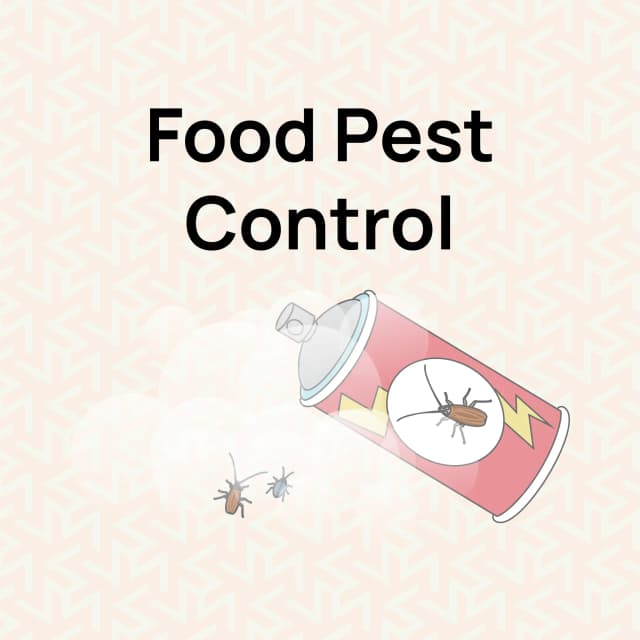
Pests can be a nuisance and a health risk. They can contaminate food, damage property and spread diseases and harmful bacteria that cause food poisoning. No matter how good your business is, pests like insects or rodents can eventually become problematic.Pests are often found near waste, food, and other areas where they can spread diseases. They can carry and spread harmful bacteria such as Salmonella, E. Coli, Campylobacter, and Listeria.Food hygiene laws require businesses to protect against pests and have proper procedures to control them.The pest control industry has grown in the past five years. Food businesses must follow hygiene laws, so more food businesses in the UK mean more pest control needs.What is a Pest?A pest is any living thing that negatively affects humans. This can include unwanted plants (weeds), fungi, worms, microbes (like bacteria or viruses), and insects. What are the Different Types of Pests?Food businesses often deal with four main types of pests:Rodents: rats and miceInsects: cockroaches, beetles, fliesBirds: pigeons, seagulls, and similar birdsMicrobes: Bacteria, fungi and virusesWhat is the Meaning of Pest ControlPest control involves protecting our health and property. It is important for food safety and hygiene. Rodents eat about 20% of the world�s food supply. They also carry fleas, ticks, and mites and spread diseases to people and animals.Cockroaches are dirty insects that can trigger allergies in 7�8% of people. Good pest control helps maintain food hygiene and health standards. Without it, food safety and health regulations would be hard to follow.What are the 3 Methods of Pest ControlPhysical Pest ControlThis approach involves using non-chemical methods to manage pests through physical means or barriers. It is often used to prevent physical contaminants of food from entering an area or to capture and remove them.Control TechniquesPest-proofing is the process of closing cracks, gaps, and building entry points to prevent pests from entering. It may also include installing screens on doors and windows.Traps use various methods to capture and kill pests. There are several common traps, such as glue traps, snap traps, and live traps. These are particularly useful for small animals like rodents and insects.Temperature Control refers to the use of extreme temperatures to kill pests. As an example, bedbugs can be killed using heat treatments, which increase the temperature to unbearable levels. Conversely, freezing can kill pests in food items or other stored products.AdvantagesNon-toxic and not harmful even around human beings and pets.Provides immediate results in some cases, like when using traps.DisadvantagesRequires regular maintenance and monitoring.May not be effective for large infestations or pests that are difficult to physically capture.Chemical Pest ControlThis method uses chemical substances to kill or repel pests that may cause danger to food. It is often used when other methods are not effective or practical.Control TechniquesControl TechniquesPesticides: These are chemicals that are used to kill insects. They are available in different forms, such as sprays, powders, and granules. They are able to attack specific pests like ants, cockroaches, or fleas.Rodenticides: Strong chemicals used to control rodent populations. These are usually in the form of bait or pellets and are placed in areas where rodents are active.Poison Baits: They are used to attract pests. The pests consume the bait and then return to their nests, where the poison has the capacity to affect other members of the population.Advantages:Highly effective for large or difficult infestations.Gives fast results and is capable of attacking certain pests.DisadvantagesImproper use of chemicals may harm humans, pets, and beneficial insects.This may lead to pesticide resistance in pests over time.Environmental impact if not handled carefully.Biological Pest ControlThis method uses natural predators, parasites, or pathogens to control pest populations.Control TechniquesThis is a technique of using natural predators, parasites or pathogens to regulate the population of the pests.�Control TechniquesIntroducing Natural Predators: Release of predators such as ladybugs, which feed on aphids, or birds that eat insects. This helps in the reduction of pest populations naturally.Using Parasites: The introduction of parasites that specifically attack pests. For example, parasitic wasps can lay eggs in or on pests like caterpillars, which are then consumed by the developing larvae.Planting Repellent Species: Growing plants that naturally repel pests. As an example, marigolds can deter nematodes in the soil, and certain herbs can repel insects.AdvantagesEnvironment-friendly and sustainable.Reduces the need for chemical pesticides.Can provide long-term pest management solutions.DisadvantagesTakes a long time to give results as compared to chemical methods.Requires careful management to avoid disrupting the local ecosystem.Effectiveness can be influenced by environmental conditions and pest species.Each method has its strengths and is chosen based on factors such as the type of pest and environmental considerations. A combination of these methods is often used for the most effective pest control strategy.What are the Ways of Controlling Pest Control in the KitchenMicrobial or biological contamination is the most common type of food contamination. Kitchens must be use appropriate methods to prevent infestation of food by pathogens. Some of the ways of controlling bacterial pest control in the kitchen are: .second-cta-block .main-heading { font-weight: bold; font-size: 22px; } .second-cta-block .book-now { background: #DF3D52; color: #FFFFFF !important; border-radius: 8px; } .second-cta-block .second-heading { font-size: 17px; } .second-cta-block .card { border: 0 !important; } .second-cta-block .card-body { border: 1px solid #909090; box-shadow: rgba(0, 0, 0, 0.16) 0px 1px 4px; border-top-right-radius: 100px; border-bottom-right-radius: 100px; background: #fdf9ee; } .second-cta-block .image-wrapper { height: 330px; position: absolute; right: -60px; top: calc(50% - 210px); /* Center the image vertically */ } .second-cta-block .image-wrapper img { height: 100%; } .second-cta-block .trustpilot-widget { width: 256px; } .cta-heading-section { width: 75%; } @media screen and (max-width:991px) { .second-cta-block { padding-top: 100px; } .second-cta-block .card-body { border: 1px solid #909090; box-shadow: rgba(0, 0, 0, 0.16) 0px 1px 4px; border-radius: 19px; border-radius: 14px; background: #fdf9ee; } .cta-heading-section { width: 100%; padding-top: 50px; } .second-cta-block .image-wrapper { height: 270px; right: 0; position: absolute; left: calc(50% - 90px); top: calc(50% - 315px); } } Get Online Food Safety Courses Food Hygiene And Safety Check the Course Rated Excellent on major review sites Food Temperature RegulationsThe Food Hygiene (England) Regulations 2006 require food businesses to manage food temperatures to prevent harmful bacteria growth. Keeping food at the right temperature helps lower the risk of food poisoning. Bacteria grow best in temperatures between 8�C and 63�C.ng, avoid storing food within this �Danger Zone� temperature range.Chilled FoodChilled foods must be kept at or below 8�C. This is the temperature of the food itself, not just the air in the fridge. Aim for 5�C or lower to be safe, especially if you open the fridge door often.Hot FoodAfter cooking or reheating, keep hot food at or above 63�C.The Two-Hour RuleYou can keep hot food below 63�C for up to two hours while on display. Use a system to track the time and dispose of any food that has been out for more than two hours unless you are sure it is still safe. If the food is safe, quickly chill it to 8�C or below or reheat it to 63�C or more.DefrostingDefrost food in a way that prevents harmful bacteria or toxins from growing. Keep defrosting food at a safe temperature. If liquid from the defrosting food (like raw meat) could be a health risk, drain it properly. Handle the food carefully after defrosting to reduce the risk of bacteria and toxins.Use By Dates and Shelf LifeThe �Use By� date is the last day the manufacturer guarantees the product is safe. Do not use or store products past this date.Perishable, high-risk food types made and stored on-site should have a �Use By� date. Generally, food should be used within two days of production.Freezing and �Use By� DatesDo not freeze food labelled with a manufacturer�s �Use By� date. Freezing can affect safety. If you must freeze them:Freeze on the day you buy or receive them, not on the last day of the shelf life.Label the package with the freeze date and the defrost date.Use the food on the day you defrost it.FIFO Food Stock RotationFIFO is a storage method that enables the correct placement of food. The food with the earliest best-before or expiry date is placed at the front or on top in a visible position. The item with a later expiration date is placed on the back.Proper food storage helps prevent cross-contamination and keeps food quality high.Cross ContaminationCross-contamination occurs when germs transfer from one surface to another, such as from raw meat or dirty hands to ready-to-eat foods.To reduce cross-contamination:Organise your fridgeWash hands frequentlyUse color-coded chopping boardsFollow the HACCP systemWhat to Do if You Find a Pest ProblemTo handle pests effectively, find them early by regularly checking your premises. Follow these steps if you discover a pest issue:Close the Business: Stop operating until pests like mice, rats, or cockroaches are removed from all food areas.Hire a Professional: Contact a qualified pest control expert to inspect and treat the infestation. Set up a contract if you do not already have a pest control service.Clean Thoroughly: Disinfect all equipment and surfaces that might be contaminated. Dispose of any contaminated food and wear gloves to avoid disease.Remove Pests: Clean up droppings, dead cockroaches, and egg cases.Prevent Future Infestations: Fix any issues that might let pests into your business.Dispose of Contaminated Food: Throw away any food that might have been affected by pests.If an Environmental Health Officer finds pests, your business could be closed immediately. This can lead to lost income, bad publicity, and costs over �1000.

What does CAVA stand for?CAVA stands for Certificate in Assessing Vocational Achievement. It is a level 3 qualification that is widely recognised across the country for assessors.What is a CAVA qualification?CAVA is a detailed and practical qualification for assessors. It focuses on teaching the skills and knowledge needed to assess learners confidently in their workplace and educational settings, such as classrooms. This makes CAVA highly applicable to real-world assessment scenarios.CAVA teaches you how to evaluate and oversee a learner's vocational skills. After completing the course and gaining occupational competence, you will be qualified to conduct assessments for learners working towards NVQs or apprenticeships.CAVA is a Common Alternative to the A1 Assessor CoursePreviously known as the A1 assessor course and the D32/D33 assessor courses, the CAVA is the current and updated qualification required for full assessor certification. Despite occasional confusion, it is distinct from the TAQA course. TAQA refers to a suite of qualifications and is not a standalone qualification.This qualification is preferred because it covers all units (1,2,3) for assessing students across different environments. It is the preferred course for learning about the different assessment methods and principles.�What is the Importance of CAVA Qualification?The CAVA qualification is classified as a Level 3 certificate. Among the three official assessor qualifications at Level 3, each serves a distinct purpose: one focuses on workplace assessment, and another on assessment in educational settings. CAVA uniquely qualifies assessors to evaluate learners in both workplace and educational environments.What are the Requirements for the Level 3 Assessor QualificationTo obtain your CAVA qualification, you will need to complete three units. This can be done part-time while you continue working. Typically, the course takes around 150 hours to complete, making it feasible for most individuals to finish in approximately 12 weeks.There are no formal prerequisites for entry, but you should have math and English skills at a Level 2 standard.Proficiency in the field you wish to assess is necessary. For most assessor qualifications, except for the UPPA, you must have at least two learners available for assessment.As part of your qualification process, you will need to assess learners.Entry RequirementsLike most Level 3 awards, the entry requirements for enrolling in the CAVA course are basic.A minimum of Level 2 (or equivalent) in literacy and numeracyBe over the age of 18 .banner-blue { border-radius: 10px; overflow: hidden; border: 2px solid #ccc; box-shadow: 0 4px 8px rgba(0, 0, 0, 0.2); background-color: #fdf9ee; } .book-now { color: white; background-color: #DF3D52; border: none; padding: 15px 60px; border-radius: 5px; cursor: pointer; font-size: 20px; text-decoration: none; } .book-now:hover { /*text-decoration: none;*/ color: white; background-color: #c33f50; } Get Certified with our TQUK Assessor Courses Regulated by OFQUAL Assessor Courses Book Now Trustpilot What are the three CAVA UnitsUnit 1 � Principles and Practices of AssessmentUnit 1 focuses on establishing a solid theoretical foundation. It teaches principles and practices related to assessment, emphasising the responsibilities and role of assessors.Unit 2 � Assessing Occupational Competence in Work EnvironmentsUnit 2 assesses learners within their respective work environments. Participants are given access to two learners for assessment purposes, which is included in the course fee.Unit 3 � Assessing Vocational Skills, Knowledge, and UnderstandingThe course's final unit evaluates learners' vocational skills, knowledge, and understanding in a learning environment.FAQsWhat does the CAVA course involve?The CAVA course includes three units:Unit 1: This unit covers the theoretical aspects of assessment, including the role and responsibilities of assessors.Unit 2: This unit focuses on assessing learners in their work environments.Unit 3: This involves assessing learners in a learning environment.How long does it take to complete the CAVA course?Completing the CAVA course typically takes 4-6 months, with a few hours of studying per week. You have up to 2 years to finish the course.Do I need access to learners for assessment?Yes, for the CAVA course, you need learners to assess. It is an Ofqual requirement to conduct real-life assessments with two learners to qualify as an assessor.Do I need to be in an assessor role already?No, prior experience as an assessor is not necessary to enrol in the CAVA course. There are no specific entry requirements. However, occupational competence in your chosen assessment area benefits future employment prospects.Do I need to be in a Further Education role?No, enrollment in the CAVA course does not require you to be in a Further Education role.What is TAQA?TAQA refers to a suite of qualifications and is not a standalone qualification.What was the A1 assessor course?The A1 assessor course was the former title of the assessor qualification until 2010, when it was renamed the CAVA qualification, the Level 3 Certificate in Assessing Vocational Achievement.What was the D32/33 assessor course?The D32/33 assessor course was the original title of the assessor qualification in the nineties. It became known as the A1 assessor course and eventually evolved into the current CAVA assessor course.Is an expert witness required for the CAVA course?Yes, you do require an expert witness for this course. He is a qualified assessor within your organisation who verifies that your assessments were conducted correctly before your course tutor grades them.

The A1 assessor course was previously known for training learners wanting to become certified assessors. However, the qualification has been discontinued and is no longer accessible. It has been replaced by updated courses designed to achieve an assessor qualification.If you are considering a career as an assessor and are aiming for the A1 assessor qualification, shift your focus to the various TAQA qualifications. These updated qualifications offer a more comprehensive approach to assessment, making them a better choice for your career.What is the A1 Assessor Qualification ?The A1 Assessor qualification, previously known as the Level 3 Award in Assessing Candidates Using a Range of Methods, was introduced in late 2002. It replaced the D32 and D33 units. It offered a single-unit qualification focused primarily on candidate assessment. However, with the evolving education landscape, TAQA qualifications have become the standard choice for training and evaluation. .main{ border:3px solid #0f7c90; border-radius:20px; position: relative; font-family:roboto; font-weight: 400; color: #000; } .main-two{ position: absolute; top:-25px; left:45px; background-color:white; } .img-div{ border-radius : 100%; padding:2px 7px; background-color:#0f7c90; margin-right:5px; width: 50px; height: 50px; } .img{ width:30px; object-fit:contain; height:auto; border-radius : 100%; } @media only screen and (max-width: 600px) { .heading{ font-size:20px; } .img{ width:20px; object-fit:contain; height:auto; border-radius : 100%; } .img-div{ width: 40px; height: 40px; } .main-two{ left:25px; } } The A1 Assessor Course, now part of the CAVA (Certificate in Assessing Vocational Achievement) qualification, trains individuals to assess learners' skills and knowledge. It includes units like UPPA (Understanding Assessment Principles), AVRA (Assess Vocationally Related Achievement), and the ACWE course for workplace assessments, teaching assessing skills in various contexts. What is TAQA?TAQA stands for Training, Assessing, and Quality Assurance. It has replaced the A1 assessor award but is not a single-unit qualification. Instead, TAQA includes several assessor and quality assurance qualifications:Level 3 Award in Understanding the Principles and Practices of Assessment (Unit 1)Level 3 Award in Assessing Competence in the Work Environment (Units 1 & 2)Level 3 Certificate in Assessing Vocational Achievement (CAVA) (Units 1, 2 & 3)Level 3 Award in Assessing Vocationally Related Achievement (Units 1 & 3)Level 4 Award in the Internal Quality Assurance of Assessment Processes and Practice (Units 1&2) V1/TAQA/D34Level 4 Certificate in the Internal Quality Assurance of Assessment Processes and Practice (Units 1,2 & 3)Which Course is Equivalent to the A1 assessor course? All assessor courses in the TAQA group now replace the A1 assessor course. This means that they are all updated versions. However, the most common alternative to the A1 assessor qualification is the Level 3 Certificate in Assessing Vocational Achievement (CAVA).The CAVA qualification is favoured because it includes all the necessary units for assessing students in different settings. However, it is important to know that it is not the closest match out of all the options available.The closest match to the A1 Assessor qualification is the Level 3 Award in Assessing Competence in the Work Environment. This course closely aligns with the content, syllabus, and goals of the A1 assessor course.It is also shorter and more cost-effective than the CAVA course, covering two units instead of three. So if you need to get your �A1 Assessors,� this course is the best replacement. Which Units are Included in the TAQA QualificationsTo become a certified assessor, you can pursue any of the assessor qualifications offered within the TAQA suite of certifications. However, the specific units covered in your chosen course will determine the scope and context of your assessment abilities.The TAQA suite's assessor qualifications encompass three key units:Understanding the Principles and Practices of Assessment: This unit is important to all assessor qualifications within the TAQA suite. It provides fundamental knowledge necessary for anyone involved in assessment processes.Assessing Occupational Competence in the Work Environment: This practical unit evaluates learners' workplace competency.Assessing Vocational Skills, Knowledge, and Understanding: This practical unit evaluates learners' vocational skills and understanding in classrooms or training courses. .banner-blue { border-radius: 10px; overflow: hidden; border: 2px solid #ccc; box-shadow: 0 4px 8px rgba(0, 0, 0, 0.2); background-color: #fdf9ee; } .book-now { color: white; background-color: #DF3D52; border: none; padding: 15px 60px; border-radius: 5px; cursor: pointer; font-size: 20px; text-decoration: none; } .book-now:hover { /*text-decoration: none;*/ color: white; background-color: #c33f50; } Get Certified with our TQUK Assessor Courses Regulated by OFQUAL Assessor Courses Book Now Trustpilot What Are the Four Different Assessor Qualifications?The TAQA assessor qualifications are quite similar, but they have one big difference: their nature of assessments.The Level 3 Award in Understanding the Principles and Practices of Assessment focuses mainly on learning assessment theory. It is suitable for beginners who need more time to be ready to assess students.The Level 3 Award in Assessing Competence in the Work Environment lets you assess students at their workplace, not in classrooms. You need to gather evidence from two students in this role.The Level 3 Award in Assessing Vocationally Related Achievement lets you assess students in classrooms or workshops rather than at their jobs. Like the previous one, you also need evidence from two students.The Level 3 Certificate in Assessing Vocational Achievement (CAVA) is the most popular. It allows you to assess students in both classrooms and at their jobs. You need evidence from both types of assessments and must actively assess students to get this certification.What are the Requirements for the CAVA Assessor Course?To get your CAVA qualification, you must complete three units. You can do this part-time while still working. The course typically takes around 150 hours, so completing it in about 12 weeks is feasible for most people. Please note that you must be at least 19 years old to enrol.There are no formal prerequisites for the entry criteria. You should have math and English skills at a level 2 standard. You also need to be proficient in the area you want to assess. Moreover, for any assessor qualification, except for the UPPA, you must have two learners to assess.To complete your qualification, you must access learners. Your training provider can help you connect with the required learners.
Create an online video course, reach students across the globe and earn money