Food labels provide information about the food we buy, from nutritional content to important dates. When you check food labels, you might encounter two important terms: "use by" and "best before." These dates guide you on when to eat your food, but they mean different things. Understanding the difference between use-by and best-before dates is useful for making informed food consumption and storage decisions.Meaning of Use By Date on Food PackagingThe use-by date indicates when a product may no longer be safe to consume. This is because, after the use-by-date, microbial contamination of food or spoilage may occur. Therefore, follow these dates to prevent foodborne illnesses.Meaning of Best Before Date on Food PackagingBest-before dates show when the food is expected to keep its peak quality. While food after this date is generally safe, its fresh taste and texture may change.Use By and Best Before Dated Food TypesUse By Dates: For perishable items like meat, dairy, and ready-to-eat meals.Best Before Dates: Non-perishable items like dry pasta, canned goods, and snacks often have best-before dates.What is the Difference Between Use By and Best Before Dates on Food Packages?Best-before and use-by dates give information about two different aspects of food.�If thoroughly cooked, food can be eaten after the best-before date, but it is unsafe to eat food beyond its use-by date. Proper storage, according to the manufacturer�s instructions, maintains food's freshness.Food Safety Importance of Use By and Best Before DatesPrevents Food Poisoning�Understanding these labels helps us avoid getting sick. If we eat something past its use-by date, we could risk getting food poisoning from bacteria like Listeria. This bacteria can grow quickly in certain foods and can be dangerous, especially for people with weaker immune systems.Food PreservationBest-before and use-by labelling on food packaging helps preserve food for the right amount of time and protects us from eating contaminated food. It also tells us whether food must be stored in the refrigerator or a freezer. For example, fresh meat, poultry, and fish can go off quickly and are usually labelled with use-by or freeze-by dates. Correctly freezing and refrigerating these food types is important for their preservation.Reduces Food WastageWhile use-by dates are important for food safety, they also help us reduce food waste. By paying attention to use-by dates, food can be consumed and bought in time without adding extra bulk, which can lead to food waste. Facilitates the FIFO Food Stock Rotation SystemRemember to organise your fridge so that older items are used first, as the First-In, First-Out (FIFO) rule suggests. If you can't eat food before its "use by" date, freeze it. Sniff Test for Dated Food TypesIf you're checking foods with a "best before" date about quality rather than safety, you can use your senses to help decide if it's still good to eat. For example, you can look for mould on bread or taste biscuits or crisps to check if they're stale.However, if the food has a "use-by" date, the sniff test isn't reliable for checking if it's safe to eat. Even if the food looks and smells okay after the use-by date, eating might still be unsafe. That's because harmful bacteria that can make you sick aren't always visible or noticeable by smell.It's up to the manufacturers to decide whether to put a use-by date or a best-before date on their products. They consider how the food is made and how risky it might be. They make sure to use the right label to keep us safe.Examples of Dated Food TypesEggsThe eggs you buy from the shop will have a date on them, either "best if used by" or "expiration" (EXP). Always get eggs on the box before the best-before date. When you get home, put the eggs in the fridge in their original box and keep them at the back of one of the middle shelves, not in the fridge door. Do not freeze raw eggs.For the best quality, try to use the eggs within 3 to 5 weeks of buying them. You can eat eggs up to 24-48 hours after their best-before date, but make sure you cook them well. Cook them until both the white and yolk are hard.�After the best-before date, eggs might not taste as good, and more salmonella bacteria could make you ill. If you're eating eggs after this date, it's important to cook them properly to kill any harmful bacteria.Milk�Milk cartons have best-before dates. If you put them in the fridge immediately when you bring them home from the shop and don't leave them out during meals, they can still be okay to drink after that date, only for a few hours.��Pasteurised milk lasts 7 to 14 days. Milk processed under ultra-high temperatures can be stored at room temperature for up to 90 days. Once opened, UHT milk deteriorates at the same rate as regular milk and should be kept in the fridge.BreadBread usually has a 'Best by' or 'Use by' date stamped on the plastic bag or tag if it's sliced. Freshly baked bread from the bakery tends to go stale faster because it often doesn't have preservatives added. When the bread starts to go off, you'll notice green or white mould spots forming. If you see these, throwing away the whole loaf, not just the affected slices, is best.Reliability of Best Before DatesManufacturers set best-before dates to encourage consumption while the food is at its peak quality. However, proper storage and handling can extend the freshness beyond this date, but caution should be exercised.Sell By and Display Until DatesSell-by and display-until dates are important for retailers in managing inventory. Consumers should primarily focus on use-by and best-before dates for food safety and quality.FAQs�Can I eat food after the Best Before date?While consuming food after the best-before date is generally safe, its quality may decline over time. Discard food if it has an unusual texture, smell and taste.�Is it safe to consume food after the Use By date?Do not consume food after the use-by date, as it may cause food poisoning due to potential bacterial growth or spoilage. Follow use-by dates strictly for food safety.How can I maximise the shelf life of food?Proper storage is key to maximising the shelf life of food. Follow storage instructions provided on the label, keep perishable items refrigerated in proper packaging to prevent contamination.How long can you eat eggs after the expiration date?�You can eat eggs up to 24-48 hours after their best-before date, but cook them well. Cook them until both the white and yolk are hard. ConclusionUnderstanding the distinction between use-by and best-before dates on food labels is important for informed decision-making regarding food consumption and storage. While use-by dates indicate safety and the risk of microbial contamination, best-before dates signify peak quality. These labels help prevent foodborne illnesses, reduce food waste, and guide consumers in proper storage practices.

In recent years, technology has dramatically impacted security in the UK. New technology has changed how we protect our homes, businesses, and public spaces, from smart home gadgets to robust surveillance systems. While these advances make us safer, they also raise some concerns.The Growth of Smart Security DevicesOne of the most significant security changes is the rise of smart devices. These gadgets help protect homes and businesses and are easy to control from your phone or computer. For example, smart cameras and video doorbells allow people to see who is at their door, even when they're not home. Other devices, like motion sensors and smart locks, can send alerts if something unusual happens.These devices can also be linked to create an intelligent security system, making monitoring and protecting a property easier. The convenience of managing everything from your phone has made home security more accessible for many people.� .main{ border:3px solid #0f7c90; border-radius:20px; position: relative; font-family:roboto; font-weight: 400; color: #000; } .main-two{ position: absolute; top:-25px; left:45px; background-color:white; } .img-div{ border-radius : 100%; padding:2px 7px; background-color:#0f7c90; margin-right:5px; width: 50px; height: 50px; } .img{ width:30px; object-fit:contain; height:auto; border-radius : 100%; } @media only screen and (max-width: 600px) { .heading{ font-size:20px; } .img{ width:20px; object-fit:contain; height:auto; border-radius : 100%; } .img-div{ width: 40px; height: 40px; } .main-two{ left:25px; } } Learn more about modern technology�s role in security through our SIA courses. Whether you�re applying for door supervision, close protection, security guarding, or CCTV operations, these courses meet the latest industry standards. SIA courses are essential for obtaining an SIA license and opening doors to opportunities in the security industry. Improved Surveillance with New TechnologySecurity cameras have become much more advanced in recent years. In the UK, public and private cameras now have better features like higher video quality, night vision, and facial recognition. These improvements help businesses and the police can quickly respond to incidents.AI (artificial intelligence) is also making surveillance brighter. It can help cameras detect unusual activity, like someone breaking into a building, or track people's movements in busy areas. While there are privacy concerns, these technologies are helpful in preventing crime and solving cases faster.Drones: A New Tool for Security Drones are another new addition to the security world. Drones with cameras monitor large areas like stadiums, festivals, or even industrial sites. They can capture live video or use thermal imaging to spot fires or intruders. Drones can quickly cover much ground, making them a valuable tool for security teams. These devices are also great in emergencies, helping to assess damage or provide live footage in hard-to-reach places like rooftops or disaster zones.Artificial Intelligence and Predictive SecurityArtificial intelligence (AI) is playing an important role in security. Many organisations now use ai ml development services to analyse huge amounts of data, such as surveillance footage or social media posts, and spot potential threats before they happen. By hiring a professional AI and ML expert, businesses can build predictive systems that not only identify risks but also recommend the best response in real time, improving decision-making and operational safety.AI also helps by automating tasks that generally take a lot of time, like monitoring dozens of cameras simultaneously. This makes it easier for security teams to respond quickly during an emergency.The Growing Need for CybersecurityThe need for strong cybersecurity increases as more devices connect to the internet. In the UK, there has been a rise in cyberattacks, like hacking and online scams. To fight back, businesses and government organisations use advanced security technology such as a secure web gateway solution to protect data and prevent attacks.Smart devices, like security cameras and locks, also need strong protection to stop hackers from gaining access. The rise of cybersecurity technology shows that digital security is just as important as physical security in today�s world.A simple step to strengthen device security is adopting a�password manager. This tool centralizes and encrypts credentials, encourages unique passwords for each device, and enables teams to share access securely�reducing the risk that one compromised password could unlock multiple systems.Privacy Concerns and ChallengesWhile new security technology brings many benefits, it also raises privacy concerns. Surveillance cameras, facial recognition, and drones can make people feel like they�re always being watched. In the UK, there are rules to ensure that technology is used fairly and doesn�t violate people's privacy.For example, the government has guidelines to protect people's data and ensure proper surveillance. But as technology evolves, the balance between security and privacy must be maintained. Beyond hardware, digital investigative tools are also becoming a standard part of a comprehensive security strategy. For instance, a Reverse address search can provide critical context for homeowners or security teams by identifying the residents or history associated with a specific property. This type of digital due diligence complements physical tools like smart cameras, allowing individuals to verify the legitimacy of visitors or neighbors and better understand the security landscape of their immediate environment.ConclusionModern technology has made the UK's security more competent, effective, and easier to manage. Smart devices, AI, and drones are all helping to protect people and property in new ways. However, it�s important to remember that with these advances come challenges, especially regarding privacy and data protection.As technology continues to improve, security will keep getting better. But we must use these tools carefully and thoughtfully to make sure they help keep us safe without invading our privacy.

In the UK, a career in the security industry requires specific qualifications to ensure that individuals are trained and legally compliant. One of the most important qualifications is the SIA licence issued by the Security Industry Authority (SIA).The SIA ensures high standards within the private security industry, protecting public safety and security professionals.There are two main categories of SIA licences: frontline and non-frontline. Understanding the difference between the two is important for anyone pursuing a career in security.What is an SIA Licence?An SIA licence is an official certification that shows an individual is qualified to perform security duties for businesses, organisations, or private clients. The SIA, a government-backed authority tasked with regulating the security industry, issued the licence.An individual must legally hold the appropriate licence to work in any security-related role in the UK. The SIA licence covers various security positions, including close protection, security guarding, and CCTV operation.There are several types of SIA licences, each corresponding to specific roles in the security sector. Understanding the primary categories�frontline and non-frontline�is key to determining which licence is necessary for your role.What is a Frontline SIA Licence?A frontline SIA licence is required for individuals directly involved in security activities. This includes roles that involve physical security tasks such as patrolling, monitoring alarms, manning doors, or interacting with the public in a security capacity.Some common types of frontline SIA licences include:Door Supervisor Licence: Required for individuals working at the entrance of venues like pubs, clubs, or other entertainment establishments. The role often involves checking IDs, ensuring the safety of patrons, and managing crowd control.Close Protection Licence: For professionals who provide personal security to individuals such as celebrities, high-profile businesspeople, or government officials.Public Surveillance Using CCTV: Required for those who monitor surveillance systems in control rooms.Key Points About Frontline LicencesDirect Involvement in Security Work: Frontline workers actively carry out security-related duties.Visibility: Frontline licences must be worn visibly while on duty. This helps to demonstrate that the individual is qualified for the role.Training Requirement: To obtain a frontline licence, you must complete an SIA-approved training course specific to the role.What is a Non-Frontline SIA Licence?A non-frontline SIA licence is for individuals who oversee or manage security operations but do not directly participate in security duties themselves. These roles are generally managerial or supervisory in nature.Examples of individuals who may require a non-frontline license include:Security Managers: Individuals who oversee the overall security operations for a company or venue.Supervisors: Those who manage teams of security personnel but do not engage in security duties directly.Employers: Individuals running security firms or businesses that employ security guards.Non-frontline SIA licences come in the form of a letter rather than a card and do not need to be displayed while working.Key Points About Non-Frontline LicencesSupervisory and Managerial Roles: Non-frontline licence holders manage and supervise security staff but do not perform hands-on security work.No Display Requirement: Unlike frontline licences, non-frontline licences do not need to be shown publicly while working.No Mandatory Training: There are no specific training requirements for obtaining a non-frontline SIA licence, although applicants must meet specific eligibility criteria.Main Differences Between Frontline and Non-Frontline LicencesFeatureFrontline SIA LicenceNon-Frontline SIA LicenceRoleDirect involvement in security duties (e.g., patrolling, door supervision)Supervisory or managerial roles (e.g., security manager, supervisor)Licence TypeIssued as a card that must be worn visiblyIssued as a letter, no need to displayRequired forSecurity guards, door supervisors, close protection officers, CCTV operatorsSecurity managers, supervisors, employersTraining RequirementsMust complete SIA-approved training for the roleNo specific training requirementsTasks AllowedPerform physical security tasks (e.g., patrolling, handling alarms)Manage or oversee security operations .main{ border:3px solid #0f7c90; border-radius:20px; position: relative; font-family:roboto; font-weight: 400; color: #000; } .main-two{ position: absolute; top:-25px; left:45px; background-color:white; } .img-div{ border-radius : 100%; padding:2px 7px; background-color:#0f7c90; margin-right:5px; width: 50px; height: 50px; } .img{ width:30px; object-fit:contain; height:auto; border-radius : 100%; } @media only screen and (max-width: 600px) { .heading{ font-size:20px; } .img{ width:20px; object-fit:contain; height:auto; border-radius : 100%; } .img-div{ width: 40px; height: 40px; } .main-two{ left:25px; } } Stay safe, stay qualified, and get the right certification to make your security career a success! SIA licences are for different security jobs like door supervisors, security guards, and CCTV operators. The Door Supervisor Licence manages crowds and entrances, while the Security Guard Licence protects property. If you work with surveillance cameras, you need a CCTV Operator Licence. Taking the right SIA courses will prepare you for the job and help you get licensed easily. Which Licence Do You Need?The type of SIA licence you need depends entirely on the nature of the security work you will be performing. If your role involves direct interaction with the public or engaging in physical security activities, you will need a frontline SIA licence.However, a non-frontline SIA licence is required if you will be working in a supervisory or managerial capacity, overseeing those involved in frontline security duties.For example, you need a frontline licence if you are employed as a door supervisor. But if you manage a team of door supervisors, you need a non-frontline licence.ConclusionUnderstanding the difference between frontline and non-frontline SIA licences is essential when entering the UK security industry. Frontline licences are required for individuals who perform direct security tasks, while non-frontline licences are for those in managerial or supervisory roles.Choosing the correct licence will ensure you comply with UK law and help you gain the necessary skills and knowledge to succeed in your security career. If you want to pursue an SIA license, carefully review the requirements for your role and choose the appropriate certification.

If you work in the UK security industry, the Security Industry Authority (SIA) has introduced changes to licence renewal requirements that could affect your career.Starting April 1, 2025, all door supervisors and security guards must complete refresher training to renew their SIA licence.This is part of the SIA�s ongoing efforts to ensure security professionals stay up-to-date with the latest safety standards and techniques.SIA Refresher Course: What Is It?The new SIA refresher training is a mandatory requirement for certain security professionals to maintain their licences. It�s designed to refresh and update the safety-critical skills that door supervisors and security guards need to keep the public safe. The refresher training will cover the latest safety topics, including advanced techniques in conflict management, terror threat awareness, and other essential skills that may have changed since your last qualification.Starting from October 1, 2024, the new refresher training courses will be available, and they must be completed to renew your SIA licence after April 1, 2025.Why is the New SIA Training Necessary?Security challenges and expectations are constantly changing. The SIA has recognised that skills can fade over time, so it wants security professionals to have up-to-date training. The training will focus on spiking awareness, terror threat awareness, and practical skills for handling various situations safely.SIA Renewal Course: Who Needs It?From April 1, 2025, the SIA will require door supervisors and security guards to complete refresher training to renew their licence.Roles affected by this new refresher training include:Door SupervisorsSecurity GuardsYou must complete this refresher training before your renewal application if you�re due to renew your licence after April 1, 2025. .main{ border:3px solid #0f7c90; border-radius:20px; position: relative; font-family:roboto; font-weight: 400; color: #000; } .main-two{ position: absolute; top:-25px; left:45px; background-color:white; } .img-div{ border-radius : 100%; padding:2px 7px; background-color:#0f7c90; margin-right:5px; width: 50px; height: 50px; } .img{ width:30px; object-fit:contain; height:auto; border-radius : 100%; } @media only screen and (max-width: 600px) { .heading{ font-size:20px; } .img{ width:20px; object-fit:contain; height:auto; border-radius : 100%; } .img-div{ width: 40px; height: 40px; } .main-two{ left:25px; } } Don�t wait until the last minute � book your SIA refresher training early to stay compliant with the new 2025 requirements. At SIA Refresher Training, we offer accredited courses to help door supervisors and security guards meet the latest standards. Stay professional and ensure your licence renewal by completing your training today! New SIA Badge: Key Modules in the Refresher TrainingThe new refresher training will include updated content on topics important for security professionals. Here�s an overview of what you can expect in the refresher training:For Door Supervisors:Conducting Searches �The latest techniques for practical and legal searches.Physical Intervention � Updated methods for handling difficult situations safely.Protecting Vulnerable People � Including specific content on handling spiking incidents.Terror Threat Awareness � Includes training on recognising and responding to terror threats (ACT/You Can ACT certificate).For Security Guards:Conducting Seaches � How to conduct searches safely and lawfully.Protecting Vulnerable People � Focus on keeping vulnerable people safe in various situations.Terror Threat Awareness � Similar to door supervisors, security guards will also complete the ACT/You Can ACT training.Important! You can choose between two options for your refresher training if you're a door supervisor:Take the door supervisor refresher training and renew your door supervisor licence.Take the security guard refresher training and switch to a licence if your role changes.What Happens If You Don�t Complete the SIA Refresher Training?If you don�t complete your refresher training in time for your licence renewal, you may face serious consequences, including:Rejection of your licence renewal � Without proof of refresher training, your SIA licence will not be renewed.Potential job loss � You may be unable to work in licensed security roles.Legal penalties � Working without the required training may result in fines.To avoid these risks, plan and complete your refresher training before your licence is due for renewal.How Often Do You Need to Complete SIA Refresher Training?The refresher training must be completed every three years, which aligns with your SIA licence renewal period. However, some training modules, like emergency first aid and physical intervention, may need to be refreshed annually.Tips for Completing Your SIA Refresher Training SuccessfullyHere are some tips to help you complete your SIA refresher training:Book early � Don�t leave it until the last minute to complete your training. Book as soon as it becomes available.Choose an accredited provider � Ensure that the training provider is SIA-approved, so you meet the official requirements.Check with your employer � Some employers may cover the cost of the training, so make sure to ask.Keep a copy of your certificate � You�ll need proof of completion for your licence renewal.Stay informed � Stay up-to-date with any changes from the SIA to ensure you�re meeting all requirements.Frequently Asked Questions (FAQs)Is refresher training mandatory for all security personnel?Yes, it�s mandatory for all door supervisors and security guards who are renewing their licences after April 1, 2025.Can I complete my refresher training online?Yes, online training is available for some roles like CCTV operators. However, physical intervention training must be completed in person.How much does SIA refresher training cost?Depending on the training provider, the cost typically ranges from �100 to �300.Can my employer pay for my refresher training?Many employers cover the cost of refresher training, so check with your employer to see if they�ll cover it.What happens if I fail the refresher training?If you fail the refresher training, you must retake it before your licence can be renewed.ConclusionThe new SIA refresher training for 2025 is essential for maintaining your license and ensuring you remain qualified to work in the security industry. By completing this refresher training, you will stay up-to-date with the latest safety standards, techniques, and regulations, giving you the tools you need to keep the public safe and advance your career.

Starting a career in the security industry can be a great opportunity, but the cost of training and obtaining an SIA (Security Industry Authority) licence can be a barrier for many. However, in 2025, there are ways you can get your SIA licence for free. What is an SIA Licence?An SIA licence is a requirement for anyone who wants to work in regulated security roles in the UK. This includes jobs like door supervisors, security guards, CCTV operators, and close protection officers. You must complete a training course and pass a criminal background check to obtain an SIA licence.How Can You Get a Free SIA Licence?There are several ways you can obtain your SIA license without paying the upfront costs:Fully Funded Training ProgramsMany organisations offer fully funded training for those wanting to enter the security industry. These programs cover the costs of the necessary training courses and exams required for your SIA license.Some of these programs are available through government-backed schemes, local authorities, or private organisations that aim to help people get started in the security sector.Job-Linked FundingSome employers may offer financial support to help you obtain your SIA licence. This is especially common in companies looking to hire security staff who want to ensure that applicants are qualified.In this case, the employer may cover the cost of your training and licence as part of the hiring process. Always check with the employer during your application process to see if they offer any funding for SIA licences.Government-Backed InitiativesThe UK government often supports programs that help individuals secure employment in high-demand industries, like security. These programs can provide funding for your training and SIA license. Some training providers work directly with government-backed schemes to offer eligible individuals free training and licensing opportunities. You can check for these schemes at your local jobcentre or online.Youth and Employment ProgramsSpecific programs often provide free training for young people or those who are long-term unemployed, including for SIA licences. These programs help people enter the workforce, particularly in sectors like security. If you fall into one of these categories, look into local opportunities for funded training through youth employment programs. SIA GrantsThe Security Industry Authority (SIA) awarded a total of �72,163.70 in grants for good causes during the 2023�2024 financial year. Recipients included Diverse FM Community Media & Training Ltd (�23,000), Employment 4 All C.I.C (�18,000), Glasgow Street Aid (�9,264), and several others, supporting community welfare and safety initiatives.The SIA Training You�ll Need to Become a Licensed Security OperativeBefore you can get your SIA licence, you will need to complete relevant training. The training courses vary depending on the licence you need:SIA Training TypeDurationFocusDoor Supervisor Training6 daysSkills necessary to work as a door supervisor in securitySecurity Guard Training4 daysSkills needed to work as a security guardCCTV Operator Training3 daysOperating CCTV systems in security settingsClose Protection Training16-19 daysTraining for close protection officers for high-profile individuals .main{ border:3px solid #0f7c90; border-radius:20px; position: relative; font-family:roboto; font-weight: 400; color: #000; } .main-two{ position: absolute; top:-25px; left:45px; background-color:white; } .img-div{ border-radius : 100%; padding:2px 7px; background-color:#0f7c90; margin-right:5px; width: 50px; height: 50px; } .img{ width:30px; object-fit:contain; height:auto; border-radius : 100%; } @media only screen and (max-width: 600px) { .heading{ font-size:20px; } .img{ width:20px; object-fit:contain; height:auto; border-radius : 100%; } .img-div{ width: 40px; height: 40px; } .main-two{ left:25px; } } Free SIA Licence Funding Options While we don't offer free SIA courses, many resources, such as FREE mock exams and E-Books, are available to help cover the cost of your SIA licence. You can explore funding opportunities through local providers, employers, and government schemes. Check out available SIA security courses like Door Supervisor, Security Guard, and CCTV Operator to help start your career in the security industry. Other Costs to ConsiderWhile many programs offer free training for the SIA licence, other associated costs may exist. These can include:Background Check � The criminal background check required by the SIA is mandatory for obtaining your licence. This usually involves a fee, although some training programs may also cover this cost.First Aid Course � You must complete an emergency first aid course, which is required for all SIA licences. Some programs include this as part of the training, but you should check whether there is an additional fee.How to Apply for an SIA LicenceYou can apply for your SIA licence after completing the necessary training and other requirements. The process is simple:Create an Online Account � Create an account on the SIA website.Submit Your Application � Log into your account and complete the application form, providing personal details and information about your training.Pay the Licence Fee�While some programs provide free training, you will still need to pay the �204 licence fee unless it�s covered by a funding scheme.Wait for Your Licence � Once your application is processed, you will receive your SIA licence, which usually takes around 14 days.FAQsWhat is an SIA licence?An SIA licence is required for anyone working in regulated security roles in the UK, such as door supervisors, security guards, CCTV operators, and close protection officers. You must complete training and pass a criminal background check to obtain the licence.Can I get an SIA licence for free?You can obtain your SIA licence for free through fully funded training programs, employer-linked funding, government-backed initiatives, or youth and employment programs.How can I find fully funded SIA training programs?Fully funded training programs are available through government-backed schemes, local authorities, or private organisations across the UK. These programs cover the cost of the necessary training courses and exams required for the SIA license.Do employers provide funding for SIA licences?Yes, some employers offer financial support for SIA licences, especially if they are hiring new security staff. Employers may cover the cost of training and licensing as part of the hiring process.Are there government schemes for funding an SIA licence?Yes, the UK government supports programs that help individuals secure employment in sectors like security. These programs can provide funding for SIA training and licences. You can check with your local job centre or online for available schemes.What SIA training do I need to complete?The training you need depends on the type of SIA licence you require. For example, Door Supervisor Training takes 6 days, while Close Protection Training can last 16-19 days. Each training course will help you develop the skills necessary for your role.What other costs are involved in obtaining an SIA licence?While many programs offer free training, additional costs include the criminal background check and the required first aid course. Some programs may cover these costs, but it is important to check in advance.ConclusionGetting your SIA licence for free in 2025 is possible with the right resources and support. By taking advantage of fully funded training programs, employer support, government-backed initiatives, or youth employment schemes, you can start your career in the security industry without worrying about upfront costs.

If you want to work in the UK security industry, getting a security license badge and renewing it has a predetermined cost. Being well-informed about the expenses of receiving an SIA licence or badge will help you process your application smoothly without delays.What is the Security Industry Authority SIAThe Security Industry Authority (SIA) is an organisation that oversees and regulates the private security industry in the UK. It was established under the Private Security Industry Act 2001 to reduce crime, improve standards, and ensure high-quality service within the industry.To work in security, you need an SIA license, which qualifies you for roles such as security guard, door supervisor, CCTV operator, or close protection officer. The license ensures you are properly trained and qualified to perform your duties. Each role requires a specific license, so choosing the one that matches your career goals is important. SIA licenses are valid for three years.Working in front-line security roles in the UK is illegal without completing the SIA training course and the SIA license process.How Much Does an SIA Badge Cost?Your first SIA license costs �204, valid for 3 years. Before applying, you�ll need to complete compulsory training, which can vary in cost depending on the licence type and training provider.If you already have an SIA license, you can get a 50% discount when applying for a license in a different sector. For example, if you have a Door Supervisor Licence and want to apply for a CCTV Licence, you�ll only pay �102 if your Door Supervisor license has more than 4 months left. This discount doesn�t apply to renewals within the same sector.SIA Licence TypeRoles CoveredCostValidityRequirementsDoor Supervisor LicenceDoor supervision at events, bars, nightclubs, and security guarding�2043 yearsDoor supervisor training course, first aid qualification, and criminal record checkSecurity Guard LicenceStatic guarding, retail security, and similar roles�2043 yearsSecurity guard training course and criminal record checkCCTV LicenceOperating CCTV systems in public spaces (Public Space Surveillance)�2043 yearsCCTV operator course and criminal record checkClose Protection LicenceBodyguard and close protection operative roles�2043 yearsClose protection training course and criminal record checkBackground Check Fees Involved in SIA ApplicationA background check, including criminal history and identity verification, is required for the SIA application process. This cost is usually included in the application fee. However, additional charges of �20-�40 may apply if your application involves checks for foreign residency.Additional Costs to Consider in the SIA ApplicationThe fee for renewing your SIA licence every three years remains �204. If your licence card is lost or damaged, you must pay a �36 fee for a replacement. .main{ border:3px solid #0f7c90; border-radius:20px; position: relative; font-family:roboto; font-weight: 400; color: #000; } .main-two{ position: absolute; top:-25px; left:45px; background-color:white; } .img-div{ border-radius : 100%; padding:2px 7px; background-color:#0f7c90; margin-right:5px; width: 50px; height: 50px; } .img{ width:30px; object-fit:contain; height:auto; border-radius : 100%; } @media only screen and (max-width: 600px) { .heading{ font-size:20px; } .img{ width:20px; object-fit:contain; height:auto; border-radius : 100%; } .img-div{ width: 40px; height: 40px; } .main-two{ left:25px; } } Stay Informed About SIA Badge Costs Whether you're training as a Door Supervisor, Security Guard, or in Close Protection, knowing the fees and requirements helps you plan. Explore our SIA courses, including CCTV Operator training, to get qualified and advance your career! How to Apply for the SIA LicenceGetting your SIA Door Supervisor License is simple when you follow these steps:Pass the Door Supervisor CourseThe first step is to complete a training course. To help prepare, you can take our free SIA Licence Training Mock Exam.Complete the Licence Application on the SIA WebsiteThe application costs �204. The SIA will review it and get back to you within 25 working days, though it can sometimes take up to 6 weeks.Complete Identity ChecksVerify your identity by showing your photo ID. You can do this at the Post Office or have a British passport holder not related to you sign the back of your photo ID.Submit Your ApplicationThe SIA will check your identity and criminal record. You may need to provide additional documents if you have lived abroad for six months or more.Receive Your 3-Year License.Once approved, you will get your SIA Door Supervisor License in the mail, valid for 3 years.We are applying for all SIA Licenses on your behalf. Visit our SIA License page and contact us now. How to Renew Your SIA LicenceRenewing your SIA License is usually simple, but sometimes you might need extra training, depending on when you got your qualification.You do not need extra training if:Your qualification was awarded after April 2021.Your certificate says "[Awarding body name] Level 2 Award in Door Supervision (QCF)".If you need extra training, pass a refresher course such as 'Top-Up Training for Door Supervisors' before renewing your license. You can start the renewal process four months before your license expires, but the new license will start only after your current one expires.FAQsWhat is the Security Industry Authority (SIA)?The SIA is responsible for regulating the private security industry in the UK. It was created under the Private Security Industry Act 2001 to reduce crime, improve standards, and ensure high-quality service in the security sector.How much does an SIA badge cost?Your first SIA license costs �204, valid for three years. You�ll also need to complete compulsory training, which varies in cost depending on the type of licence and training provider.Can I get a discount if I already have an SIA licence?If you already hold an SIA license, you can get a 50% discount when applying for an additional license in a different sector. For example, if you have a Door Supervisor License and want a CCTV License, you�ll pay only �102 if your current license is still valid for more than 4 months.Are there any additional costs for the SIA application process?A background check, including criminal history and identity verification, is part of the application process and is usually covered by the �204 fee. However, additional charges of �20-�40 may apply if foreign residency checks are needed.What are the costs for renewing or replacing my SIA licence?The fee for renewing your SIA license every three years is �204. If your license card is lost or damaged, the replacement fee is �36.How do I apply for the SIA Licence?To apply, you must complete the Door Supervisor training course, submit an application on the SIA website, and pass identity and background checks. Once approved, you will receive your license in the mail, valid for three years.Do I need extra training to renew my SIA licence?If your qualification was awarded after April 2021 and includes the certificate �[Awarding body name] Level 2 Award in Door Supervision (QCF),� you won�t need extra training. However, if additional training is required, you can complete a refresher course before renewing your licence. .banner-blue { border-radius: 10px; overflow: hidden; border: 2px solid #ccc; box-shadow: 0 4px 8px rgba(0, 0, 0, 0.2); background-color: #fdf9ee; } .book-now { color: white; background-color: #DF3D52; border: none; padding: 15px 60px; border-radius: 5px; cursor: pointer; font-size: 20px; text-decoration: none; } .book-now:hover { /*text-decoration: none;*/ color: white; background-color: #c33f50; } Get your Legal SIA Licence by signing up for our SIA Security courses Security Courses Book Now Rated Excellent on major review sites ConclusionIn summary, getting your first SIA license costs �204 and is valid for 3 years. You will also need to complete the required training, which can vary in price. If you already have an SIA licence, you can get a 50% discount when applying for a licence in a different sector. Other costs to remember include background check fees and a �36 charge if your licence card is lost or damaged. Knowing these costs will help you plan and avoid delays in getting or renewing your SIA licence.

You must renew your SIA Licence to keep working in the private security industry in the UK. Before renewing, you need to complete SIA Refresher Training and a First Aid Course.The licence must be renewed every three years, and to meet industry rules, employees must undergo extra training and pass a criminal background check.Can I Still Renew My SIA Security Licence After It Expires?You can renew your SIA security licence online, starting about four months before it expires. However, SIA licences do not renew automatically and must be renewed every three years.Your employer may be able to renew your licence for you. If not, you will need to complete the renewal process yourself.You should apply for renewal as early as possible to avoid delays affecting your workability. You cannot legally work in the security sector without a valid SIA licence.SIA Renewal CostRenewing your SIA licence costs £204, the same as applying for a new licence. This fee is required every three years.No additional training or qualifications are needed for most licence renewals, except for renewing a Door Supervisor Licence, which requires extra training.How to Renew the SIA LicenceRenewing your licence is straightforward. Follow these steps:Step 1If you haven't already, create a personal online account on the SIA website. You will need this account to start the renewal process.Step 2Log in to your account and submit your renewal application. You must provide personal information, such as your addresses from the past five years. After submitting, you�ll receive instructions on the next steps.Step 3Follow the instructions provided and pay the renewal fee.The SIA may request additional documents, which they will notify you about. Once everything is submitted, the renewal process typically takes around 14 days.How to Work in the Security SectorYou must have an SIA licence to work as a Door Supervisor, Security Guard, or CCTV operator in the security sector.You must complete a relevant training course to get an SIA licence. After completing the course, you can apply for your licence and start working in security.Please note: Renewing your CCTV Licence does not require any refresher training. You can renew your licence by paying a fee of �204. The renewal process can be started up to four months before your licence expires.When Do I Need to Renew My SIA Licence?You must renew your SIA licence every three years to continue working in regulated security roles.It�s important to keep track of your licence expiration date and start the renewal process early to avoid any gaps in your ability to work. While the SIA usually sends reminders when your licence is due for renewal, it is your responsibility to renew on time.The renewal process may include updating your details, providing proof of required training or qualifications, and paying the renewal fee. If you don�t renew your licence before it expires, you won�t be allowed to work in a regulated security role until the renewal is complete.SIA Licence TypeRefresher Course RequiredCourse DurationDoor Supervisor LicenceTop-Up Door Supervisor Training2 daysSecurity Guard LicenceTop-Up Security Guard Training1 dayClose Protection LicenceTop-Up Close Protection Training3 daysCCTV Operator LicenceNo refresher course is requiredN/ASIA Top-Up Refresher Training for Door SupervisorsThe SIA Top-Up Refresher Training allows Door Supervisors to renew their expired licences. This updated course covers all the requirements for licence renewal and ensures compliance with the latest SIA standards.The SIA occasionally introduces extra training requirements to ensure licence holders stay updated with important new topics.For example:Door Supervisors: If you hold an SIA Door Supervisor Licence valid for three years, you must complete the Top-Up Door Supervisor Training to renew it.Security Guards: If you�ve completed the SIA Security Guard course, you must take the Top-Up Security Guard Training to continue working in the private security industry.Additional training is especially required if you have not obtained updated licence-linked qualifications introduced since the summer of 2010. This ensures all licence holders meet current standards.Looking to Book the SIA Licence Renewal Course?To renew your SIA licence, you must complete the required SIA Top-Up Training based on your licence type. Door Supervisors must complete a two-day Top-Up Training for Door Supervisors course, while Security Guard Top-Up is a one-day course. An Emergency First Aid course is compulsory for all licence renewals. Once you pass the required training, your certificate information will be uploaded to the SIA portal, allowing you to apply for your renewal immediately.What�s New in the SIA Top-Up Refresher CourseThe course includes important updates, such as:Terror Threat AwarenessVulnerability Awareness, including issues like spikingAdvanced Physical Intervention SkillsThese updates align with current SIA standards, providing the skills to handle modern security challenges and ensuring a smooth licence renewal process.FAQsHow often do I need to renew my SIA licence?You must renew your SIA licence every three years to continue working in regulated security roles in the UK.Can I still renew my SIA licence after it expires?Yes, you can renew your SIA licence online for up to four months before it expires. However, SIA licences do not renew automatically, so you must complete the renewal process on time.What is the cost of renewing an SIA licence?Renewing your SIA licence costs �204, the same amount as applying for a new licence. This fee is required every three years.What additional training is required for renewing a Door Supervisor licence?To renew a Door Supervisor licence, complete the SIA Top-Up Door Supervisor Training. This course is mandatory for all Door Supervisors.How do I renew my SIA licence?To renew your SIA licence, create a personal account on the SIA website, log in, and submit your renewal application. You may need to provide personal information and pay the renewal fee. The process usually takes around 14 days.Can I work in the security sector without an SIA licence?You cannot legally work in the security sector without a valid SIA licence. Working as a Door Supervisor, Security Guard, or CCTV Operator is required in the UK.ConclusionRenewing your SIA licence is important for continuing to work in the UK security industry. Complete any necessary training, such as the Top-Up Training and Emergency First Aid, and submit your renewal application on time. Following the simple renewal process, you can maintain your eligibility and stay compliant with industry standards.

Many people think of "assessment" as just taking a test, but it's more than that. There are two main types of assessment: summative assessment and formative assessment. Sometimes, these are called "assessment of learning" and "assessment for learning."Both types are used in almost every classroom. The key to good assessment is understanding what each type does and using them best to help students learn.Formative vs Summative AssessmentAssessment and its methods help teachers and students track progress toward learning goals and can be done in many ways.Formative AssessmentsFormative assessment is used during the learning process to identify areas where students struggle or have gaps in their knowledge. It helps the teacher and student determine how to improve and close those gaps.This assessment type focuses on learning, not final grades, encouraging students to take charge of their learning. Formative assessments include self-assessments, peer assessments, quizzes, discussions, or written activities. The goal is to improve education as it happens, not just to grade the students.Summative AssessmentsOn the other hand, summative assessment happens at the end of a lesson, unit, or course. It�s used to measure how well students have learned and their success. Summative assessments are usually graded and are often considered more important, though they don�t always have to be.These assessments can be most effective when used alongside formative assessments, allowing teachers to see how students learn throughout the course and how much they have learned at the end, provided that the assessors follow the principles of assessment. .main{ border:3px solid #0f7c90; border-radius:20px; position: relative; font-family:roboto; font-weight: 400; color: #000; } .main-two{ position: absolute; top:-25px; left:45px; background-color:white; } .img-div{ border-radius : 100%; padding:2px 7px; background-color:#0f7c90; margin-right:5px; width: 50px; height: 50px; } .img{ width:30px; object-fit:contain; height:auto; border-radius : 100%; } @media only screen and (max-width: 600px) { .heading{ font-size:20px; } .img{ width:20px; object-fit:contain; height:auto; border-radius : 100%; } .img-div{ width: 40px; height: 40px; } .main-two{ left:25px; } } Learn more about formative and summative assessments in the assessment and teaching process. Our assessor and IQA courses, including the Level 3 CAVA Certificate and the Level 4 Award in the Internal Quality Assurance of Assessment Processes and Practice, offer a range of learning modules to help you become a trainer for renowned organisations. Formative vs Summative Assessment: Key DifferencesHere�s a simple table comparing formative and summative assessments:FeatureFormative AssessmentSummative AssessmentTimingOngoing, during the learning processAt the end of a lesson, unit, or coursePurposeTo monitor progress and improve learningTo evaluate overall learning or achievementFocusIdentifies learning gaps and misconceptionsMeasures final knowledge, skills, or proficiencyFeedbackProvides feedback to improve learningProvides a final grade or evaluationExamplesQuizzes, discussions, peer reviews, self-assessments, assignmentsFinal exams, end-of-term projects, standardised testsGradingOften not graded or lightly graded, it focuses on improvementUsually graded and heavily weightedStudent InvolvementEncourages self-reflection and active participationFocuses on the result, often a final judgment of the student's workEffect on LearningHelps students adjust and improve during learningReflects what students have learned at the end of instructionFormative assessments are ongoing and aimed at improving learning, while summative assessments are final evaluations that measure overall achievement.

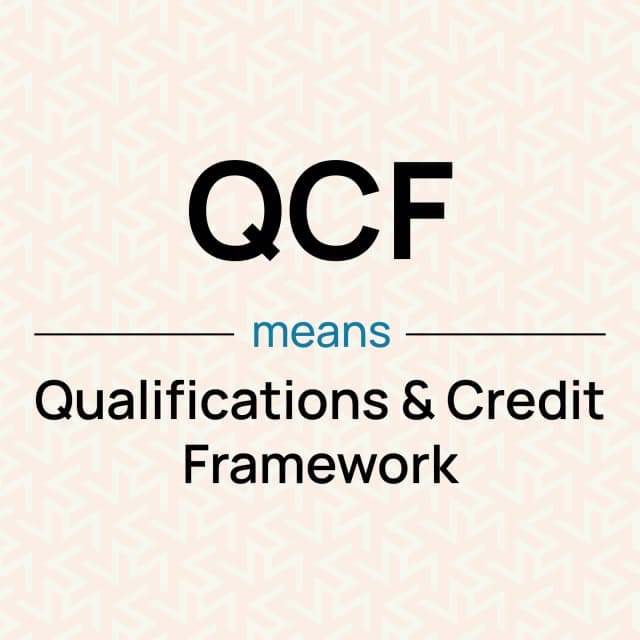
The QCF replaces NVQs, which were phased out in September 2011. There are many benefits to taking a QCF course, no matter your situation. For example, studying for a QCF qualification can help you gain valuable skills and experience if you're unemployed and looking for work.The Qualifications and Credit Framework (QCF) is a new system that replaces the National Qualification Framework (NQF). It works by giving credits for different qualifications and units.Each unit has a set number of credits, which can be transferred, allowing you to earn qualifications at your own pace. Regulators manage the system in England (Ofqual), Wales (DCELLS), and Northern Ireland (CCEA).The Old Frameworks (QCF & NVQ)NVQ (National Vocational Qualifications)NVQs were qualifications that showed you had the skills needed for a particular job. You earned an NVQ by showing you could do specific tasks at work, usually through a portfolio of your work and observation by an assessor. There were eight levels in NVQs:Level 1: Basic workplace skillsLevel 8: Management levelQCF (Qualifications and Credit Framework)The QCF was introduced in 2008 to replace the NVQ system. It made understanding and comparing qualifications from different areas and schools easier. The QCF focused on the difficulty of a qualification and how many credits it was worth.Award: 1-12 creditsCertificate: 13-36 creditsDiploma: 37+ creditsQCF courses were more flexible and quicker than NVQ courses, allowing learners to work independently.What is the Qualification and Credit Framework (QCF)?The Qualifications and Credit Framework (QCF) is a system that makes it easier to earn qualifications by awarding credits for different units. It replaced the older National Qualification Framework (NQF). Each unit you complete has a certain number of credits, and these credits can be transferred, giving you the ability to earn qualifications at your own pace. Three regulators manage the QCF:Ofqual in EnglandDCELLS in WalesCCEA in Northern IrelandQCF Levels: How Does the QCF System Work?The QCF system is based on units with a credit value and level. These levels range from Entry Level to Level 8 (the highest).1 credit = about 10 learning hours.This means you can estimate how much time you�ll need to complete your qualification.You can earn three types of qualifications through the QCF:AwardsCertificatesDiplomasQCF Credit Value: How Are Credit Points Awarded?You need 1 to 12 credits to earn an Award, which equals 10 to 120 hours of learning.You need 13 to 26 credits or 130 to 260 hours to earn a certificate.To earn a Diploma, you need 37 credits or more, which means 370 hours or more of learning.The QCF system measures the size of the qualification, not its difficulty. The difficulty level is shown by the title of the qualification, and the size and subject of the qualification are linked to how many credits it has.How is Quality Ensured?The QCF regulators are responsible for ensuring that all qualifications meet the required standards. They:Develop and approve units and qualificationsMaintain a unit databankMonitor the organisations that offer QCF qualifications to ensure qualityThis helps ensure that every qualification awarded through the QCF meets the proper standards.The New System (RQF)RQF (Regulated Qualifications Framework)The RQF replaced the QCF in 2015. It still classifies qualifications based on how difficult they are and how much learning they need. But now, there are no strict deadlines to finish your qualification so you can work through it at your own pace.The RQF also allows more freedom for schools and organisations to update and improve their courses. It focuses more on the quality of the results than on strict rules.Differences Between RQF and QCFWhile the RQF and QCF systems share some similarities, there are a few key differences that set them apart:FeatureRQF (Regulated Qualifications Framework)QCF (Qualifications and Credit Framework)Qualification TimeIntroduces Total Qualification Time (TQT), which estimates how long a qualification will take to completeBased on credits and units, where each unit had a credit value that showed the time needed to complete itQualification DescriptorsUses qualification descriptors to explain what�s expected at each level, providing more clarity for studentsHad level descriptors, but they were less detailed than the RQF'sFlexibility and Credit TransferIt offers more flexibility for learners to accumulate credits and transfer them between different qualifications and institutionsCredit accumulation is allowed, but with stricter rules, making it less flexible than the RQFFocus and DevelopmentMore focus on outcomes, creativity, and personalised learning. Awarding bodies can update qualifications more easilyFocusing more on structure and rules makes it harder to update qualifications quicklyKey TakeawaysRQF offers flexibility, explicit expectations, and more freedom to update qualifications.QCF was more rigid with its rules and structure but allowed credit accumulation.RQF is considered an improvement over QCF because of its focus on clear outcomes, flexibility, and creativity. .main{ border:3px solid #0f7c90; border-radius:20px; position: relative; font-family:roboto; font-weight: 400; color: #000; } .main-two{ position: absolute; top:-25px; left:45px; background-color:white; } .img-div{ border-radius : 100%; padding:2px 7px; background-color:#0f7c90; margin-right:5px; width: 50px; height: 50px; } .img{ width:30px; object-fit:contain; height:auto; border-radius : 100%; } @media only screen and (max-width: 600px) { .heading{ font-size:20px; } .img{ width:20px; object-fit:contain; height:auto; border-radius : 100%; } .img-div{ width: 40px; height: 40px; } .main-two{ left:25px; } } Want to become a part of RQF Qualifications in the assessment process? Our assessor and IQA courses, including the Level 3 CAVA Certificate and the Level 4 Award in the Internal Quality Assurance of Assessment Processes and Practice, offer a range of learning modules to help you become a trainer for renowned organisations.
Create an online video course, reach students across the globe and earn money