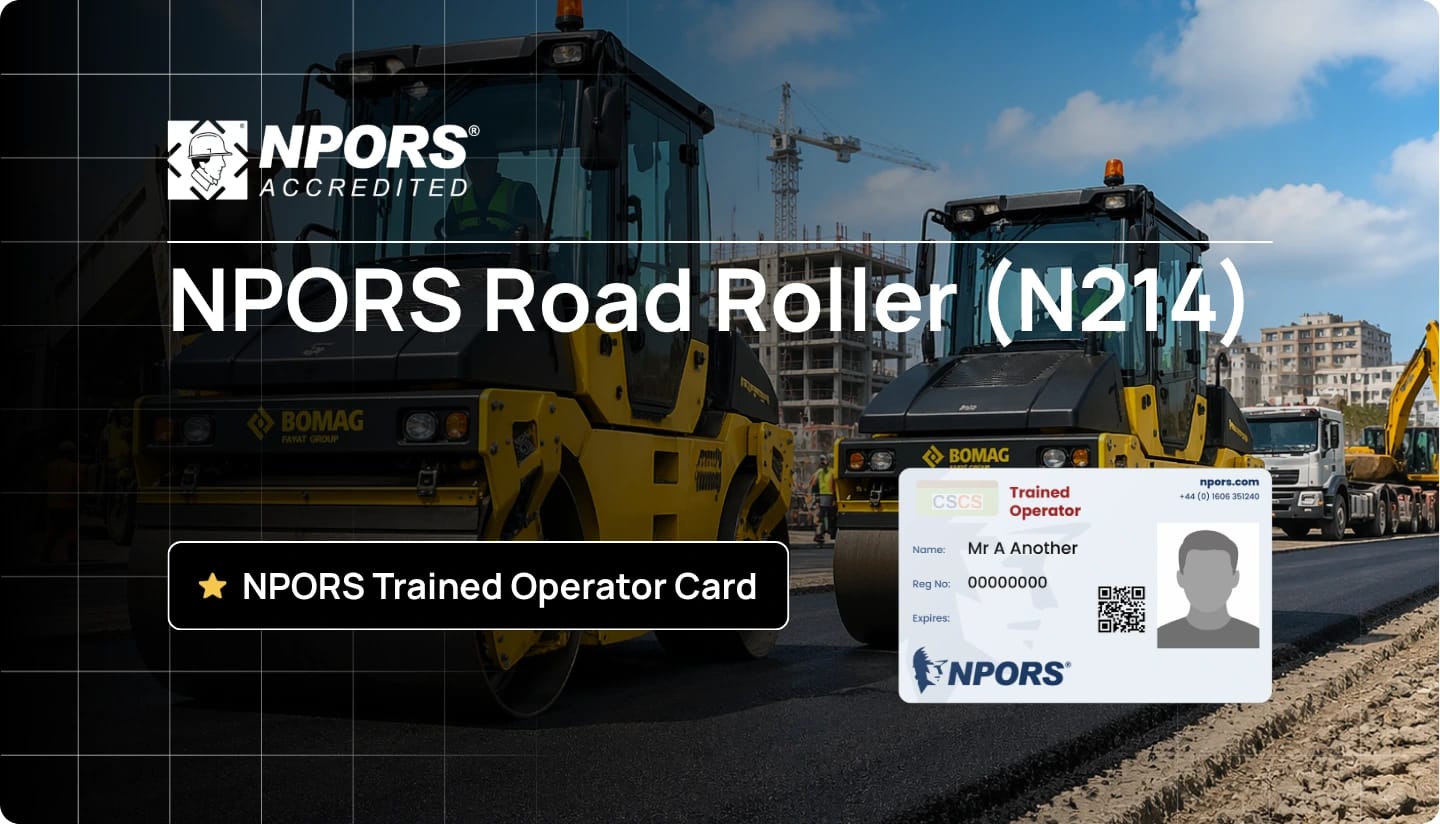
What is NPORS Road Roller?
The NPORS Road Roller qualification is an accredited course designed for individuals who wish to operate road rollers safely and effectively in the construction industry. Road rollers are commonly used in various construction projects, including roadworks, highways, and building foundations, where they help compact and level materials such as asphalt and gravel. The NPORS Road Roller training ensures operators are well-prepared to operate these powerful machines across a range of environments, from flat surfaces to steep gradients.
During the course, participants learn essential skills such as conducting pre-use checks, understanding machine components, operating the roller across different soil and material types, and following best safety practices to minimise risks.
Did You Know? You can upgrade your 2-year NPORS Red Trained Operator Card to a 5-year Blue Competent Operator Card by completing the NVQ Level 2 Diploma in Plant Operations. This qualification is assessed directly on-site, with no classroom exams required.
Who Needs NPORS Road Roller (N214)?
This course is ideal for individuals who wish to operate road rollers safely and effectively, including:
- Construction Workers: Those needing road roller operation skills for roadworks, highways, and infrastructure projects.
- Grounds Maintenance Operators: Professionals using road rollers for landscaping, surfacing, and compaction tasks in various land-based operations.
- Civil Engineering Contractors: Operators involved in large-scale construction projects requiring road compaction and material levelling.
- New & Experienced Operators: Perfect for beginners or experienced workers looking to gain or refresh their road roller operation skills.
This course ensures that all participants can operate road rollers safely and efficiently, in full compliance with industry safety standards and regulations.
Benefits of the NPORS Road Roller (N214) Training
- ✓ Ideal for both novice and experienced operators looking to gain or refresh their road roller skills.
- ✓ Receive the NPORS Road Roller Ticket, recognised across the UK construction and civil engineering industries.
- ✓ Hands-on experience with road roller operation, compaction techniques, and machine maintenance.
- ✓ Train with expert instructors to master road roller controls, safety protocols, and operational procedures.
- ✓ Comply with UK health and safety regulations for construction and roadwork operations.
- ✓ Enhance your employability in the construction, civil engineering, and roadwork industries.
- ✓ Opportunities to progress towards NVQ Level 2 and upgrade to the Blue Competent Operator Card for further career advancement.
What You'll Learn
In the NPORS Road Roller (N214) Training, you’ll acquire the following essential skills:
- Safe Road Roller Operation
- Pre-Use Checks
- Terrain Handling
- Compaction Techniques
- Health and Safety Practices
- Hazard Identification
- Road Roller Maintenance
- Practical Hands-On Training
How Will the Course be Delivered?
The NPORS Road Roller (N214) Training course provides comprehensive instruction on the safe operation of road rollers, with a focus on practical skills and adherence to safety standards. We offer two flexible delivery methods to suit your needs:
- On-site Training: This is the preferred option for many. We come directly to your workplace, allowing operators to train on the road rollers they will be using. This eliminates travel time, reduces disruption to regular activities, and ensures hands-on learning in a real-world environment.
- Training Centre: For those who prefer an off-site setting, we offer comprehensive classroom and practical training at our dedicated training centre. This option provides a structured, immersive experience that lets you focus fully on the course material in a safe, controlled environment.
Experienced operators can complete the course in one day, while novice learners may require up to 3 days to gain technical confidence and master road roller operation safely.
This extended duration provides beginners with ample hands-on experience to fully understand road roller settings, compaction techniques, and UK safety legislation, including the correct use of machinery, before their final assessment.
Entry Requirements
To enrol in the NPORS Road Roller (N214) training course, learners must be at least 16 years old. A basic understanding of spoken and written English is essential, as it will help you follow instructions, complete the theory assessment, and communicate effectively on-site.
What to Bring on the Day: Please ensure you bring the following items on the day of training: a valid Photo ID (e.g., Passport or Driving Licence), your National Insurance number, and full PPE, including a hard hat, high-visibility vest, and steel-toed safety boots. If you are applying for the CSCS-badged Red Trained Operator Card, you must also provide physical proof of your valid CITB Health, Safety and Environment (HSE) test result.
Assessment
The assessment for the NPORS Road Roller (N214) course takes place on the final day of training and includes both theory and practical components. The theory assessment consists of 25 questions: 20 multiple-choice and 5 open-ended, covering essential topics such as health and safety regulations, road roller controls, safe operation, and emergency procedures.
The practical assessment requires you to demonstrate your ability to operate a road roller safely, including:
- Conducting thorough pre-use inspections and safety checks
- Safely operating the road roller across various terrains, such as asphalt, gravel, and soil
- Performing compaction tasks to achieve optimal surface results
- Responding appropriately to on-site signals and instructions
What You’ll Receive After the Course
Upon successful completion of your NPORS Road Roller (N214) training and assessment, you will receive your certificate and operator card within 5-10 working days. Each successful candidate also receives an NPORS Operator Logbook to record their hours of experience. There are two main card options available, depending on your workplace needs.
- Traditional NPORS Card: This card is valid for 5 years and can be renewed indefinitely with employer sign-off, upon confirmation of 300+ hours of experience, or by completing a refresher course. The Traditional NPORS Card is ideal for private sites or utilities and does not require an NVQ. It is essential to keep your NPORS Logbook up to date for this renewal.
-
NPORS Card with CSCS Logo: The NPORS Red Trained Operator Card is valid for 2 years and is non-renewable. To receive this card, operators must have passed the CITB Health, Safety, and Environment (HSE) test within the last two years. After the 2-year validity period, operators must upgrade to a Blue Competent Operator Card by completing the relevant NVQ Level 2 Diploma in Plant Operations. The Blue Card is valid for 5 years and provides operators with ongoing recognition of their competence in the industry.
Since many major UK construction sites require a CSCS-badged card, we recommend completing your CITB exam before enrolling in the course. This will ensure that your card is issued with the correct credentials as soon as you finish your training.
Common Questions About the NPORS Road Roller (N214) Course
Can I take the NPORS Road Roller course online?
No, this course requires in-person practical training at an approved training centre. Operating a road roller requires hands-on experience with real equipment, and the course combines classroom learning with practical, on-the-job training to ensure learners can safely operate a road roller in real-world environments.
What types of jobs can I apply for?
The NPORS Road Roller (N214) qualification opens doors to various roles, including Road Roller Operator, Construction Equipment Operator, and Civil Engineering Worker. With a focus on safe road roller operation, compaction techniques, and maintenance, you’ll be well-equipped to work on construction sites, highways, infrastructure projects, and more across the UK.
How much does this course cost?
Our pricing is structured to be cost-effective, especially for businesses that arrange group bookings. Training multiple employees on-site reduces the "per-person" cost and eliminates travel expenses. Novice operators may incur higher fees due to additional training days needed to meet NPORS safety standards. For a customised quote based on your location, click "Enquire Now" or call us at 0333 344 1293.
Which NPORS operator card will I get after passing the course?
Upon successful completion of the course, you will receive the Traditional NPORS Card, valid for 5 years. If you have passed the CITB Health, Safety, and Environment (HS&E) test within the last two years, you will get the NPORS Red Operator Card with the CSCS logo.
How do NPORS and CPCS qualifications compare for site access?
Both NPORS and CPCS are well-recognised awarding bodies in the UK construction industry, and both adhere to strict safety standards for plant operations. While they are separate schemes, both provide a route to obtaining a CSCS logo card, which is required for access to major construction sites under the Build UK framework.
For example, the NPORS Road Roller (N214) and CPCS Road Roller qualifications cover similar technical knowledge and safety requirements for road roller operation. The choice between the two depends on site-specific requirements or an employer’s internal training policies, as both demonstrate a high level of competence in road roller operations.
Related CPCS and NPORS Courses
If you're looking to broaden your plant operation qualifications or need a different category, explore our other accredited training courses:
NPORS Categories
CPCS Categories
Not sure which awarding body your site requires? Our team can advise you on the most suitable qualifications for your project. Call us today on 0333 344 1293 or explore our full range of NPORS courses and CPCS training options.