


Event Stewards Stewarding at Spectator Events
IntroductionThe requirement for security is great as the events sector begins to thrive again. Frequently, when someone works at an event or venue, everyone immediately thinks of the security guard position. The function of an event steward is sometimes disregarded, but if you�ve ever attended a football game, concert, festival, or other public events, you�ve probably come across stewards and seen the crucial work they do. But what does a steward do during a gathering? What exactly do they do? Ultimately, they are there to protect you and ensure that your experience is safe and pleasurable.�Event StewardsEvent Stewards are skilled team members who are crucial to the smooth operation of an event and the safety of all attendees. Stewards can perform a wide range of duties and have many distinct responsibilities. Stewarding at Spectator Events includes being a comforting, approachable presence; controlling who is allowed entry to the event; and taking on the duty of handling any anti-social behaviour. They can also conduct any necessary searches, although legally speaking, they must be qualified to do so, such as having a Level 2 Certificate in Spectator Safety. Additionally, to conduct searches, they must be employed directly by the stadium or arena where the event occurs. To ensure that an event proceeds as planned while ensuring the health and safety of the audience, event stewards play a crucial role in managing crowd management. They perform their duties at gatherings like sporting events, music festivals, protests, vehicle rallies, and important transportation hubs.Role of a StewardStewarding at Spectator Events means a great deal of responsibility for keeping an eye out for any dangers that might endanger everyone attending a particular event. As an event steward, you have many duties before, during, and after an event. One of them is to avoid the location being too crowded. This is crucial since crowded gatherings are frequently the source of harmful accidents, and experienced stewards can stop this from happening. To lead people out during an emergency evacuation, they must also be aware of the locations of the fire exits and other escape routes.Additionally, they can conduct ticket entry checks and traffic/pedestrian management (crossing points, pedestrian pathways) to guarantee that automobiles and pedestrians can enter and exit the area in a secure, orderly manner. To learn more about the role and responsibilities of an event steward, enrol in a stewarding course today. .banner-blue { border-radius: 10px; overflow: hidden; border: 2px solid #ccc; box-shadow: 0 4px 8px rgba(0, 0, 0, 0.2); background-color: #fdf9ee; } .book-now { color: white; background-color: #DF3D52; border: none; padding: 15px 60px; border-radius: 5px; cursor: pointer; font-size: 20px; text-decoration: none; } .book-now:hover { /*text-decoration: none;*/ color: white; background-color: #c33f50; } Get your Legal SIA Licence by signing up for our SIA Security courses Security Courses Book Now Rated Excellent on major review sites Importance of StewardsThe presence of stewards has several advantages, and it is now necessary when planning events. Any type of event planning is never simple or easy; it can be stressful and involve complications. An event steward makes it possible to assign various jobs to qualified individuals who can subsequently complete them, making everything operate more smoothly. When planning an event, it is crucial to conduct a risk assessment since it enables you to look for any potential safety hazards. This is also an excellent technique to estimate the number of stewards required for this. The following is a helpful generalisation for selecting an adequate number of stewards: At least one steward is required for every ten attendees, per location, for groups of 1 to 100. The number of stewards needed will also be determined by the access and egress plan, which should be carefully established. You may require a certain number of stewards to check tickets and guide the public as they enter, but once the majority have arrived, their tasks may shift to other aspects of the event or getting the venue or site ready for everyone to safely leave.Another significant benefit of stewarding is that it makes the event feel safer, increasing attendees� enjoyment. They provide reassurance to attendees and security for the audience and the venue. Stewarding at spectator events should be done professionally as the stewards are frequently attendees� initial point of contact. It is crucial to act professionally so that people know they have a reliable person they can turn to if they need assistance with anything. Like with many events, there is always a chance that someone would go to cause trouble and not for the proper reasons. Any problem like this can be immediately resolved by a steward stepping in.Preparation for an EventPreparation is one of the most vital components, regardless of the event�s size. Event stewards should always be well-prepared because an equipment check is one of the most important tasks they perform in advance. They must make sure everything is there and functional. They need to know they can do their jobs well and to a high standard because of this. Radio and battery checks are also conducted to ensure that all communication is crystal-clear and simple to receive. Before the event, time is mostly employed to identify potential issues so they can be resolved as soon as possible.An event would struggle to go as smoothly without a steward. Therefore, there is no straightforward response to the question, �What is a steward�s duty at an event?� because they participate in various aspects of events. They facilitate smooth operations, provide guests with a safe environment, and aid in keeping people safe. They reassure workers and attendees that anything could be handled professionally if the worst were to happen.
The Importance of Safeguarding in Education
IntroductionMaking sure those in your charge are safe inside and outside your institution should always be your first responsibility if you work in education. You have a moral and legal obligation to respond to any indications that someone may be experiencing abuse at home or in their society.Everyone in the organisation must design and follow rigorous safeguarding policies to guarantee everything is being done to protect individuals at risk. Today�s column explores the significance of safeguarding, particularly in education.What is safeguarding?Even though everyone involved in the education industry should know the word, you might not know what safeguarding entails. Simply expressed, safeguarding refers to the actions taken to protect the health, happiness, and human rights of those entrusted to your care. Safeguarding is typically used in environments with a duty of care for children, adolescents, or vulnerable adults, such as in the education, health, and social care sectors.Why is safeguarding important?Safeguarding is crucial for defending vulnerable people from injury, abuse, and neglect. Failure to uphold your safeguarding obligations may cause someone�s suffering to continue. Effective safeguarding is essential to identify the warning signs of abuse and notify the appropriate authorities in time to assist victims.Safeguarding is essential in schools because the teaching staff has unique access to information about how kids grow, act, and interact with others. So, they are more likely to detect physical or psychological abuse. They can also use their special position to inform kids about the risks they face inside and outside the classroom and how to receive help.What is safeguarding policy?A company�s safeguarding strategy outlines how it intends to safeguard individuals� welfare in its care. It should outline the organisation�s plans for safeguarding children, adolescents, and vulnerable adults against danger and abuse inside and outside its facilities.Education organisations must have a written safeguarding policy statement as part of their duties. The organisation�s safeguarding policy should be outlined in this statement and its commitment to safeguarding and strategies for keeping persons under its care safe.You might want to refer to the official Ofsted safeguarding policy and inspectors� instructions as a resource. These materials set forth the criteria for evaluating safeguarding in early childhood education and skill-building settings across the nation.Safeguarding is essential in schools because the teaching staff has unique access to information about how kids grow, act, and interact with others. So, they are more likely to detect physical or psychological abuse. They can also use their special position to inform kids about the risks they face inside and outside the classroom and how to receive help.What are the six principles of safeguarding?Six safeguarding principles are outlined in The Care Act 2014, the primary safeguarding law that applies to NHS bodies. Although this statute solely pertains to NHS institutions, these concepts are applicable everywhere, especially in the field of education.PersonalisationThe assumption of person-led decisions and informed consent are all aspects of empowerment.PreventionIt is preferable to act now before harm is done.ProportionalityIs the ability to respond in a way that is both reasonable and least invasive, given the risk at hand.Protectionaid and advocacy for those who are most in need.PartnershipServices that work with their communities to find local solutions. Communities can help prevent, identify, and report neglect and abuse.AccountabilityAccountability and openness in providing safety measuresWhat is safeguarding children?Any educational organisation in charge of children must have a defined safeguarding procedure. A key component of the overall safeguarding process is child protection, which aims to protect children in your care from danger, abuse, or exploitation.These four categories describe child safety:Defending kids from maltreatment and cruelty.Avoiding harm to children�s growth or health.Ensuring that children receive safe and efficient care as they grow.Taking measures to ensure the best outcomes for all children and young people.Who is responsible for safeguarding children?Everyone who interacts with children has a duty to keep them safe. To do this, they must be aware of the warning signs of abuse and follow the procedures for reporting their concerns. Working Together to Safeguard Children, government guidance outlines how everyone must be responsible, communicative, and alert to safeguard children from harm.Local governments and social care teams are responsible for conducting investigations once concerns have been raised. The criteria for a wide range of authorities, organisations, and people who have a duty of care for children are outlined in Sections 10 and 11 of the Children Act of 2004.What is contextual safeguarding?Understanding and responding to children�s or young people�s experiences of damage outside their families is a key component of the contextual safeguarding method. It acknowledges young people�s connections with their neighbourhoods, educational institutions, and online networks that can result in abuse, injury, or exploitation.Individuals with safeguarding obligations, such as those working in the education sector, must recognise the need to act when appropriate because many parents have little to no influence on these connections outside the family home.What is the safeguarding of vulnerable adults?At times, it may be vital to protect adults and children. These people are referred to as �vulnerable adults.�A vulnerable adult is a person who is over 18 and who is either unable to care for oneself or who, due to their circumstances, is very susceptible to exploitation or damage. Some elements that may contribute to the classification of people as vulnerable include:physical or mental impairmentsAdvantage of povertyexperiencing traumaRacial, religious, or political exclusionrejection from their families or communitiesBut everything is covered in this list. No, employees must be aware of any person in their care who may be vulnerable to exploitation or abuse. They must make sure that any warning indications put forward by these people are seen and taken seriously.Safeguard trainingThis blog cannot cover every aspect of safeguarding because it is a vast subject. You must receive formal training to gain a solid understanding of safeguarding practice. When it comes to training, ESS offers a few different choices for individuals who are interested in learning more about protecting adults.The three-month Level 2 course, NCFE CACHE Understanding Safeguarding and Prevent, focuses on the fundamentals of Prevent Duty and safeguarding, particularly internet safety. This course offers the theoretical understanding required for protecting adults. This might involve employment in hospitals, adult education programmes, community centres, and jails.We heartily suggest the free online courses offered by the Education & Training Foundation for individuals seeking yearly updates to maintain their safeguarding knowledge and credentials. Depending on your job situation, we recommend their Safeguarding in FE and Training and Safeguarding & Safer Recruitment in FE courses.
How To Conduct a Secondary Survey in First Aid
The secondary survey assesses the injuries of an awake, responsive person. It involves thoroughly examining the person's health history, assessing the four vital signs and conducting a systematic head-to-toe examination. If we discover any injuries, we administer first aid accordingly. Finally, we document all our actions and findings of the entire process. A secondary survey is performed after completing the primary steps of first aid (remembered as DRABC).What is the Difference Between a Primary and a Secondary Survey First, we always do a primary survey to quickly find and stop any life-threatening injuries. Once the person is more stable, we do a secondary survey. This is where we gather more information about what might have caused the person's injuries or illness. Primary Survey Secondary Survey� First examination Second examination� Assesses and stabilities a person in life threatening conditions� Diagnoses and treats major injuries after stabilisation�� Follows DRABC steps Follow AMPLE steps� Does not involves a head to toe examination� Involves a head to toe examination For responsive or unresponsive patients� Typically for responsive patients� Why Do We Perform the Secondary Survey in First AidIn a secondary survey, we look for injuries. We physically examine every part of the injured person's body from head to toe. We check the front, back, sides, underneath, and top. This survey includes looking at the airway again and checking the lungs again.When To Perform the Secondary Survey in First AidIf the person has more than one injuryIf it will take more than 20 minutes for medical help to arriveIf you're taking the person to get medical help .main{ border:3px solid #0f7c90; border-radius:20px; position: relative; font-family:roboto; font-weight: 400; color: #000; } .main-two{ position: absolute; top:-25px; left:45px; background-color:white; } .img-div{ border-radius : 100%; padding:2px 7px; background-color:#0f7c90; margin-right:5px; width: 50px; height: 50px; } .img{ width:30px; object-fit:contain; height:auto; border-radius : 100%; } @media only screen and (max-width: 600px) { .heading{ font-size:20px; } .img{ width:20px; object-fit:contain; height:auto; border-radius : 100%; } .img-div{ width: 40px; height: 40px; } .main-two{ left:25px; } } Ready to Learn More? Put your knowledge of the secondary survey into practice by enrolling in a course today! Our First Aid courses offer complete training to help you handle critical situations. Whether you want to improve your skills or workplace safety, these courses help build confidence and expertise. View our Emergency First Aid at Work (EFAW) and Level 3 First Aid at Work courses. These courses meet the UK legal requirements and help you keep people safe. How to Perform a Secondary Survey in First AidSAMPLE History TakingAsk questions to learn more about the person's medical background. Remember the word "SAMPLE" to help you remember what to ask:S stands for Symptoms: What the person feels, like pain or weakness.A stands for Allergy: Do they have any allergies? These could be to nuts or medicines like penicillin or aspirin.M is for Medication: Are they taking any medicines?P is for Previous medical history: Do they have any ongoing health conditions like diabetes or epilepsy? Have they had any surgeries or injuries before?L is for Last Meal: When did they last eat or drink?E is for Event history: What happened, and where did it happen? Was it because of an illness or an accident? Talk to anyone nearby to find out more, and look for any clues that could help understand what happened. Also, check if they have any special jewellery that might have medical information on it.Vital SignsCheck four critical things:Level of Consciousness: Are they awake and aware?Breathing: Are they breathing normally?Pulse: What's their heartbeat like?Skin Condition and Temperature: Is their skin normal, and are they warm enough?By conducting this secondary survey, we ensure that we've covered everything and helped the person in the best possible way.Check the Level of ConsciousnessChecking someone's level of consciousness (LOC) helps us understand how aware they are. We often use the letters AVPU to do this:A for Alert: If someone is alert, they're fully awake and can answer questions. They know who they are, where they are, and what time it is.V for Verbal: If they respond only when spoken to but aren't fully alert, they're in the verbal stage. They might seem confused and not know where they are or what's happening.P for Pain: If they only react when you give them a little pain, like pinching them, they're in the pain stage. They might move or make noises, but they cannot communicate appropriately.U for Unresponsive: If they're not reacting, even to pain, they're unresponsive. This is serious, and we need to act quickly to help them.Remember, another quick way to check is to look at their eyes, listen to what they say, and see if they can follow simple commands like squeezing your fingers.BreathingTo check someone's breathing, watch their chest rise and fall for 30 seconds. You can also gently place your hand on their stomach to feel it. Count how many breaths they take in that time, and then double it to know how many breaths they take per minute. Here's what's expected:For babies, breathing below 25 breaths is too slow, 30-50 is normal, and over 60 is too fast.For children: Below 15 is too slow, 20-30 is normal, and over 40 is too fast.For adults: Below 10 is too slow, 10-20 is normal, and over 30 is too fast. Normal Breathing Rated (no. of breaths)Infant30-50Child20-30Adult10-20�PulseYour pulse shows how often your heart beats in a minute. You can check it by feeling the person�s wrist, neck, or upper arm. Use two fingers and press gently until you feel the pulse. Count how many beats you feel in 30 seconds, then double it to get the beats per minute.Normal Pulse Rates:For babies: A normal pulse range is between 120 and 150 beats per minute.For children: It can vary between 80 and 150 beats per minute.For adults: The average pulse rate is usually between 60 and 100 beats per minute.Normal Pulse Rates (beats/min)Infant120-150Child80-50Adult60-100�Skin Condition and TemperatureWhen we check someone's skin, we're looking at a few things:Temperature: Is their skin warm or cold?Colour: Does their skin look normal or pale?Dryness: Is their skin dry or wet/sweaty?To check, gently feel their forehead and cheeks with your hand. If their skin is normal, it should feel warm and dry and be a regular colour. But if it's pale, cold, and sweaty, it could mean they're going into shock.Head-to-Toe ExaminationThis is a thorough check of the person's whole body for any injuries we might have missed earlier. Here's how to do it:Before you start, ask if they feel any pain and explain what you will do.Talk to them throughout, & watch their face for any signs of pain.Keep going, and even if you find something, make a note and continue.Be respectful and only expose areas you need to check.Look for any bumps, bruises, or anything unusual.If they're unconscious, look for any medical alert tags or jewellery.Always look before touching.Let's start at the head:Feel the skull for anything unusual.Check the ears for any fluid.Look at the eyes. Are the pupils the same size?Check the nose for any runny stuff.Look inside the mouth. Are the teeth okay? Are the lips a standard colour?Now, let's move to the neck:Check if the neck veins look big or bulging.See if they're wearing a necklace with medical info.Feel the collarbones.Check both shoulders.Now, onto the arms:Check each arm carefully.Squeeze each fingernail and see if the colour comes back quickly.Ask them to squeeze your fingers. Are they strong enough and equal on both sides?Next, let's look at the chest and underneath:Ask if it hurts when they breathe.Make sure the chest goes up and down as it should with each breath.Reach around to the back as far as you can.Let's check the tummy and underneath:Use your hands flat to feel the tummy gently.Don't press too hard. Just see if there's any pain, tenderness, or stiffness.Put your hand flat on their tummy and ask them to push against it. Does it hurt?Reach around to the back as far as you can.Now, let's look at the hips:Please put your hands on the hip bones and gently squeeze to check they're stable.Moving down to the legs, ankles, and feet:Check each leg one by one.See if one leg is shorter than the other.Check the kneecap and the area underneath carefully.Give a little pinch on the foot and ask if they felt it.Could you put your hands on their feet? Ask them to push and then pull against your hands. Are they equally strong on both sides? Ask them to wiggle their toes and see if they can do it.Check the circulation in their legs.Provide First-Aid for InjuriesOnce you've finished checking everything, it's time to give the right first aid for any injuries or illnesses you find. If the person has more than one injury, start with the most serious one.Pro Tip: Act quickly if you find serious injuries. Administer first aid immediately, even if you have not completed the survey. Keep the person's safety top priority.�DocumentationAfter you've given first aid, write down what you've found and what you've done. This information can help doctors or other medical staff who will care for the person later. It is important to know if the injury happened at work because it might need an investigation. You'll usually fill out forms provided for this purpose, and you should keep them as required by the rules in your area.First-Aid TrainingThe Emergency First Aid training course is designed for low-risk environments such as offices and small retail stores. It gives participants the fundamental knowledge and skills to manage emergencies in these settings effectively.On the other hand, First Aid Training at Work is one of the extensive first aid courses that meets the requirements specified in the Health and Safety Regulations (First Aid) 1981 and goes a step beyond the Emergency First Aid at Work (EFAW) course, qualifying you to work in high-risk workplaces. .banner { border-radius: 10px; overflow: hidden; border: 2px solid #ccc; box-shadow: 0 4px 8px rgba(0, 0, 0, 0.2); background-color: #fdf9ee; } .book-now { color: white; background-color: #DF3D52; border: none; padding: 15px 60px; border-radius: 5px; cursor: pointer; font-size: 20px; text-decoration: none; } .book-now:hover { /*text-decoration: none;*/ color: white; background-color: #c33f50; } Get Trained in All First-Aid Skills First Aid Courses Book Now Rated Excellent on major review sites FAQsWhat are the four vital signs for a secondary survey?The four vital signs of a secondary survey are checking the level of consciousness (LOC), breathing rate, pulse rate, skin condition and temperature.What does SAMPLE stand for in a secondary survey?SAMPLE stands for Symptom, Allergy, Medication, Previous medical record, Last meal and Events leading to the casualty. It is the order in which the history of the injured person is taken.What is the main aim of the secondary survey?The main aim of the secondary survey is to check for major injuries that might have been missed during the primary survey.What are the steps included in Emergency Scene Management?The steps included in ESM include scene survey, primary survey, secondary survey and ongoing casualty care.
The Importance of First Aid in Schools
Accidents and emergencies are bound to happen in a school's active environment, where children constantly learn, play, and grow. Having trained personnel and a structured first aid program can help maintain the safety and well-being of students and staff alike.Why First Aid Matters in SchoolsFirst aid is not just about addressing physical injuries; it includes a range of skills that can save lives. It helps prevent injuries from worsening and provides immediate care until professional help arrives. The importance of first aid in school includes the following:Immediate Response to AccidentsSchools carry out activities where accidents like cuts, falls, or burns can occur. Knowledge of first aid equips teachers and staff to respond promptly and appropriately.Life-Saving PotentialIn critical situations such as cardiac arrests, choking incidents, or severe allergic reactions, quick action through first aid techniques can help save lives.Promoting Safety AwarenessTeaching first aid creates a culture of safety awareness among students, encouraging them to take responsibility for their well-being and that of others.First Aid in School Policy as a Legal RequirementSchools are places where learning happens, but they must also be safe. When accidents or medical emergencies happen, having the right knowledge and tools for first aid can make a difference.Schools are legally required to ensure student safety. In the United Kingdom, laws require schools to have enough first aid supplies, medical staff, and training. But beyond laws, schools have a moral duty to keep students safe by being ready for medical emergencies.Under the Health and Safety (First Aid) Regulations 1981, first aid should always be available at schools and colleges. The availability applies on campus or during off-site activities like field trips. Regulations say employers must provide the right first aid equipment, facilities, and trained staff based on a first aid assessment. The basic first aid requirements for schools and colleges are:A suitable first aid kit is stocked according to the assessment, meeting minimum standards suggested by HSE.An appointed person or designated first aider(s) responsible for first aid.Information for staff about where to find equipment, facilities, and first aid personnel.How To Include First Aid in the School CurriculumTo ensure comprehensive coverage, schools can include first aid education into their curriculum through:Structured Training ProgramsFormal first aid courses are part of physical education or health classes.Simulation ExercisesConduct regular drills and simulations to practice emergency response scenarios.Continuous LearningProviding refresher courses and updates to keep skills current among staff and students. .banner { border-radius: 10px; overflow: hidden; border: 2px solid #ccc; box-shadow: 0 4px 8px rgba(0, 0, 0, 0.2); background-color: #fdf9ee; } .book-now { color: white; background-color: #DF3D52; border: none; padding: 15px 60px; border-radius: 5px; cursor: pointer; font-size: 20px; text-decoration: none; } .book-now:hover { /*text-decoration: none;*/ color: white; background-color: #c33f50; } Get Trained in All First-Aid Skills First Aid Courses Book Now Rated Excellent on major review sites What are the Types of First Aid Needed in SchoolsSchools should prepare for various types of first aid scenarios, including:Emergency First AidDealing with immediate, life-threatening situations such as cardiac arrest, severe bleeding, or unconsciousness.Basic First AidTreating minor injuries like cuts, bruises, sprains, and burns common among children during daily activities.Mental First AidAddressing emotional distress, anxiety, or panic attacks in students is increasingly recognised as essential alongside physical first aid.What Does First Aid Training in School Involve?First aid training in schools teaches students essential skills:calling emergency servicesassessing safetycommunicating with the injuredtreating cuts, bleeding, and burnsapplying bandagesassisting with fractures and CPRhandling head injuries, allergies, and nosebleedspreparing students to respond confidently in medical emergencies.The Department for Education made first aid training compulsory for students in England's state-funded schools in 2020. It is now part of children's health education and varies by age group. .main{ border:3px solid #0f7c90; border-radius:20px; position: relative; font-family:roboto; font-weight: 400; color: #000; } .main-two{ position: absolute; top:-25px; left:45px; background-color:white; } .img-div{ border-radius : 100%; padding:2px 7px; background-color:#0f7c90; margin-right:5px; width: 50px; height: 50px; } .img{ width:30px; object-fit:contain; height:auto; border-radius : 100%; } @media only screen and (max-width: 600px) { .heading{ font-size:20px; } .img{ width:20px; object-fit:contain; height:auto; border-radius : 100%; } .img-div{ width: 40px; height: 40px; } .main-two{ left:25px; } } Ready to Learn More? Put your knowledge of the importance of first aid in schools into practice by enrolling in a course today! Our First Aid courses offer complete training to help you handle critical situations. Whether you want to improve your skills or workplace safety, these courses help build confidence and expertise. View our Emergency First Aid at Work (EFAW) and Level 3 First Aid at Work courses. These courses meet the UK legal requirements and help you keep people safe. First Aid Learning for Primary School StudentsBasic first aid for common injuries, including head injuries.How to call emergency services.First Aid Learning for Secondary School StudentsBasic first aid for injuries and illnesses.Life-saving skills like CPR.How and when to use a defibrillator.What is the Importance of Mental Health First Aid at SchoolMental health first aid is like regular first aid but for mental health. It is often overlooked, but it is very important.Nowadays, young people struggle with mental health issues. School staff should know about mental health first aid and get trained.Studies show that 1 in 6 children aged 5-16 might have a mental health problem. And more than half of young� adults aged 16-25 have talked to their doctor about mental health issues.Mental health first aid teaches school staff how to spot signs that a young person might be having mental health problems. Staff must be able to notice these signs early and know how to help someone in a crisis. This training is especially important for staff in secondary schools.What should a School First Aid Kit Contain?A school first aid kit should contain everything needed for common accidents. It should include the following items:bandagesantiseptic wipesgauze for cuts and scrapessplintsice packsEpiPen for allergiessaline solution for washing wounds or eyesCPR face shieldsburn gelinhaler for anaphylactic shock.Checking and replacing items regularly keeps the kit ready for any emergency.Who can Administer First-Aid Training in Schools?First Aid Training in school is delivered by qualified people. Determining who should be responsible for first aid in schools is critical:Trained Personnel:Designated staff membersTeachersAdministratorsSchool NursesBefore delivering first aid training to pupils, they should undergo regular training and CPR certification.What are the Positive Impacts of First Aid in SchoolsAn effective first aid program in school has several benefits:Increased Safety: Immediate response reduces the severity of injuries and accidents, creating a safer school environment overall.Empowerment: Both staff and students feel empowered and confident in their ability to handle emergencies effectively.Community Engagement: Involving parents and the broader community in first aid workshops or training sessions leads to a collaborative approach to safety.What Qualifications are Required by a First Aider at School?First-aiders need to have specific qualifications:1. They must have a valid certificate in either:First aid at workEmergency first aid at workAny other suitable training based on what the school needs.It is a legal requirement for schools and early years providers that all staff have first-aid training. At least one person must have a current paediatric first-aid certificate. This person must be present whenever children are around and go on trips with them.ConclusionFirst aid is a life-saving practice. By prioritising first aid education and preparedness, schools improve safety and nurture a community where compassion and responsibility thrive. From physical injuries to mental health crises, the ability to respond promptly and effectively ensures that schools provide necessary protection and support. Introducing basic first aid skills into the curriculum empowers students to assist others and potentially save lives in emergencies.�
Differences Between Risk Control and Hazard Control
Identifying threats is one of the first tasks you must take when conducting a risk assessment. You can then evaluate the hazards after this. But how do hazards and risks differ from one another?Since the terms, risks and hazards are frequently used interchangeably, you are not alone in wondering what the distinction is.The two terms are synonymous. There is no risk if there is no hazard. But they differ, and comprehending those variations is crucial to risk analysis. Let�s examine the distinctions between hazards and risks and their relationships. What is a Hazard?Anything that has the potential to be harmful is a hazard. A risk can result in loss, harm, death, or other adverse outcomes.There are risks in almost every workplace, family, and setting. A material, piece of equipment, activity, working approach, or process could all be hazards. We are legally required to identify dangers at work when performing risk assessments.Let�s first define a risk before we examine the risk connected to this hazard. A forklift truck, for instance, could be a risk. Both individuals who use it and those who work close to it could be harmed by it.What is a Risk?A risk is a possibility that the hazard will cause harm to someone. A risk evaluates the likelihood and severity of a potential injury.The risk is evaluated based on the possibility of harm occurring and the severity of the injury. When these two criteria are taken into consideration, a risk may be large or low.The likelihood and severity are calculated to determine the risk level. When looking at how a risk assessment was conducted, you will frequently encounter a risk matrix, such as this:The degree of harm could be anything from minor, short-term damage to serious, permanently disabling injuries or death. The risk of harm from the danger can be anywhere between very rare to quite likely.Implementing Risk ControlGenerally speaking, there are six risk-controlling actions you can take:EliminateSubstituteIsolateEngineering controlsAdministrative controlsPersonal protective equipment (PPE)EliminationThe eradication of a hazard is not always possible, even though it will always be the best course of action. The risk of someone being exposed to a hazard is automatically eliminated if hazards can be removed entirely. An illustration of this would be the risk of lead poisoning that existed in the past for people working at gas stations and other occupations that required frequent contact with petroleum. Two initiatives�the self-service gas pump and the removal of lead from petroleum�have eliminated that risk.Substitution of the Hazard with Lesser RiskWhile replacing the risk may not eliminate all of the dangers connected to a given process or activity and may even introduce new risks, doing so should nevertheless lessen the overall risk of injury or adverse health impacts. For instance, painting a house�s gable end would need you to work at the top of a ladder while someone else supported the ladder below you. Scaffolding might be used in place of a ladder. While the sturdier platform wouldn�t remove the risk of falling, it would make working conditions much safer.Isolation of the HazardWhen isolating a hazard, this can be done by limiting access to plant and/or equipment, or in the case of poisonous or explosive materials, by putting them away in a safe container and doing so under stringent supervision. While installing noisy equipment in an inaccessible enclosure or room isolates the hazard from people, a fume cabinet can isolate the risk from people nearby if you�re utilising specific chemicals (s). The appropriate and secure storing of fireworks during a display is a prime illustration of this.Engineering ControlsThe term �engineering� here can be slightly misleading as we are not discussing mechanical or electrical engineering. What is meant by the use of the word �engineering� is as an alternative to the words� devising�, �designing� or �redesigning� a process to place a barrier between the person(s) and a hazard or removing the hazard entirely from the person�s vicinity, such as machinery guarding, proximity guarding, extraction systems or removing the operator to a remote location away from the hazard.Administrative ControlsWhen discussing administrative controls, we refer to how things are carried out and how individuals collaborate to finish a task. To reduce any risk of injury and/or adverse health impacts, administrative controls include implementing standard operating procedures, safe work practices, and/or providing adequate and sufficient training, teaching, or information (s).Personal Protective EquipmentGloves, glasses, earmuffs, aprons, safety shoes, and dust masks are a few examples of personal protection equipment (PPE), all intended to reduce exposure to specific risks. PPE is typically employed in conjunction with one or more of the other control measures discussed above and is typically considered the last line of defence. It is well known that single-use dust masks cannot consistently produce and maintain an effective seal around the nose and mouth, which can cause a harmful false sense of security and, as a result, an increased risk. This is an example of the ineffectiveness of this control strategy. When this is the case, a dust extraction system with fitting air respirators may be preferred, especially if utilising chemicals containing isocyanate poses a risk of severe health impacts even at extremely low exposure levels.Difference Between Hazard and RiskA risk can take many forms because danger may be harmful in various ways. For our example of a hazard, we employed a forklift. The operation of a forklift truck has the potential to cause harm in several ways, including:Contact with pedestriansOverturningContact with other vehicles or machinesDropping the loadUnauthorised useBy putting management practises in place, the risk can be reduced. Keep in mind that likelihood and severity determine the danger. To ensure that even if an employee was exposed, the amount would be so little that the consequences would be minimal, the severity may be decreased, for instance, by only permitting a very small amount of the material to be obtained. By establishing ventilation and exclusion zones, mandating the use of personal respiratory equipment, and enforcing these measures, the chance of dangerous exposure could also be decreased.To ensure that something with the potential to cause harm (the hazard) cannot actually cause harm or that the harm is minimised, a combination of control measures can drastically lower the risk level (the risk). A work may frequently be labelled as high risk when it is actually high hazard. A task or activity need not be high risk just because it entails risks. Hazardous work can be made safe if each risk is managed so that the activity may be completed without incident. The risk is still present, but it is under control.At Hurak, we specialise in offering online courses that cover a wide range of workplace health and safety topics. Feel free to contact us if you have any questions or want more information on any of these.
Health and Safety Officer: Key Roles and Responsibilities
Promoting health and safety in the workplace is crucial, given the predicted 38.8 million working days lost due to work-related illness in 2019�20.Health and safety officers assist their business in ensuring the workplace is safe and secure for their employees by working to prevent accidents, injuries, and any illnesses related to the workplace. This position is focused on controlling risks in addition to the obligation of the business and employees to protect health and safety at work.In this post, we look at how to become a health and safety officer and offer advice on the duties and obligations required, as well as suggestions to get you started. We also consider which laws should be followed while implementing policies and procedures so that you may make judgments that will ensure everyone�s safety.With our approved Health and Safety training courses, you can learn about common workplace dangers and find out how to keep everyone safe. These programmes are meant to provide you the knowledge you need to identify potential risks in your company.Health and Safety OfficerAs a health and safety officer, a qualified individual oversees and controls the organisation�s adherence to health and safety regulations. By ensuring that accident prevention and the proper health and safety procedures are followed at all times, you continuously promote safety awareness as a health and safety officer.Any organisation that wants to avoid avoidable accidents or injuries must maintain constant monitoring. Health and safety officers must be knowledgeable about the Health & Safety at Work Act of 1974 and other pertinent health and safety laws. They should know their general responsibilities, applicable laws and codes of conduct, enforcement methods, ways to access and disclose information, and requirements.A Health and Safety Officer plays a crucial role in mitigating construction claims by implementing proactive safety measures and ensuring strict adherence to regulatory guidelines. Their responsibilities include conducting thorough site inspections, identifying potential hazards, and fostering a culture of safety to minimize the risk of incidents that could lead to construction claims.They will be responsible for maintaining safety data, developing new practices, and bolstering current regulations in this capacity. Health and safety officers are crucial to keep workers safe and promote a more effective and productive workplace.Becoming familiar with current legislation may ensure a consistently safe workplace environment. Being a health and safety officer is a fulfilling career, whether you work in an office, school or even on a construction site.As a health and safety officer, you can focus on a particular subject, like first aid or fire safety, or you might decide to offer advice on all safety-related matters. Regardless of your path, you will be accountable for helping your business uphold a high health and safety standard and ensure that employees� welfare and well-being are always protected.Health and Safety Officer: Roles and ResponsibilitiesThe primary duty of a health and safety officer is to ensure everyone�s safety at all times. To do this, they will be responsible for a variety of tasks. Regarding safeguarding employees employed by the company and anybody else its operations might impact, there are specific obligations that the organisation must respect (e.g. members of the public). To assist their employer in maintaining the continued efficacy of the control measures put in place by the competent person, officers should be aware of their tasks and obligations (who may be the employer, the health and safety officer, or someone else).Health and safety officers frequently concentrate on examining workplace locations to guarantee adherence to pertinent legislation. It is part of their responsibility to get familiar with typical workplace dangers and to know how to deal with them if they become risks. In complex healthcare environments, this operational safety function is often overseen at a strategic level by a�Medical Directorship, which holds ultimate responsibility for clinical governance and patient safety protocols. Making decisions on creating and promoting successful policies can be aided by this foundational knowledge.Generally speaking, health and safety officers may be in charge of:Monitoring and evaluating dangerous or harmful situations.Drafting health and safety regulations that are specific to the tasks at hand.Putting health and safety measures into action.Doing risk analyses.Checking the electrical apparatus.Examining previous mishaps to determine what went wrong and how to avoid it.Keeping in touch with employees who cannot work due to illness or injury.Distributing pertinent information about preventing accidents.Assisting staff and setting up training as required.Communicating about provisions, such as first aid supplies, with the first aider and/or designated person.Taking current health and safety training to stay knowledgeable.Officers in charge of health and safety are in charge of implementing plans that follow the plan, do, check, and act method.PlanDoCheckActNo matter where you work, by following these four measures, you can guarantee that health and safety are always maintained efficiently.Your primary duty as a health and safety officer is to maintain everyone�s health and safety. However, keep in mind that it is the employer�s responsibility to establish this work environment, and it is your responsibility to assist them.Every employee has a right to work in a setting where risks to their health and safety are appropriately managed, and they will be in good physical and mental health. Workers have a responsibility to protect their health and safety as well as the health and safety of others, even though it is the health and safety officer�s role to assist in maintaining these measures. They must always follow all directions and their training and collaborate with everyone they work with, including their employers. They must speak with their health and safety officer immediately if they have any specific questions or concerns about health and safety at work. By taking these steps, you can guarantee that the workplace is always safe and healthy.Your health and safety officer duties may change depending on the setting you choose to work in. For instance, compared to individuals who work in education, healthcare, or an office, a health and safety officer on a construction site will have different duties.Health and Safety as a CareerAccidents do occur, regardless of the field you choose to work in or the workplace environment. As a health and safety officer, you will have the chance to collaborate with staff members to reduce risks and foster a pleasant work environment. In light of this, if you enjoy helping people, working as a health and safety officer could be immensely rewarding.Not only do you have the opportunity to save lives, but you also have the freedom to work in various industries for organisations of all shapes and sizes and travel the globe. You may benefit while fostering a strong culture of health and safety in your company if you have the necessary knowledge and abilities. If so, you must be familiar with the pertinent rules and regulations of the nation where the business is located.For instance, encouraging good health and safety in a school is significant to many individuals, including students, instructors, governors, and parents. A health and safety officer�s responsibility is to serve as the centre of the school�s health and safety management plans.A health and safety officer has a lot of duties to do. All environments can become safer, more productive places to work by promoting employee well-being and controlling workplace risks. Whether you want to work as an internal team member, on your own, or for a more prominent organisation, a health and safety officer is vital. Anyone with the necessary skills and skill set can work effectively as a health and safety officer.
Consequences Of Poor Health & Safety Procedures in a Workplace
There can seem to be too many health and safety standards at times. It may not seem critical at the time, but delaying a legally necessary cleaning programme or skipping a periodic equipment maintenance check might have major repercussions.This essay will show the consequences of dispensing with your health and safety obligations, which should inspire you to prioritise health and safety in your company.Spending the time and money necessary to correct your health and safety culture is crucial because it can devastate your company, customers, and employees. Poor health and safety measures can leads to:Increased Risk of Ill Health and DeathSerious injuries or fatalities may occur due to your failure to implement sufficient health and safety procedures. A work-related illness or injury can affect an employee�s quality of life and keep them out of work for a while, but it can also hurt your business�s productivity, finances, and reputation, all of which can be challenging to repair.Four riders were seriously hurt when the Smiler roller coaster at Alton Towers crashed in the summer of 2015. An HSE investigation revealed no issues with the track, the vehicles, or the system intended to keep them apart while the ride was in operation. Nevertheless, HSE investigators �found the main reason to be a lack of comprehensive, reliable systems for taking safety-critical judgments. When working with passengers on the ride, personnel made several mistakes that the entire system [�] was unable to prevent.Following a guilty plea to violating section 3(1) of the Health and Safety at Work Act, 1974, Merlin Attractions was given a $5 million fine. Many people were hurt in the collision, and two teenagers had to have their legs amputated as a result. All of this was brought on by Merlin�s failure to give health and safety responsibilities more importance.The Smiler incident has served as a reminder that safety is of the utmost importance to the entire industry. Since then, Alton Towers has upgraded their safety systems and made technological changes to the Smiler roller coaster. �It is something we will never forget and it is something we are utterly determined will never be repeated,� said Nick Varney, chief executive of Merlin Entertainments.Loss of ReputationFor a company to prosper, it is essential to have a positive reputation. It may result in more customers and investors, a more positive perception of your company in the community, and more people wanting to join it. However, a weak health and safety culture will harm a company�s reputation.The Deepwater Horizon oil rig exploded in the Gulf of Mexico in 2010, killing eleven people and gravely injuring many more. When it was discovered that hazily written safety regulations caused the explosion, BP came under harsh criticism for the incident. According to the U.S.A. Chemical Safety and Hazard Investigation Board, �Several regulation features are inadequate or lacking.�BP lost about $40 billion as a result of the Deepwater Horizon accident, and their stock price fell.Legal RepercussionsMaking a workplace a safe place for employees is the legal obligation of an employer. If the employers don�t take care of their legal obligations, they could end up paying a lot in legal fees, paying a lot in fines, and even going to jail.A planned arson attack culminated in a fire and explosion at Crofty Point Metals Ltd in Swansea in July 2013. Even though the owner was fully aware that the security and safety procedures needed to be improved, he was nonetheless held accountable. He repeatedly disregarded enforcement notices that advised him to tighten security to stop unauthorised people from entering the site, both to the company and himself. After receiving their notifications, HSE inspectors returned to the facility in December 2016 and discovered open, unattended gates, loose gas cylinders dispersed throughout, and insufficient safety requirements.The business admitted guilt and paid heavy fines for breaking Sections 2 (1) and 3 (1) of the Health & Safety at Work Act, 1974. After entering a plea of guilty to violating Sections 2 (1), 3 (1), and 37 (1) of the Health & Safety at Work Act, 1974, the site owner received a year in prison and a 7-year ban from serving as a director or manager of any company.Decrease in Productivity, Increase in TurnoverIf you don�t value health and safety, your company may experience a decline in productivity and a rise in staff turnover as morale drops. Why should employees be encouraged to put in extra effort if you don�t demonstrate appreciation for them by meeting even the most basic needs? When going to work, everyone should feel secure. If not, they probably will search elsewhere.You should keep your team motivated and keep responsible staff who can work safely and productively by upholding your health and safety obligations.
How To Perform the Primary Survey Using the DRABC Steps
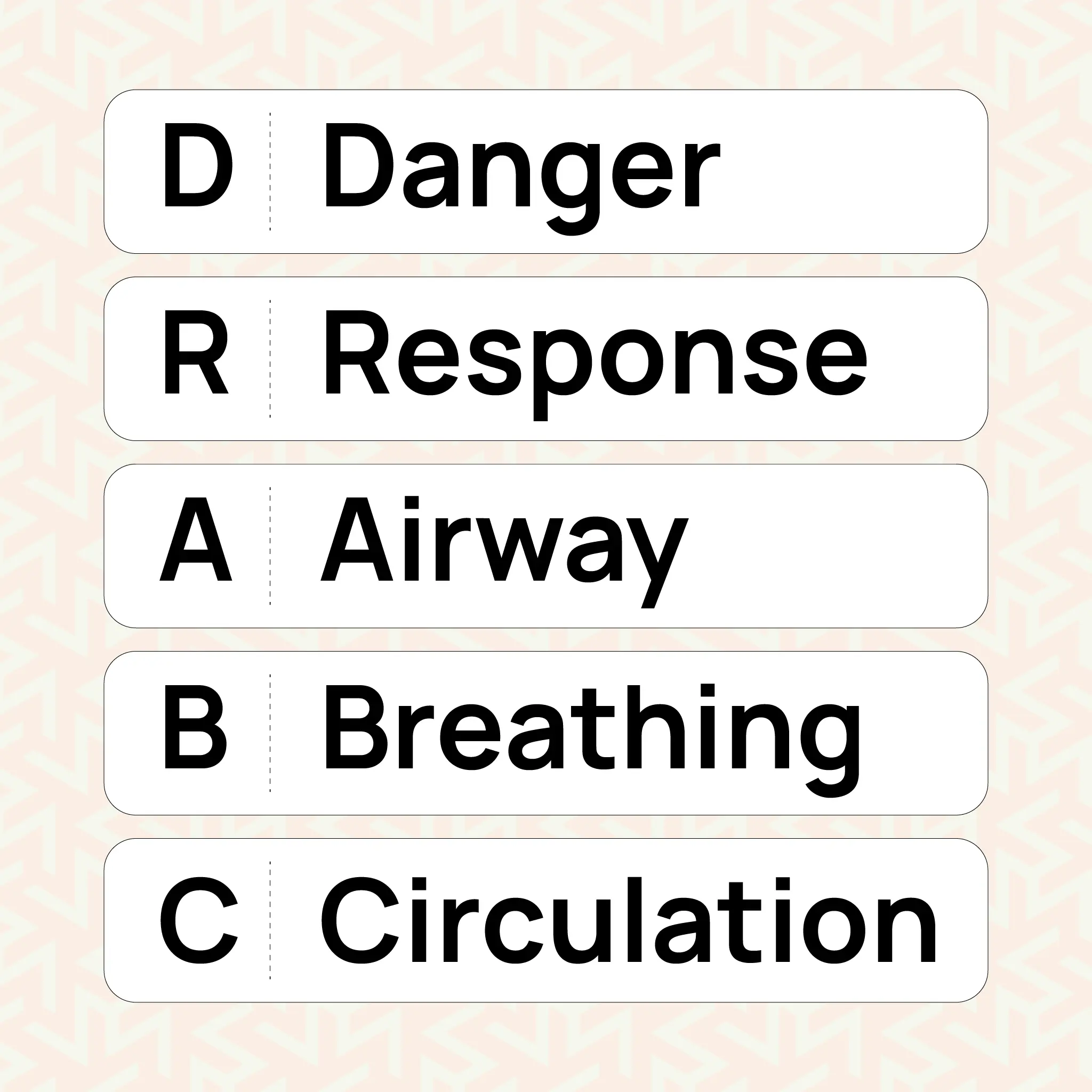
When someone is unconscious, their life is in danger. Their airway might be blocked, they may not be breathing, and their blood circulation could have stopped. It is important to follow the primary survey steps to assess casualties in the order of DRABC: Danger, Response, Airway, Breathing, and Circulation. Remember to take quick action because brain damage or even death can happen quickly. A secondary survey is performed after completing the primary steps of first aid.Primary Survey in First Aid Using DRABCWhen helping someone in an emergency, you always start with the primary survey. This means you quickly assess what is happening and the person's needs.The primary survey uses the letters DRABC to help you remember the steps: Danger, Response, Airway, Breathing and Circulation.D - Danger: First, you check for danger around you, such as oncoming traffic or a falling object.R - Response: Next, see if the person responds. Gently shake their shoulders when you talk to them. Are they awake or unconscious?A - Airway: Then, make sure their airway is clear. That means checking if anything is blocking their breathing passage.B - Breathing: After that, check if they're breathing normally. Look, listen, and feel for any signs of breathing.C - Circulation: Finally, check for signs of circulation, like a pulse. This tells you if their heart is beating.Knowing what to do next could help save someone's life, so it's important to follow these steps in the correct order. .main{ border:3px solid #0f7c90; border-radius:20px; position: relative; font-family:roboto; font-weight: 400; color: #000; } .main-two{ position: absolute; top:-25px; left:45px; background-color:white; } .img-div{ border-radius : 100%; padding:2px 7px; background-color:#0f7c90; margin-right:5px; width: 50px; height: 50px; } .img{ width:30px; object-fit:contain; height:auto; border-radius : 100%; } @media only screen and (max-width: 600px) { .heading{ font-size:20px; } .img{ width:20px; object-fit:contain; height:auto; border-radius : 100%; } .img-div{ width: 40px; height: 40px; } .main-two{ left:25px; } } Ready to Learn More? Put your knowledge of the primary survey into practice by enrolling in a course today! Our First Aid courses offer complete training to help you handle critical situations. Whether you want to improve your skills or workplace safety, these courses help build confidence and expertise. View our Emergency First Aid at Work (EFAW) and Level 3 First Aid at Work courses. These courses meet the UK legal requirements and help you keep people safe. DRABC StepsDANGER - 1st Step of the Primary Survey DRABCThe first thing to do in an emergency is to check for dangers. Look around to see if anything could harm you, the person needing help, or anyone nearby. This helps you decide if it's safe to go close to someone who needs help.WHAT TO DOIf you see any hazards, like live electricity, try to make the area safe first. For example, if there's electricity, turn it off. Otherwise, use an insulating object, such as wood or plastic, to move the person away. When there is a risk of electricity, do not touch them directly.When you are sure it is safe, you can approach the person who needs assistance. But if it's still not secure, don't go near them. Instead, get emergency medical helpRESPONSE - 2nd Step of the Primary Survey DRABCA person can lose consciousness when something disrupts the brain's normal functioning. Here are some signs that someone might be unconscious:They can't respond to simple questions or touch.They might not realise when they're in danger and can't protect themselves.They can't clear their airways by coughing or swallowing. This means saliva, blood, vomit, or objects could block their breathing tubes. The tongue, which becomes floppy, might also fall back and block the throat.WHAT TO DOFirst, try to determine whether the person is unconscious by asking simple questions or telling them to do something simple, such as "What's your name?" or "Open your eyes," and gently shake them. If they don't respond, they're probably unconscious. Don't shake them vigorously, especially if they're children or babies.Place the individual in the side position, and examine his airway, breathing and pulse.If the unconscious person is breathing and has a pulse, keep them in the side position. Ensure their airway remains open and clear, and monitor their breathing and pulse regularly until medical assistance arrives.�How to Keep the Unconscious Person in a Side PositionThis is also called the lateral, recovery, or stable side position.Kneel beside the person.Straighten their far arm out, perpendicular to their body. Bend their near arm at the elbow and place it across their chest, with the fingers near the far shoulder.Bend their near leg up to the right angle of their body.Hold the shoulder and hip closest to you, gently rolling them onto their side. Their top leg should rest on the ground with the thigh at a right angle and the calf parallel to the straight leg.Rest their uppermost, bent arm on the elbow of the straight arm.the person is a child older than 1 year, gently tilt their head back. Their face should be slightly downwards so any fluid can drain from their mouth, and their tongue can fall forward, away from the airway.Pro Tip:When someone is unconscious, act fast. Use DRABC: Danger, Response, Airway, Breathing, Circulation. Brain damage or death can happen quickly if you delay.AIRWAY - 3rd Step of the Primary Survey DRABCNow, ensure the person's airway is clear. If they're unconscious:Gently tilt their head back and lift their chin with your hand on their forehead.Peep in their mouth to check whether something is obstructing their passageway.What to Do: If the person is responsiveCheck whether anything is obstructing their airway and causing difficulty breathing.If you see something, encourage them to clear it by coughing or using their hands.For adults and kids, you can help them by giving back slaps or abdominal thrusts. For babies under a year old, you can help them with back blows or chest thrusts.Once the blockage is cleared, move on to the next step.What To Do: If the person is responsiveCheck whether anything is obstructing their airway and causing difficulty breathing.If you see something, encourage them to clear it by coughing or using their hands.For adults and kids, you can help them by giving back slaps or abdominal thrusts. For babies under a year old, you can help them with back blows or chest thrusts.Once the blockage is cleared, move on to the next step.What To Do: If the person is unresponsiveIf you see something, try to remove it carefully. But don't put your fingers in their mouth if you can't see anything, as you might push a blockage deeper.BREATHING - 4th Step of the Primary Survey DRABCBreathing should be regular, quiet, and easy. Tilt the head back, watch the chest for movement, and listen for breathing sounds. Do this for about ten seconds to see if air comes from the mouth or nose.WHAT TO DOIf they're unresponsive and not breathing normally, call emergency services immediately. If you know CPR, start with rescue breaths. If not, do chest compressions. If there's an AED nearby, ask someone to bring it.Giving Rescue BreathsMouth-to-mouth resuscitation is the best way to give rescue breaths. Mouth-to-nose resuscitation is used for a jaw injury or if the person needs to be revived in water. Mouth-to-mask resuscitation is done by trained people to avoid direct contact, especially if the person might have a disease like hepatitis or HIV.Typically, 30 compressions followed by 2 rescue breaths are performed in case of abnormal breathing.Mouth-Mouth ResuscitationKneel beside the person.Lay them on their back.Gently tilt their head back and support their jaw with your fingers. Don't press on their throat. Their mouth should be slightly open.Pinch their nose closed. Take a deep breath and cover their mouth with yours, sealing gaps.Keep their head tilted and give 2 breaths, enough to make their chest rise slightly.Start compressions as recommended.When they start breathing again, please put them in the side position and check their airway, breathing, and pulse regularly.Follow similar steps for mouth-to-nose and mouth-to-mask resuscitation but adjust for the different techniques.CIRCULATION - 5th Step of the Primary Survey DRABCIn this step, check the person for any significant bleeding.What To DoIf they're bleeding heavily, try to stop it by pressing directly on the wound with a clean cloth or dressing. Then, call emergency services for help.Stay with them until help arrives. Try to keep them calm and reassure them that help is coming. If they're not bleeding but still unresponsive, put them in the recovery position. This helps keep their airway clear if they vomit.Cardiopulmonary Resuscitation (CPR)If someone's heart has stopped, CPR is vital to keep them alive until help arrives. CPR is exhausting, so it's best if two people can take turns to keep the rhythm right. Remember, even if you're not trained, attempting CPR is better than doing nothing.What To Remember During an EmergencyPlease don't go near the person unless it's safe. Check for danger to yourself, others, and the injured person first.Stay as calm as possible, even though you might feel upset, and try to reassure the injured person.Time is significant.Don't move the person unless you have to for safety reasons.Please don't leave them alone. Get someone to call for medical help straight away. But if you're alone and help won't come soon, you'll need to go for help yourself. Call 999 or the emergency number in your area.Keep messages to the emergency services short: say where you are, what's happened, how many people are involved, and how badly they're hurt.Please don't give them anything to eat or drink.First-Aid TrainingThe Emergency First Aid training course is designed for low-risk environments such as offices and small retail stores. It gives participants the fundamental knowledge and skills to effectively manage emergencies in these settings. .banner { border-radius: 10px; overflow: hidden; border: 2px solid #ccc; box-shadow: 0 4px 8px rgba(0, 0, 0, 0.2); background-color: #fdf9ee; } .book-now { color: white; background-color: #DF3D52; border: none; padding: 15px 60px; border-radius: 5px; cursor: pointer; font-size: 20px; text-decoration: none; } .book-now:hover { /*text-decoration: none;*/ color: white; background-color: #c33f50; } Get Trained in All First-Aid Skills First Aid Courses Book Now Rated Excellent on major review sites FAQsWhat does DRABC stand for in first aid?DRABC in the first-aid primary survey stands for Danger, Response, Airway, Breathing and Circulation.Should you carry out a primary survey on every casualty?Use a primary survey and apply the DRABC steps whenever you witness a casualty, such as an accident or a fall, provided it is safe to approach the injured person.What is the purpose of the primary survey?The purpose of the primary survey is to treat life-threatening casualties quickly. These accidents could include airway blockage, breathing difficulties, shock or a brain injury.How can you assess the responsiveness of a casualty?First, check if the person is unconscious by asking simple questions and gently shaking them. If they don't respond, they're likely unconscious. Avoid shaking them vigorously, especially if they're children or babies. Next, put the person in the side position and check their airway, breathing, and pulse.How many compressions must be performed in case of abnormal breathing?Typically, 30 compressions followed by 2 rescue breaths are performed in case of abnormal breathing.
Safe Lifting Guidelines and Techniques
Manual handling is one of the main factors contributing to occupational accidents and illness in the UK. It was the second-leading cause of work-related ill health, accounting for 30% of instances, and caused 8.9 million lost working days. There were 480,000 total cases, including long-standing ones, of work-related musculoskeletal illnesses in 2019�20, including 152,000 new cases (one of the most frequent repercussions of improper manual handling techniques).Understanding what influences a person�s capacity for safe task performance is essential. These figures show that the effects of inadequate manual handling are too widespread and can seriously impact people�s health. Therefore, you must comprehend proper manual handling, weight restrictions, and handling practices to guard against bodily harm.Businesses in the UK are required by law to safeguard the health and safety of their employees. Therefore, employing safe manual handling practices and abiding by weight restrictions will guarantee that your company complies with the requirements of the pertinent UK legislation and guidance guidelines.Your training in the principles and techniques of safe manual handling will be sufficient thanks to our manual handling training. A variety of our health and safety courses are also available here.This article will comprehensively review the manual handling weight restrictions and recommendations provided by the Health and Safety Executive and outlined in the law (HSE).Manual Handling Weight Limits for LiftingThere are no set restrictions on how much manual handling and lifting can be done at work because it relies on many variables, including the nature of the task and the worker�s unique skills.Employers are required to take adequate action to minimise the risk of injury caused to employees by manual handling activities to the lowest level reasonably possible under the Manual Handling Operations Regulations (MHOR) 1992. Different weight restrictions and techniques will be needed to achieve this depending on the sort of manual handling activity.The hierarchy of measures outlined by the MHOR states that production lines and other forms of automation should always be used before manual handling procedures are avoided. If this is not feasible, the responsibility holder must evaluate the hazards presented by manual handling activities at work and decide how to control them. Perform a risk analysis of the manual handling operations as part of this. Then, to lessen the dangers to people�s health and safety, they must implement the required safety measures.During the risk assessment for manual handling, duty holders must take into account the following 4 important factors:Task � For instance, how much time it will take, how often it will be performed, whether it is repetitive, whether it offers enough time for rest or recovery, and whether it requires twisting, stooping, or reaching upwards. All of these factors may influence how demanding the work is.Individual � Everyone has different physical abilities and limitations depending on various factors, such as age or physical make-up. New or pregnant mothers, persons with impairments, and people returning to work after an injury may all be particularly at risk. Since no two persons are similar, employers must tailor the work and safety procedures to each employee�s talents to ensure that everyone is equally protected from health and safety concerns.Load � It can be challenging for a person to secure a firm grip and maintain control of the weight if it is too large or bulky, challenging to hold, and has a fluctuating centre of gravity (for example, if it contains liquid). The body might be put under extra stress as a result of this.Environment � The task will be more challenging and consequently more physically demanding to do, for instance, if there isn�t enough room in the area for the person managing the weight to move comfortably, if the floor is uneven or has different levels, or if the person can�t see clearly. High workloads, short deadlines, and a lack of control over the task and working methods can all cause psychological reactions that increase the risk for people.TILE, or occasionally LITE, is the name of these four elements. They are crucial when determining safe lifting techniques and weight restrictions for particular manual handling activities. The MHOR and related HSE manual handling advice publications recommend weight restrictions for lifting, carrying, pushing, pulling, and team actions in light of these variables and other guidance.This information must be considered in the context of the particular manual handling activities at your place of employment because there is no one size fits all solution. However, the guidelines are helpful resources for the individual in charge of establishing the essential manual handling restrictions.Safe Lifting WeightsAlthough the MHOR does not specify weight restrictions, the HSE provides some lifting and lowering best practices. Although the HSE claims they employ �broad assumptions or generalisations where, if met, the risk of injury is deemed to be low,� they should not be referred to as �safe limits� because this depends on all the elements involved, as was noted above. Work performed outside these advised ranges is probably more likely to result in an injury.Based on information from the general population, the HSE�s lifting and lowering risk filter specifies overall safe lifting capacities for men and women as follows:This demonstrates that the average man�s safe upper limit for manually handling a load is 25 kg, and the average woman�s is 16 kg.It�s important to remember that this only applies if the person carrying the load can hold it close to their body and at knuckle height. It is no longer safe to manage a 25 kg burden if the load moves across the zones, such as when you lift a box from knuckle height to a shelf at shoulder height. The lower weight must be used if the load is anticipated to move across zones while the task is being completed.The fact that these risk filters only apply to manual handling operations where the load:Simple to hold in both hands.Is working under appropriate conditions.Can be supported using secure lifting and handling techniques with the worker�s body in a stable position.Enables holding against the body.It is not carried more than 10 metres without stopping.Does not impede the person�s ability to walk normally.Does not interfere with the carrier�s vision.Requires neither much below knuckle height nor much over elbow height for the carrier�s hands.without having to be hoisted first, it can be safely put upon the shoulder The filter values can be used up to 20 metres in this circumstance.Certain elements will necessitate a complete evaluation of manual handling activities and possibly differing weight limitations and handling techniques.For instance, if the weights are greater than those in the risk mentioned above, filter if the handling requires twisting, if there is more than one lift every two minutes, if a team is involved, if the weights vary significantly, if the load is challenging to grasp, and if the person is at an elevated risk (e.g. those with disabilities or a recent injury).Safe Lifting Weights and TechniquesDuty holders can assess the most frequent risk elements in lifting and lowering, carrying, and team handling tasks using the HSE Manual Handling Assessment Charts (the MAC tool). It uses a number of visuals and infographics to help illustrate how different elements enhance the amount of risk and how each risk range will demand careful thought on how to preserve people�s health.For instance, determining the weight and frequency of the loads involved in lifting is the first topic covered in this tutorial. It demonstrates how the level of risk rises as lift rate and weight increase.As opposed to lower bands, the risk has increased as tasks move into a new colour band, and more safety controls are likely to be needed.The MAC tool addresses the following manual handling risk areas:Lifting Operations:Load weight/frequency.Vertical lift zones.Postural constraints.Hand distance from the lower back.Floor surface.Torso twisting and sideways bending.Grip on the load.Environmental factors.Carrying Operations:Load weight/frequency.Asymmetrical torso or load.Floor surface.Hand distance from the lower back.Obstacles on the route.Carry distance.Postural constraints.Grip on the load.Environmental factors.Team Handling Operations:�Load weight.Vertical lift zones.Hand distance from the lower back.Grip on the load.Torso twisting and sideways bending.Carry distance.Postural constraints.Communication, coordination, and control.Floor surface.Obstacles on the route.Environmental factors.It will be crucial for your employer to take into account the advice in the MAC tool and the risk zones specified for each location if any of these relate to your line of work