
What is an NVQ Assessor?
NVQ assessors work closely with learners, observing their performance, reviewing evidence, and providing guidance to help them achieve their qualifications. They evaluate the skills, knowledge, and competencies of individuals undertaking NVQs or similar work-based qualifications. They are crucial in ensuring that candidates meet industry standards or job roles.How to Become an NVQ AssessorIf you�re interested in becoming an assessor and want to assess vocational competence in your sector, then the Level 3 Certificate in Assessing Vocational Achievement is the qualification you need. This course is designed to train NVQ, On-Programme or End-Point Assessors in any industry. You can use this qualification to assess any area you deem occupationally competent.Good communication, organisation, and people skills are essential for giving helpful feedback, managing your time, and supporting learners. Once qualified, look for jobs with training providers or colleges and highlight your experience and qualifications. Keep learning and improving to stay effective and credible in your role.What Qualifications Do You Need to Be an NVQ Assessor?To become an NVQ assessor, you need:Industry-Specific Qualification: A qualification in the field you intend to assess, typically at the same or higher level than the NVQs you�ll determine.Assessor Qualification: The Level 3 Certificate in Assessing Vocational Achievement (CAVA) or equivalent. This qualification teaches you the skills to evaluate learners effectively.With the right qualifications, experience, and dedication, you can become qualified as an NVQ assessor, helping others achieve their professional goals. .main{ border:3px solid #0f7c90; border-radius:20px; position: relative; font-family:roboto; font-weight: 400; color: #000; } .main-two{ position: absolute; top:-25px; left:45px; background-color:white; } .img-div{ border-radius : 100%; padding:2px 7px; background-color:#0f7c90; margin-right:5px; width: 50px; height: 50px; } .img{ width:30px; object-fit:contain; height:auto; border-radius : 100%; } @media only screen and (max-width: 600px) { .heading{ font-size:20px; } .img{ width:20px; object-fit:contain; height:auto; border-radius : 100%; } .img-div{ width: 40px; height: 40px; } .main-two{ left:25px; } } Want to become an NVQ assessor in the UK Teaching Industry? Our assessor courses, including the Level 3 CAVA Certificate, offer a range of learning modules to help you become an assessor for renowned organisations. How Much Do NVQ Assessors Get Paid?The salary of an NVQ assessor can vary depending on factors such as experience, location, and the industry they specialise in. On average, NVQ assessors in the UK earn between �25,000 and �35,000 per year. More experienced assessors or those working in high-demand sectors may earn upwards of �40,000 annually. Some assessors also work freelance, charging hourly or per-assessment fees.
What is The Difference Between an Internal Quality Assurer (IQA) and an Assessor in the UK
An Assessor works directly with learners, evaluating their progress and ensuring they meet the required standards for their qualifications. An Internal Quality Assurer (IQA) oversees the assessment process, ensuring consistency, fairness, and compliance with established standards.In professional development and training, knowing the roles of an Assessor and an Internal Quality Assurer (IQA) is important. These roles are key in maintaining high training standards in different organisations across the UK.What Is an Assessor?An Assessor�s primary role is to support and assess learners as they work towards vocational qualifications. Whether in a workplace, training centre, or college, Assessors are directly involved with the learners. They are responsible for:Assessing Competency: Ensuring that learners meet the required occupational standards.Providing Feedback: Offering constructive guidance to help learners improve and succeed.Tracking Progress: Keeping detailed records of learners� achievements and goals.Being a Point of Contact: Building strong, supportive relationships with learners to motivate and guide them.Individuals usually complete the Level 3 Certificate in Assessing Vocational Achievement (CAVA) to become an Assessor. This qualification enables them to assess learners in both workplace and educational environments. .main{ border:3px solid #0f7c90; border-radius:20px; position: relative; font-family:roboto; font-weight: 400; color: #000; } .main-two{ position: absolute; top:-25px; left:45px; background-color:white; } .img-div{ border-radius : 100%; padding:2px 7px; background-color:#0f7c90; margin-right:5px; width: 50px; height: 50px; } .img{ width:30px; object-fit:contain; height:auto; border-radius : 100%; } @media only screen and (max-width: 600px) { .heading{ font-size:20px; } .img{ width:20px; object-fit:contain; height:auto; border-radius : 100%; } .img-div{ width: 40px; height: 40px; } .main-two{ left:25px; } } Want to become a qualified assessor or IQA in the UK Teaching Industry? Our assessor and IQA training courses, including the Level 3 CAVA Certificate, offer a range of learning modules to help you become an assessor for renowned organisations. What Is an IQA?An Internal Quality Assurer (IQA) oversees the assessment process to ensure consistency, fairness, and adherence to standards. IQAs focus on maintaining the quality of assessments and are often in a supervisory or managerial role. Their responsibilities include:Monitoring Assessment Processes: Ensuring that Assessors apply standards correctly and consistently.Standardisation: Promoting uniformity in assessment practices across different Assessors.Supporting Assessors: Providing guidance and feedback to help Assessors improve their practices.Quality Assurance: Review records, evidence, and decisions to confirm assessments meet regulatory requirements.To become an IQA, individuals need advanced qualifications such as the Level 4 Award in the Internal Quality Assurance of Assessment Processes and Practice or the Level 4 Certificate in Leading the Internal Quality Assurance of Assessment Processes and Practice.Key Differences Between Assessors and IQAsThe table below highlights the primary differences between Assessors and IQAs:AspectAssessorInternal Quality Assurer (IQA)Role FocusSupporting and assessing learners directlyOverseeing and ensuring the quality of assessmentsResponsibilitiesEvaluating learners, setting goals, and tracking progressMonitoring Assessors, standardising practices, and ensuring compliance with standardsInteractionDirectly engages with learners.Works with Assessors rather than learners.Qualifications NeededLevel 3 Certificate in Assessing Vocational Achievement (CAVA)Level 4 IQA Award or Certificate in Internal Quality AssurancePosition in HierarchyDirectly supports learnersSupervises and supports AssessorsKnowing that an assessor's role differs from an IQA's is important. An IQA checks that assessments in an organisation are done fairly. They review the decisions made by assessors. Assessors are the ones who carry out the evaluations that the IQA checks.ConclusionWhile Assessors and IQAs play distinct roles, they work together to ensure learners achieve their vocational qualifications through a fair and effective process. Assessors focus on the learners, guiding them through their qualifications, while IQAs ensure that the assessment process is consistent, high-quality, and compliant with standards.Whether you�re considering becoming an Assessor or an IQA, understanding the responsibilities and qualifications required for each role is the first step toward making an informed career choice. Both roles are critical in shaping the UK's reliable vocational education system.
What is an Assessor and How to Become a Qualified Assessor
To become qualified, one needs industry experience and an accredited qualification, such as the Level 3 Certificate in Assessing Vocational Achievement, which ensures they can assess effectively and ethically.Businesses across sectors actively seek assessors, offering opportunities for career advancement and a rewarding salary. Given their responsibilities, assessors must possess expertise in their respective fields and undergo training. It is important to learn relevant skills and knowledge before assuming the role of an assessor.What is an Assessor?An assessor is a qualified professional in the vocational and educational industry who guides trainees towards achieving their career goals. They evaluate learners' skills and knowledge against set standards. Their duties include planning and conducting assessments to gauge learners' work-related competence.NVQ AssessorAn NVQ assessor evaluates a student's skills and knowledge to ensure they meet the standards to achieve their National Vocational Qualification (NVQ). NVQ assessors work in many industries and settings, including schools, colleges, and workplaces.What Qualifications do you Need to Become a Qualified Assessor?Obtaining a Relevant Assessor Qualification, such as the Level 3 CAVA Certificate, is important to qualify as an assessor. This credential allows individuals to conduct assessments in educational environments and trains them to evaluate competence in occupational settings.Upon completion of the certification, assessors become eligible to evaluate learners pursuing National Vocational Qualifications (NVQs) and apprenticeships.These are the Four levels of courses for assessor qualifications:Level 3 Award in Understanding Assessment Principles and PracticesThe UPPA assessor course focuses on knowledge and is excellent for current assessors who want to improve their skills. It teaches the background knowledge and importance of assessment practices.Level 3 Award in Assessing Vocationally Related AchievementThe AVRA assessor course allows you to assess students in a training setting, like a workshop or classroom, but not in their workplace. To finish the course, you will complete four assessments on two learners (8).Level 3 Award in Assessing Competence in the Work EnvironmentThis ACWE assessor course lets you assess students at their workplace rather than in a classroom. Like the Vocationally Related Achievement award, you will determine the skills of two learners.Level 3 (A1, D32/33) Certificate in Assessing Vocationally Related Achievement (CAVA)The CAVA qualification lets you assess students in training and at their workplace. To finish, you must do 8 assessments with each learner (16 assessments in total). .main{ border:3px solid #0f7c90; border-radius:20px; position: relative; font-family:roboto; font-weight: 400; color: #000; } .main-two{ position: absolute; top:-25px; left:45px; background-color:white; } .img-div{ border-radius : 100%; padding:2px 7px; background-color:#0f7c90; margin-right:5px; width: 50px; height: 50px; } .img{ width:30px; object-fit:contain; height:auto; border-radius : 100%; } @media only screen and (max-width: 600px) { .heading{ font-size:20px; } .img{ width:20px; object-fit:contain; height:auto; border-radius : 100%; } .img-div{ width: 40px; height: 40px; } .main-two{ left:25px; } } Want to become a qualified assessor in the UK Teaching Industry? Our assessor courses, including the Level 3 CAVA Certificate, offer a range of learning modules to help you become an assessor for renowned organisations. What are the responsibilities of an assessor?The responsibilities of an assessor vary based on the vocation assessed and the employing organisation. Common responsibilities are:Observing students' competency in the workplaceOffering feedback and guidance to studentsParticipating in standardisation meetings alongside other assessorsDesigning and conducting training sessions and workshopsApproving awards upon fulfilment of all criteriaMaintaining comprehensive records of students' advancements.How is an Assessor Different from an Internal Quality Assurer?AssessorInternal Quality AssurerSpecific range of responsibilitiesBroad range of responsibilitiesAssesses learnersSupervises assessors�Direct evaluation of learner�s performance�Maintains the quality of training and assessments within an organisationMust qualify TAQA Level 3 CertificationsMust qualify TAQA Level 4 CertificationsCareer Opportunities for a Qualified AssessorOnce you finish the TAQA Level 3 qualification (CAVA Level 3), you can assess learners in a classroom or at work. You can determine skills in many qualifications, including:ApprenticeshipsFunctional SkillsTechnical CertificatesNVQsAwardsCertificatesDiplomasOnce you gain some experience, you can move on to something more challenging and rewarding. The next step in this career path is the TAQA Level 4 of internal quality assurance training.How Much Do Qualified Assessors Earn?Beginner or apprentice assessors can earn around �23,000 a year. The salary is typically around �25,000 annually for those who are established. Experienced ones can earn up to �35,000 per year. These figures can vary, and if you work as a freelance assessor, you can choose your working hours and days.FAQsWhat is the TAQA assessor qualification?The TAQA assessor qualification is a nationally recognised certification in the UK. It is designed for individuals who are currently assessing or want to assess the occupational competence of others in the workplace.What is the difference between CAVA and TAQA?CAVA is a qualification part of the TAQA suite. It stands for Certificate in Assessing Vocational Achievement. TAQA is not a qualification for Training, Assessment, and Quality Assurance. As the name suggests, TAQA is a suite of qualifications relevant to training, assessment, and quality assurance.Can anyone become an assessor?Anyone can become an NVQ assessor if qualified and gain relevant industry experience. NVQ assessors evaluate learners� competency in their chosen vocational field.What are the different types of assessors?Based on the certification, assessors can be Workplace, Off the Job or End-Point Assessors.
What is the Difference Between IQA and EQA
Quality assurance is important for addressing quality-related issues within organisations. Problems like biased assessments can harm an organisation's reputation, making early detection important to avoid costly corrections of systemic errors. To become a quality assurer, one must complete the appropriate qualifications, which come in two types: internal and external. It is important for learners to carefully review course guidelines to select the right qualification.Internal Quality Assurance (IQA)Internal Quality Assurance (IQA) is fundamental to maintaining high standards in products or services. IQAs ensure that assessments are fair and of high quality. They oversee assessors' activities and verify that evaluations are conducted impartially.External Quality Assurance (EQA)External Quality Assurers (EQAs) operate independently from the organisations or assessment centres they oversee. They provide guidance, support, and assistance to the centre�s Internal Quality Assurers (IQAs). EQAs also work with assessors and other personnel involved in the qualification process to ensure that all candidates are treated fairly. They ensure that qualifications are delivered in adherence to regulatory standards, such as those established by OFQUAL. This includes measures to prevent cheating or unethical conduct, including plagiarism or impersonation during assessments.Which EQA Qualification Do I Need?The primary qualification in this field is the Level 4 Award in External Quality Assurance of Assessment Processes and Practice.It covers the theoretical understanding of the EQA role and the practical aspects of conducting visits, checks, and monitoring. It is suitable for individuals who oversee assessment quality externally.The Level 4 Award in Understanding the External Quality Assurance of Assessment Processes and Practice is for EQA beginners who want to understand the principles and methods of external quality assurance without needing practical application.This qualification aims to train individuals for roles in the workplace where they are responsible for upholding assessment quality standards. .banner-blue { border-radius: 10px; overflow: hidden; border: 2px solid #ccc; box-shadow: 0 4px 8px rgba(0, 0, 0, 0.2); background-color: #fdf9ee; } .book-now { color: white; background-color: #DF3D52; border: none; padding: 15px 60px; border-radius: 5px; cursor: pointer; font-size: 20px; text-decoration: none; } .book-now:hover { /*text-decoration: none;*/ color: white; background-color: #c33f50; } Get Certified with our TQUK Assessor Courses Regulated by OFQUAL Assessor Courses Book Now Trustpilot What is the Difference Between Internal and External Quality Assurance QualificationsWhile IQA and EQA focus on maintaining quality standards, they differ in objectives and operational levels.Internal Quality Assurance�External Quality Assurance�Administrative authority�Legislative authority�Focuses on improvement within an organisationFocuses on accountability & compliance of an organisationTypically follow local regulations�Typically follow global regulationsInstitutional level of operationThe national level of operation�The end report is private�The end report is public�
Appropriate Methods of Assessments
Assessors' core responsibility is to evaluate learners. To do so effectively, they must use assessment methods they will most likely learn and apply during the assessor course.What are Assessment Methods in Education and Training?Assessment methods check learners' skills and knowledge needed to pass a qualification.A qualification or assessment strategy specifies which methods to use. Learners must answer questions or write assignments if the qualification needs evidence of knowledge. A learner can be evaluated using the following assessment approaches:QuestionsAssignmentsDiscussionsWitness testimonySimulationRoleplayReflective accounts, where learners talk or write about what they did in a real situation .banner-blue { border-radius: 10px; overflow: hidden; border: 2px solid #ccc; box-shadow: 0 4px 8px rgba(0, 0, 0, 0.2); background-color: #fdf9ee; } .book-now { color: white; background-color: #DF3D52; border: none; padding: 15px 60px; border-radius: 5px; cursor: pointer; font-size: 20px; text-decoration: none; } .book-now:hover { /*text-decoration: none;*/ color: white; background-color: #c33f50; } Get Certified with our TQUK Assessor Courses Regulated by OFQUAL Assessor Courses Book Now Trustpilot What are the Types of Assessment MethodsObservationObservation is a natural way to gather evidence of a learner�s skills. If assessing a group, each learner�s observation should be recorded individually, noting how each one acted, spoke, or performed.ObservationObserving learner�s performing skills either in the workplace or a learning environment. This includes job roles or skills during apprenticeships.�Strengths of Observations- Allows direct view of learner�s skills in action- Enables assessment of how learners perform tasks and correct mistakes- Multiple criteria can be assessed simultaneously- Motivates by addressing many criteria in a single observationLimitations of Observations- Timing issues, especially if observation needs to be done in person and the learner works unconventional hours (e.g., night shifts).- In settings where recording is not feasible (e.g., nurseries), reliance on notes and�memory may be challenging.QuestioningQ&A can be an oral or in-writing assessment method, and it can also include quizzes or exams. Questioning helps you see what the candidate understands and where they need to improve. It is a useful approach to identify areas for growth and plan the next steps.QuestioningA popular method for assessing a learner�s understanding and stimulating their thinking. It involves asking questions to assess knowledge and encourage deeper thought.Strengths- Can include various types: multiple-choice, short answers, or essays- Questions can be personalised or drawn from a question bank- Challenges learners and promotes their potential- Can target critical thinking and skill recognition- Oral questions may be better for learners with dyslexia or visual impairmentsLimitations- Closed questions (yes/no) limit the ability to demonstrate knowledge- Writing questions can be time-consuming- Written responses may be copied or plagiarized- Essay-style questions may be challenging for some learners, so various question types are neededProjectsProjects and assignments help you see what a candidate knows by gathering all their work in one place. This can include reports, essays, or research tasks. Mistakes or missing information in their work show where their knowledge needs improvement. You can help them learn more and cover gaps before the final assessment.ProjectsProjects are useful for collecting a lot of information at once. They can include reports, essays, or research tasks.Strengths of Projects- Reveals gaps in the learner�s knowledge for targeted extra training- Provides real-world experience in a professional or vocational setting- Structured with a clear beginning, middle, and end, allowing for formative feedback and reflectionLimitations of Projects- Keeping the learner engaged can be challenging, especially if projects last several weeks or months- Maintaining motivation throughout the entire project duration is necessaryRecognition of Prior Learning (RPL)RPL, or Recognition of Prior Learning, looks at any previous qualifications, awards, or certificates the candidate has earned. As an assessor, you compare this prior work with the current criteria to see if the candidate has met them. This method is favoured by candidates because it might reduce their workload if they have already covered the material.RPL (Recognition of Prior Learning)RPL involves considering any previous qualifications the learner has that show they already know or understand parts of their current qualification.Strengths of RPL- Helps learners avoid repeating work they have already completed- Saves time by allowing learners to progress faster- Previous work history is valued and not wastedLimitations of RPL- Requires assessing if previous learning aligns with current qualification criteria- Learners may need to demonstrate their knowledge with a brief assignment- Sometimes, it may be easier to observe the learner cover the criteria againWitness TestimonyWitness Testimony relies on having a trustworthy candidate. For this method, you need a qualified professional who works with the candidate to write a report on when they saw the candidate perform a task or skill and confirm their competence.The candidate must also write a report about the same task or skill. As the assessor, you compare both reports. If they match well, the testimony is likely valid and can be used to meet certain assessment criteria.Witness TestimonyTo get a valid witness testimony, you need a qualified professional who works with the candidate, like a line manager, to write a report on when they saw the candidate perform a task or skill to confirm their competence.Strengths of Witness Testimony- The witness can confirm the candidate�s competence or achievements if they know the assessment criteria- Useful for practical skills; videos can support this but have their limitationsLimitations of Witness Testimony- The assessor must validate the suitability of the witness and verify the authenticity of their statements- There is a risk of fraud if learners sign statements themselves or if managers falsely act as witnesses to sign off on tasks they have not observedWork ProductIf your candidate is working in a job related to their qualification, like an apprenticeship, they are likely doing tasks every day that could count as evidence for their criteria. Since they are already doing the work that meets the criteria, it might not make sense to ask them to repeat it in an assignment. This method is often popular with candidates because it lets them achieve two goals at once.For example, a business administration student might take screenshots of emails to show their work. Depending on what the criteria require, if a screenshot can prove they have the needed skills, it is a good option.Work ProductWork products involve assessing a candidate�s performance through their job-related tasks, often seen in Apprenticeships where candidates produce work relevant to their qualification.Strengths of� � � Work ProductThe finished product can provide high-quality evidence of the learner�s understanding and competence in a unit. It also serves as a tangible example of the learner�s skills.Weaknesses ofWork ProductThe end product can be challenging to assess. A portfolio is often needed to show both the understanding and the process, which can be time-consuming and unclear in terms of criteria benchmarks.VASCR Principles of Assessment MethodsThe VASCR principles�Valid, Authentic, Sufficient, Current, and Reliable�help ensure assessment fairness and accuracy. They make sure that:The assessments are genuinely created by learners.They stay relevant.They cover all the required learning outcomes.They show consistent results over time.What Qualifications Do You Need to Become a Qualified Assessor?To become a qualified assessor, you need a relevant qualification, like the Level 3 CAVA Certificate. This certification allows you to conduct assessments in educational settings and train to assess skills in various job environments.Once you complete this certification, you can assess learners working towards National Vocational Qualifications (NVQs) and apprenticeships.
What is CAVA Qualification?
What does CAVA stand for?CAVA stands for Certificate in Assessing Vocational Achievement. It is a level 3 qualification that is widely recognised across the country for assessors.What is a CAVA qualification?CAVA is a detailed and practical qualification for assessors. It focuses on teaching the skills and knowledge needed to assess learners confidently in their workplace and educational settings, such as classrooms. This makes CAVA highly applicable to real-world assessment scenarios.CAVA teaches you how to evaluate and oversee a learner's vocational skills. After completing the course and gaining occupational competence, you will be qualified to conduct assessments for learners working towards NVQs or apprenticeships.CAVA is a Common Alternative to the A1 Assessor CoursePreviously known as the A1 assessor course and the D32/D33 assessor courses, the CAVA is the current and updated qualification required for full assessor certification. Despite occasional confusion, it is distinct from the TAQA course. TAQA refers to a suite of qualifications and is not a standalone qualification.This qualification is preferred because it covers all units (1,2,3) for assessing students across different environments. It is the preferred course for learning about the different assessment methods and principles.�What is the Importance of CAVA Qualification?The CAVA qualification is classified as a Level 3 certificate. Among the three official assessor qualifications at Level 3, each serves a distinct purpose: one focuses on workplace assessment, and another on assessment in educational settings. CAVA uniquely qualifies assessors to evaluate learners in both workplace and educational environments.What are the Requirements for the Level 3 Assessor QualificationTo obtain your CAVA qualification, you will need to complete three units. This can be done part-time while you continue working. Typically, the course takes around 150 hours to complete, making it feasible for most individuals to finish in approximately 12 weeks.There are no formal prerequisites for entry, but you should have math and English skills at a Level 2 standard.Proficiency in the field you wish to assess is necessary. For most assessor qualifications, except for the UPPA, you must have at least two learners available for assessment.As part of your qualification process, you will need to assess learners.Entry RequirementsLike most Level 3 awards, the entry requirements for enrolling in the CAVA course are basic.A minimum of Level 2 (or equivalent) in literacy and numeracyBe over the age of 18 .banner-blue { border-radius: 10px; overflow: hidden; border: 2px solid #ccc; box-shadow: 0 4px 8px rgba(0, 0, 0, 0.2); background-color: #fdf9ee; } .book-now { color: white; background-color: #DF3D52; border: none; padding: 15px 60px; border-radius: 5px; cursor: pointer; font-size: 20px; text-decoration: none; } .book-now:hover { /*text-decoration: none;*/ color: white; background-color: #c33f50; } Get Certified with our TQUK Assessor Courses Regulated by OFQUAL Assessor Courses Book Now Trustpilot What are the three CAVA UnitsUnit 1 � Principles and Practices of AssessmentUnit 1 focuses on establishing a solid theoretical foundation. It teaches principles and practices related to assessment, emphasising the responsibilities and role of assessors.Unit 2 � Assessing Occupational Competence in Work EnvironmentsUnit 2 assesses learners within their respective work environments. Participants are given access to two learners for assessment purposes, which is included in the course fee.Unit 3 � Assessing Vocational Skills, Knowledge, and UnderstandingThe course's final unit evaluates learners' vocational skills, knowledge, and understanding in a learning environment.FAQsWhat does the CAVA course involve?The CAVA course includes three units:Unit 1: This unit covers the theoretical aspects of assessment, including the role and responsibilities of assessors.Unit 2: This unit focuses on assessing learners in their work environments.Unit 3: This involves assessing learners in a learning environment.How long does it take to complete the CAVA course?Completing the CAVA course typically takes 4-6 months, with a few hours of studying per week. You have up to 2 years to finish the course.Do I need access to learners for assessment?Yes, for the CAVA course, you need learners to assess. It is an Ofqual requirement to conduct real-life assessments with two learners to qualify as an assessor.Do I need to be in an assessor role already?No, prior experience as an assessor is not necessary to enrol in the CAVA course. There are no specific entry requirements. However, occupational competence in your chosen assessment area benefits future employment prospects.Do I need to be in a Further Education role?No, enrollment in the CAVA course does not require you to be in a Further Education role.What is TAQA?TAQA refers to a suite of qualifications and is not a standalone qualification.What was the A1 assessor course?The A1 assessor course was the former title of the assessor qualification until 2010, when it was renamed the CAVA qualification, the Level 3 Certificate in Assessing Vocational Achievement.What was the D32/33 assessor course?The D32/33 assessor course was the original title of the assessor qualification in the nineties. It became known as the A1 assessor course and eventually evolved into the current CAVA assessor course.Is an expert witness required for the CAVA course?Yes, you do require an expert witness for this course. He is a qualified assessor within your organisation who verifies that your assessments were conducted correctly before your course tutor grades them.
What is an A1 Assessor Course
The A1 assessor course was previously known for training learners wanting to become certified assessors. However, the qualification has been discontinued and is no longer accessible. It has been replaced by updated courses designed to achieve an assessor qualification.If you are considering a career as an assessor and are aiming for the A1 assessor qualification, shift your focus to the various TAQA qualifications. These updated qualifications offer a more comprehensive approach to assessment, making them a better choice for your career.What is the A1 Assessor Qualification ?The A1 Assessor qualification, previously known as the Level 3 Award in Assessing Candidates Using a Range of Methods, was introduced in late 2002. It replaced the D32 and D33 units. It offered a single-unit qualification focused primarily on candidate assessment. However, with the evolving education landscape, TAQA qualifications have become the standard choice for training and evaluation. .main{ border:3px solid #0f7c90; border-radius:20px; position: relative; font-family:roboto; font-weight: 400; color: #000; } .main-two{ position: absolute; top:-25px; left:45px; background-color:white; } .img-div{ border-radius : 100%; padding:2px 7px; background-color:#0f7c90; margin-right:5px; width: 50px; height: 50px; } .img{ width:30px; object-fit:contain; height:auto; border-radius : 100%; } @media only screen and (max-width: 600px) { .heading{ font-size:20px; } .img{ width:20px; object-fit:contain; height:auto; border-radius : 100%; } .img-div{ width: 40px; height: 40px; } .main-two{ left:25px; } } The A1 Assessor Course, now part of the CAVA (Certificate in Assessing Vocational Achievement) qualification, trains individuals to assess learners' skills and knowledge. It includes units like UPPA (Understanding Assessment Principles), AVRA (Assess Vocationally Related Achievement), and the ACWE course for workplace assessments, teaching assessing skills in various contexts. What is TAQA?TAQA stands for Training, Assessing, and Quality Assurance. It has replaced the A1 assessor award but is not a single-unit qualification. Instead, TAQA includes several assessor and quality assurance qualifications:Level 3 Award in Understanding the Principles and Practices of Assessment (Unit 1)Level 3 Award in Assessing Competence in the Work Environment (Units 1 & 2)Level 3 Certificate in Assessing Vocational Achievement (CAVA) (Units 1, 2 & 3)Level 3 Award in Assessing Vocationally Related Achievement (Units 1 & 3)Level 4 Award in the Internal Quality Assurance of Assessment Processes and Practice (Units 1&2) V1/TAQA/D34Level 4 Certificate in the Internal Quality Assurance of Assessment Processes and Practice (Units 1,2 & 3)Which Course is Equivalent to the A1 assessor course? All assessor courses in the TAQA group now replace the A1 assessor course. This means that they are all updated versions. However, the most common alternative to the A1 assessor qualification is the Level 3 Certificate in Assessing Vocational Achievement (CAVA).The CAVA qualification is favoured because it includes all the necessary units for assessing students in different settings. However, it is important to know that it is not the closest match out of all the options available.The closest match to the A1 Assessor qualification is the Level 3 Award in Assessing Competence in the Work Environment. This course closely aligns with the content, syllabus, and goals of the A1 assessor course.It is also shorter and more cost-effective than the CAVA course, covering two units instead of three. So if you need to get your �A1 Assessors,� this course is the best replacement. Which Units are Included in the TAQA QualificationsTo become a certified assessor, you can pursue any of the assessor qualifications offered within the TAQA suite of certifications. However, the specific units covered in your chosen course will determine the scope and context of your assessment abilities.The TAQA suite's assessor qualifications encompass three key units:Understanding the Principles and Practices of Assessment: This unit is important to all assessor qualifications within the TAQA suite. It provides fundamental knowledge necessary for anyone involved in assessment processes.Assessing Occupational Competence in the Work Environment: This practical unit evaluates learners' workplace competency.Assessing Vocational Skills, Knowledge, and Understanding: This practical unit evaluates learners' vocational skills and understanding in classrooms or training courses. .banner-blue { border-radius: 10px; overflow: hidden; border: 2px solid #ccc; box-shadow: 0 4px 8px rgba(0, 0, 0, 0.2); background-color: #fdf9ee; } .book-now { color: white; background-color: #DF3D52; border: none; padding: 15px 60px; border-radius: 5px; cursor: pointer; font-size: 20px; text-decoration: none; } .book-now:hover { /*text-decoration: none;*/ color: white; background-color: #c33f50; } Get Certified with our TQUK Assessor Courses Regulated by OFQUAL Assessor Courses Book Now Trustpilot What Are the Four Different Assessor Qualifications?The TAQA assessor qualifications are quite similar, but they have one big difference: their nature of assessments.The Level 3 Award in Understanding the Principles and Practices of Assessment focuses mainly on learning assessment theory. It is suitable for beginners who need more time to be ready to assess students.The Level 3 Award in Assessing Competence in the Work Environment lets you assess students at their workplace, not in classrooms. You need to gather evidence from two students in this role.The Level 3 Award in Assessing Vocationally Related Achievement lets you assess students in classrooms or workshops rather than at their jobs. Like the previous one, you also need evidence from two students.The Level 3 Certificate in Assessing Vocational Achievement (CAVA) is the most popular. It allows you to assess students in both classrooms and at their jobs. You need evidence from both types of assessments and must actively assess students to get this certification.What are the Requirements for the CAVA Assessor Course?To get your CAVA qualification, you must complete three units. You can do this part-time while still working. The course typically takes around 150 hours, so completing it in about 12 weeks is feasible for most people. Please note that you must be at least 19 years old to enrol.There are no formal prerequisites for the entry criteria. You should have math and English skills at a level 2 standard. You also need to be proficient in the area you want to assess. Moreover, for any assessor qualification, except for the UPPA, you must have two learners to assess.To complete your qualification, you must access learners. Your training provider can help you connect with the required learners.
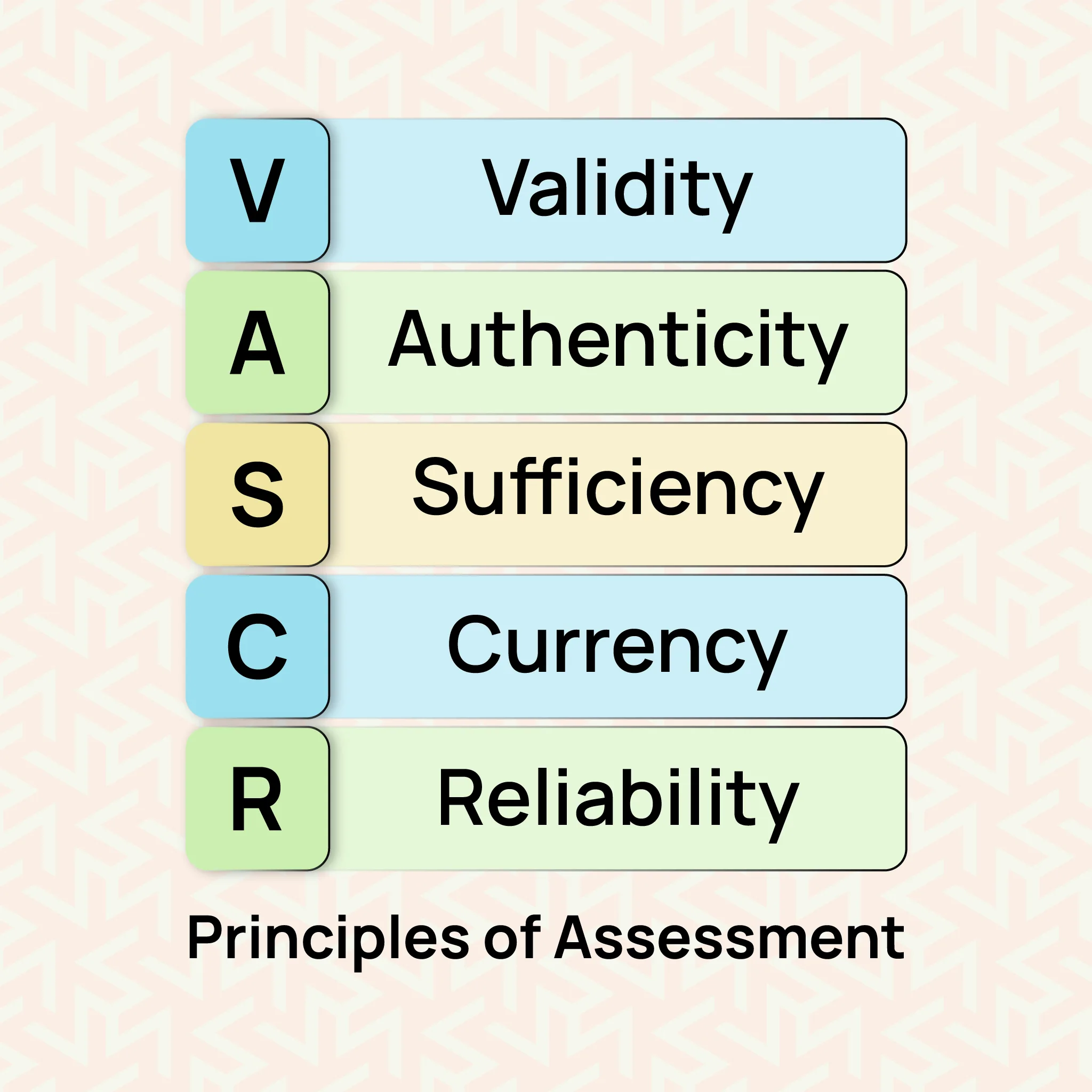
VASCR Principles of Assessment
Studying the concepts and principles of assessment is important. It helps us understand how assessments work and why they are important. This knowledge confirms that assessments are fair, reliable, and valid.Knowledge about the concepts and principles improves the quality of assessments and the accuracy of the outcome. It is also useful for evaluating learning effectively.Importance of Assessment PrinciplesAssessment principles are important for accurate and ethical learning and development practices. They guide how qualified assessors consistently evaluate learners' knowledge, skills, and abilities without bias.Ethical Considerations in AssessmentEthical principles in assessment include conducting assessments responsibly and ethically. This includes respecting learners' rights and well-being and avoiding bias or discrimination based on gender, race, disability, or socioeconomic status.Assessors must promote fairness by designing assessments for diverse learner backgrounds and experiences.Key Ethical PracticesConfidentiality: Keeping assessment information private and secure.Respect for Diversity: Creating inclusive and respectful assessments of different backgrounds.Clear Communication: Providing clear instructions and expectations to learners.Objectivity: Maintaining impartiality and fairness throughout the assessment process.Validity and Reliability: Using assessment methods that accurately measure what they intend to measure.By following ethical guidelines, practitioners create supportive learning environments and uphold integrity in assessments. Transparency is also important. Assessors should openly communicate with learners about assessment purposes, evaluation criteria, potential outcomes, benefits, and available support.Understanding Concepts and Principles of AssessmentThe concepts and principles of assessment are the fundamental ideas and values guiding the assessment process. Key concepts include measuring a learner's knowledge and learning standards using various assessment types. .main{ border:3px solid #0f7c90; border-radius:20px; position: relative; font-family:roboto; font-weight: 400; color: #000; } .main-two{ position: absolute; top:-25px; left:45px; background-color:white; } .img-div{ border-radius : 100%; padding:2px 7px; background-color:#0f7c90; margin-right:5px; width: 50px; height: 50px; } .img{ width:30px; object-fit:contain; height:auto; border-radius : 100%; } @media only screen and (max-width: 600px) { .heading{ font-size:20px; } .img{ width:20px; object-fit:contain; height:auto; border-radius : 100%; } .img-div{ width: 40px; height: 40px; } .main-two{ left:25px; } } The VASCR principles�Validity, Authenticity, Sufficiency, Currency, and Reliability�ensure fair, accurate, and consistent assessments. The Level 3 Certificate in Assessing Vocational Achievement (CAVA) and the Level 3 Award in Understanding the Principles and Practices of Assessment (UPPA Unit 1) allow you to apply these principles effectively in assessment practices. Benefits of Studying Assessment Concepts and PrinciplesStudying assessment concepts and principles helps design assessments that accurately measure learner progress and achievements. It promotes effective feedback to motivate and guide learners, improving their learning journey. .banner-blue { border-radius: 10px; overflow: hidden; border: 2px solid #ccc; box-shadow: 0 4px 8px rgba(0, 0, 0, 0.2); background-color: #fdf9ee; } .book-now { color: white; background-color: #DF3D52; border: none; padding: 15px 60px; border-radius: 5px; cursor: pointer; font-size: 20px; text-decoration: none; } .book-now:hover { /*text-decoration: none;*/ color: white; background-color: #c33f50; } Get Certified with our TQUK Assessor Courses Regulated by OFQUAL Assessor Courses Book Now Trustpilot The VASCR Principles of AssessmentIn assessment, following the VACSR principles�Valid, Authentic, Sufficient, Current, and Reliable�confirms complete fairness and accuracy.These principles make sure that assessments are genuinely produced by learners, remain relevant, cover all learning outcomes, and show consistency over time.Validity Principle in AssessmentThe Validity Principle is about assessments accurately measuring what they intend to assess�knowledge, skills, or abilities. Key aspects of the Validity Principle include:Content ValidityThe assessment's content aligns with the course or program's learning outcomes and objectives.Construct ValidityExamines whether the assessment measures the underlying theoretical construct or concept it purports to measure. This involves demonstrating that the assessment items reflect the intended construct or skill.Criterion-Related ValidityDetermines how well the assessment correlates with an external criterion, such as another established assessment or real-world performance. It includes concurrent validity (how well the assessment compares with a similar assessment simultaneously) and predictive validity (how well the assessment predicts future performance).Face ValidityRefers to whether the assessment appears to measure what it is intended to measure on the surface.Valid assessments provide reliable results reflecting a learner's capabilities, contributing to meaningful and fair evaluations.Authenticity Principle in AssessmentThe authenticity principle confirms that submitted evidence truly belongs to the learners.In the modern digital age and busy schedules, plagiarising or purchasing coursework from online sources is a temptation. However, submitting work that is not one's own undermines the purpose of learning and achieving qualifications.It constitutes plagiarism, cheating, and fraud, which legal authorities and regulatory bodies condemn.Key aspects of the Authenticity Principle include:OriginalityLearners must submit work that is their creation and not copied or plagiarised from others, and should consider performing a plagiarism check to ensure authenticity.GenuinenessThe evidence presented should accurately represent the learner's skills, knowledge, and abilities without falsification or fabrication.RelevanceThe evidence should be directly related to the assessment task and the learning outcomes being assessed.Proper referencing is essential to acknowledge all sources used, and learners must submit only genuine evidence without fabrication.How to Verify the Authenticity of the Learner's WorkProvide a copy of the learner's secure email address to send evidence to the assessor.Use an individual learner's login on their e-portfolio system.Obtain a learner's declaration confirming that all portfolio contents are their own.Record either a video or audio of the learner confirming the authenticity of their work or participating in an assessment like a reflective discussion.Sufficiency Principle in AssessmentThe Sufficiency Principle requires evidence to directly address learning outcomes and assessment criteria. Assessments accurately gauge learner competence. For instance, if asked to discuss CPD and reflective practice, focusing only on CPD would not meet the requirements.In practice, this principle guides the development of assessments based on content breadth and depth. Key aspects of the Sufficiency Principle include:CoverageThe evidence should comprehensively cover all aspects of the assessment criteria and learning outcomes specified for the task.DepthThe evidence should thoroughly understand and apply the assessed knowledge, skills, or abilities.QualityThe evidence should be sufficient for accurate assessment and evaluation.Assessments should include all levels and assessment methods (e.g., written responses and practical demonstrations). Multiple assessment types offer a comprehensive view of learner capabilities. Using the Sufficiency Principle guarantees fair, valid, and reliable assessments. It allows practitioners to gather evidence, aiding accurate evaluations and tailored learning interventions.Current Principle in AssessmentEvidence should be recent and dated close to the assessment date. It must be current andrelevant, reflecting present expectations and standards. Key aspects of the Current Principle include:TimelinessThe evidence should be recent and dated close to the assessment date to reflect current knowledge and practices accurately.RelevanceThe evidence should be pertinent and applicable to evaluating assessment criteria and learning outcomes.ValidityUsing current evidence enhances the validity of assessments by ensuring that they accurately measure current competence and understanding.Outdated qualifications or evidence may not meet current practice guidelines or legislative changes. All evidence should align with expected timelines and represent real-world scenarios.Reliability Principle in AssessmentThe Reliability Principle in assessment refers to the consistency and dependability of assessment results. It confirms that assessments produce consistent outcomes when administered under similar conditions and with similar groups of learners. This consistency allows for reliable judgments about learners' knowledge, skills, or abilities.Key aspects of the Reliability Principle include:ConsistencyAssessments should yield consistent results over time and across different assessors or evaluators.RepeatabilityThe assessment process should be repeatable, meaning that if it were conducted again under the same conditions, it would produce similar results.PrecisionThe assessment method should measure what it intends to measure accurately and reliably.Practitioners improve reliability using standardised procedures, clear assessment criteria, and well-defined scoring rubrics. They also avoid potential sources of error, such as bias or variability in scoring, for fair and consistent evaluation of learners.Structured Approach to AssessmentWhen beginning any assessment process, consider the VASCR principles: Valid, Authentic, Sufficient, Current, and Reliable. These principles confirm that the evidence collected meets standards and accurately reflects the learner's capabilities. You can confidently proceed with the Assessment Cycle if the evidence satisfies these criteria. This cycle involves initial assessment, planning assessments aligned with learning outcomes, engaging learners in relevant activities, etc.Initial AssessmentInitial assessments aim to understand students' motivations for joining the course, their prior subject experience, and any learning difficulties or disabilities. This helps determine their starting level. An Initial Skills Assessment aids in accurately grading students.Methods and Questions: Choose an initial assessment method to uncover relevant information to guide students towards their learning goals.Planning the AssessmentOnce initial information is gathered, plan how to assess session/course activities aligned with learning outcomes. Communicate assessment criteria to students, making sure they understand expectations.Assessment Criteria: Prepare a detailed list of criteria to clarify what students must demonstrate.Assessment Methods: Decide on assessment methods such as observation, questioning, or practical demonstrations.The Learning Activity or OpportunityStudents engage in learning activities where evidence is collected to evaluate progress. This evidence sufficiently demonstrates the application of taught concepts or skills.Evidence Gathering: Determine the most effective methods to gather evidence that validates learning in your subject area.Making a JudgementEvaluate student progress based on shared criteria. Assessments should be fair, transparent, and unbiased. They should involve students in setting learning goals.Judgement Criteria: Use the VASCR (Valid, Authentic, Sufficient, Current, Reliable) principles for comprehensive and accurate assessments.Feedback & Action PlanProvide constructive feedback highlighting strengths and areas for development. To avoid overwhelming students, limit feedback to three strengths and three areas for improvement.Feedback Delivery: Decide on the method of feedback delivery�whether through conversation, written format, or a structured session. You can also provide quick access to feedback forms through QR codes to make it easier for learners to respond, including options like The QR Code Generator (TQRCG).Action Plan: Develop an actionable plan outlining steps for improvement so students know how to progress effectively.This assessment cycle repeats with subsequent assessments or new modules/tasks for continuous improvement and tailored support for each student's learning journey.ConclusionThe VASCR principles produce fair, meaningful, and beneficial assessments for learner development. Following these principles of validity, authenticity, sufficiency, current, and reliability improves the credibility of assessment processes and supports learners in achieving their educational goals.
How to Become a Qualified Assessor
Businesses across diverse sectors actively seek assessors, offering opportunities for career advancement and a rewarding salary. An assessor is responsible for guiding trainees towards achieving their career goals.They evaluate learners' skills and knowledge against set standards. Their duties include planning and conducting assessments to gauge learners' work-related competence.Given their responsibilities, assessors must possess expertise in their respective fields and undergo training. It is important to acquire relevant skills and knowledge before assuming the role of an assessor.What Qualifications do you Need to Become a Qualified Assessor?Obtaining a Relevant Assessor Qualification, such as the Level 3 CAVA Certificate, is important to qualify as an assessor. This credential enables individuals to conduct assessments in educational environments and trains them to evaluate competence in occupational settings.Upon completion of the certification, assessors become eligible to evaluate learners pursuing National Vocational Qualifications (NVQs) and apprenticeships.These are the three levels of courses for assessor qualifications: Level 3 Award in Understanding Assessment Principles and PracticesThe UPPA assessor course focuses on knowledge and is excellent for current assessors who want to improve their skills. It teaches the background knowledge and importance of assessment practicesLevel 3 Award in Assessing Vocationally Related AchievementThe AVRA assessor course allows you to assess students in a training setting, like a workshop or classroom, but not in their workplace. To finish the course, you will complete four assessments on two learners (8). .banner-blue { border-radius: 10px; overflow: hidden; border: 2px solid #ccc; box-shadow: 0 4px 8px rgba(0, 0, 0, 0.2); background-color: #fdf9ee; } .book-now { color: white; background-color: #DF3D52; border: none; padding: 15px 60px; border-radius: 5px; cursor: pointer; font-size: 20px; text-decoration: none; } .book-now:hover { /*text-decoration: none;*/ color: white; background-color: #c33f50; } Get Certified with our TQUK Assessor Courses Regulated by OFQUAL Assessor Courses Book Now Trustpilot Level 3 Award in Assessing Competence in the Work EnvironmentThis ACWE assessor course lets you assess students at their workplace rather than in a classroom. Like the Vocationally Related Achievement award, you will determine the skills of two learners.Level 3 (A1, D32/33) Certificate in Assessing Vocationally Related Achievement (CAVA)The CAVA qualification lets you assess students in training and at their workplace. To finish, you must do 8 assessments with each learner (16 assessments in total).What are the responsibilities of an assessor?The responsibilities of an assessor vary based on the vocation assessed and the employing organisation. Common responsibilities of an assessor are:Observing students' competency in the workplaceOffering feedback and guidance to studentsParticipating in standardisation meetings alongside other assessorsDesigning and conducting training sessions and workshopsApproving awards upon fulfilment of all criteriaMaintaining comprehensive records of students' advancements.How is an Assessor Different from an Internal Quality Assurer?Knowing that an assessor's role differs from an IQA's is important. An IQA checks that assessments in an organisation are done fairly. They review the decisions made by assessors. Assessors are the ones who carry out the evaluations that the IQA checks.Career Opportunities for a Qualified AssessorOnce you finish the TAQA Level 3 qualification (CAVA Level 3), you can assess learners in a classroom or at work. You can determine skills in many qualifications, including:ApprenticeshipsFunctional SkillsTechnical CertificatesNVQsAwardsCertificatesDiplomasOnce you gain some experience, you can move on to something more challenging and rewarding. The next step in this career path is the TAQA Level 4 of internal quality assurance.How Much Do Qualified Assessors Earn?Beginner or apprentice assessors can earn around �23,000 a year. The salary is typically around �25,000 annually for those who are established. Experienced assessors can earn up to �35,000 per year. These figures can vary, and if you work as a freelance assessor, you can choose your working hours and days.FAQsWhat is the TAQA assessor qualification?The TAQA assessor qualification is a nationally recognised certification in the UK. It is designed for individuals who are currently assessing or want to assess the occupational competence of others in the workplace.What is the difference between CAVA and TAQA?CAVA is a qualification part of the TAQA suite. It stands for Certificate in Assessing Vocational Achievement. TAQA is not a qualification for Training, Assessment, and Quality Assurance. As the name suggests, TAQA is a suite of qualifications relevant to training, assessment, and quality assurance.Can anyone become an assessor?Anyone can become an NVQ assessor if qualified and gain relevant industry experience. NVQ assessors evaluate learners� competency in their chosen vocational field.What are the different types of assessors?Assessors evaluate the learner�s skills, knowledge, and competence across various settings. Based on the certification, NVQ assessors are Workplace NVQ Assessors, Off-the-job NVQ Assessors or End-Point Assessors.