

Can you reheat food
Reheating food once is recommended by the Food Standards Agency (FSA). However, with special attention to food safety guidelines, reheated meals can be enjoyed without affecting quality.General Safety of Reheating FoodFood safety guidelines require food leftovers to be evenly heated to an average internal temperature of �165�F (74�C) for a duration of at least 2 minutes in microwaves and stove tops. Reheating food in baking ovens requires higher temperatures and more time. For even heating, frequent stirring is preferred. Proper storage and defrosting of leftover food is done at the correct refrigeration temperature range between 0�C and 4�C.For more information, visit our blog article �The Safety of Reheating Food More Than Once.� .second-cta-block .main-heading { font-weight: bold; font-size: 22px; } .second-cta-block .book-now { background: #DF3D52; color: #FFFFFF !important; border-radius: 8px; } .second-cta-block .second-heading { font-size: 17px; } .second-cta-block .card { border: 0 !important; } .second-cta-block .card-body { border: 1px solid #909090; box-shadow: rgba(0, 0, 0, 0.16) 0px 1px 4px; border-top-right-radius: 100px; border-bottom-right-radius: 100px; background: #fdf9ee; } .second-cta-block .image-wrapper { height: 330px; position: absolute; right: -60px; top: calc(50% - 210px); /* Center the image vertically */ } .second-cta-block .image-wrapper img { height: 100%; } .second-cta-block .trustpilot-widget { width: 256px; } .cta-heading-section { width: 75%; } @media screen and (max-width:991px) { .second-cta-block { padding-top: 100px; } .second-cta-block .card-body { border: 1px solid #909090; box-shadow: rgba(0, 0, 0, 0.16) 0px 1px 4px; border-radius: 19px; border-radius: 14px; background: #fdf9ee; } .cta-heading-section { width: 100%; padding-top: 50px; } .second-cta-block .image-wrapper { height: 270px; right: 0; position: absolute; left: calc(50% - 90px); top: calc(50% - 315px); } } Get Online Food Safety Courses Food Hygiene And Safety Check the Course Rated Excellent on major review sites Can You Reheat Meat?Reheating meat can be done safely, if the correct temperature and storage conditions are thoroughly followed.ChickenReheating cooked chicken is safe but it is important to avoid moisture loss and changes in texture. Reheat chicken to an internal temperature of 74�C (165�F) for a minimum of 2 minutes. Reheating chicken in a microwave multiple times should be avoided as it can drastically lower its quality and taste.If leftover chicken is stored in the fridge for more than four days, it is safer to discard it. However, cooked poultry can be safely stored in the freezer for up to 6 months.Pork and Pork ProductsReheating pork dishes is safe, but maintaining their taste and texture can be a difficult task. This is particularly difficult for roast pork or pork chops, which may become dry and tough. Proper storage is required for reheating pork food.�To keep pork safe for later consumption, do not leave it out at room temperature for more than two hours.SausagesYou can reheat sausages using the microwave or stovetop. Before reheating, cut the sausages lengthwise into two halves and add a small amount of water. This will prevent them from drying out. Refrigerate or freeze leftover sausages within two hours and consume it within three days.BaconBacon can be reheated in an oven by baking it on a wire rack or foil-lined baking sheet until it is heated internally.GammonLeftover gammon can be reheated in either sliced form or as a whole joint. Warm the gammon and place it on a baking sheet at a suitable temperature.ChorizoChop the chorizo into smaller pieces for even reheating. Spread the slices on a microwave-safe plate, preferably in a single layer. Reheat in short intervals of 30 seconds to a minute, to avoid overcooking.BeefReheating beef dishes is safe. Using a microwave or stove top are preferred methods as oven reheating can lead to dryness and toughness. For best results, consider reheating beef in sauces like gravy, casseroles, or pies to retain moisture. Beef dishes already in sauce can be reheated as is or with a small amount of water in the microwave or stovetop.SteakReheating steak can be carried out by the use of a damp paper towel on top of the steak. Then heat it on medium, rotating the meat in between, for at least 2 minutes.�LambLike other meats, reheating should bring the cooked lamb to an internal temperature of 165�F (74�C), measured with a thermometer. Proper storage and defrosting procedures are essential before reheating. Portions should be cooled, sliced, wrapped in foil, and frozen for later use. For leftover frozen lamb, thaw or defrost it in a refrigerator.DuckIt is safe to reheat leftover duck. Place the duck in a microwave-safe dish and add broth or water, to prevent dryness. A plastic wrap or a paper towel can be used to cover the dish. Reheat the duck for 2-3 minutes on medium heat, until the temperature reaches at least 165�F (75�C) before serving.Meat BallsThe correct method to reheat meatballs depends on whether they are served with sauce or not. When serving with sauce or gravy, reheat them gently on the stovetop by combining them with the sauce in a pan over low heat. If not served with sauce, reheat them in the oven making sure they are warmed evenly without drying out.HaggisHaggis can be frozen and reheated for later use. When reheating, defrosting in the refrigerator from the frozen state is important. Haggis can be reheated either by steaming or microwaving.KebabReheating kebab is safe the day after but not recommended beyond that due to meat freshness concerns. Use a microwave or heat on a stove to retain juices. Cool leftovers completely before refrigerating in airtight containers.Can You Reheat Seafood?When reheating seafood dishes, it is important to address timing and method for suitable taste and safety. Cooked fish can typically be reheated within four days, with the addition of onions or garlic, to improve flavour.PrawnsIt is best to reheat prawns once to avoid texture issues. Make sure prawns reach an internal temperature of 165�F (74�C) for safe consumption, whether reheating from frozen or thawed.FishMinimum internal cooking and reheating temperature for fish is 70�C (158�F), for a time span of 15 seconds. Preheat the oven and place seafood in a buttered dish and cover with foil. Bake for around 15 minutes. For salmon, preheat to 275�F (135�C).It is advisable to only reheat fish once to avoid bacteria growth. Reheating to boiling confirms safety but may affect taste. Proper reheating maintains both safety and flavour.TunaCanned tuna and casseroles can be reheated by using a standard reheating method. For tuna steaks, reheating is possible if they are refrigerated properly. If the tuna steak has been lightly pan-seared and remains rare in the middle, a quick sear should be enough, preserving its quality.Can You Reheat Eggs and Dairy Foods?Leftover cooked eggs and egg-based dishes can be safely enjoyed if they are stored correctly and reheated to a sufficient temperature.Several reheating techniques are suitable for different types of cooked eggs and egg dishes. Internal temperature should reach at least 165�F (74�C) before serving. Reheating cooked egg dishes does not affect their nutritional value but may undergo minor changes in texture or taste.EggsWhile reheating eggs is generally safe, not all types of cooked eggs reheat well. Scrambled eggs and omelettes can be reheated. Hard-boiled eggs, whether shelled or not, can be safely reheated by placing them in boiling water for a few minutes. It is safe to reheat fried eggs but they may become tough and rubbery.MilkWhen using the microwave, reheat milk on medium to high power, stirring every 15 seconds until steam rises. On the stovetop, reheat directly in a saucepan with regular stirring.Reheating milk is possible but not advisable, as it may form a gritty texture and lose its flavour. If reheating is necessary, store the milk in the refrigerator in an airtight container. Make sure not to keep reheated milk for more than two days and discard any leftovers after this period.CheeseMany dishes containing cheese can be reheated either in the oven or microwave, but only once. Refrigerate them within two hours of cooking and consume them within 2 to 4 days to maintain freshness and safety.CustardIt is important to note that the custard can be stored in the refrigerator for a maximum of 48 hours. When reheating, use a very low heat and stir continuously until the custard is thoroughly heated. Do not bring it to a boil. Reheat only once and serve immediately.PaneerIt is safe to reheat paneer in a microwaved covered dish. Avoid overheating that can lead to a tough texture. Upon reaching the desired temperature, remove the dish from the microwave. This will maintain better taste and texture.Can You Reheat Grains and Legumes?Reheating grains and legumes is possible, if done the right way. The cooked grains and legumes can be stored in the refrigerator for a maximum of four days or in the freezer for up to six months. Thoroughly reheat them before consumption and discard any remains having unpleasant odours or appearances.PastaReheat pasta with bolognese sauce in the oven. Add extra sauce or oil if needed, and bake under appropriate conditions. For pasta without sauce, boil water and immerse the sauce-free pasta for 30-40 seconds. You can also use a metal strainer submerged in boiling water for a brief reheating period. Drain and serve.NoodlesA recommended method for reheating noodles without sauce involves placing them in a metal strainer. Then submerge them in boiling water until warmed, for approximately 30 seconds. This technique maintains texture due to the brief exposure to intense heat.QuinoaThe best approach for reheating cooked quinoa is in the microwave. Place thawed or frozen quinoa in a microwave on high heat until it reaches the appropriate temperature.OrzoLike any pasta, leftover orzo might become slightly dry. Add water before reheating. For extra flavour, add lemon juice and seasoning with salt and pepper.Bulgar WheatBulgur, once cooked, can be stored in the refrigerator for up to four days. When reheating refrigerated bulgur, place it in a saucepan with a small amount of water. Cook over medium heat until it is heated thoroughly.LentilsTo reheat lentils, place the dish in a microwave and add a small amount of water or stock. Cover the dish and microwave it, stirring periodically until heated to 165�F (74�C).Kidney BeansReheat kidney beans once to preserve taste and texture. Make sure there is enough moisture during reheating. Kidney beans should be stored correctly in the fridge or freezer.Baked BeansReheating baked beans is feasible if they have been properly stored in a sealed container and refrigerated within 2 hours. Consumed leftover baked beans within three days. Baked beans must never be reheated in the original metal container. Achieve an appropriate reheating temperature to at least 165�F (74�C).ChickpeasTo reheat, soak the chickpeas in freshwater and bring it to a boil. This is achieved on a stove top for 5-6 minutes, or in a microwave for 1-2 minutes.Cooked RiceTo reheat leftover rice using a microwave, add 2 tablespoons (30 ml) of water per cup of rice. Microwave for 3�4 minutes until hot at a temperature of 165�F (74�C). For stir-frying, use oil in a pan over medium heat, breaking up clumps and checking temperature with a thermometer. Avoid reheating rice more than once.Can You Reheat Vegetables?While reheating vegetables is possible, it is important to be cautious and avoid overheating them. Studies indicate that exposing vegetables like spinach, carrots, turnips, or celery to intense heat can convert their high nitrate content into harmful toxins. This can lead to health issues such as cancer and infertility. However, there are safe methods to reheat vegetables.QuicheFor reheating of quiche, preheat the oven to 350�F (180�C) allow the chilled quiche to reach room temperature. Then, set it on a wire rack in the oven and warm for 10-15 minutes. To prevent the crust from burning, loosely cover the quiche with foil during reheating.Baked PotatoesReheating baked potatoes can be done by slicing them into quarters. This is followed by covered microwaving for 2 minutes. For oven reheating, baking at 350�F (177�C) for at least 20 minutes is recommended.Garlic BreadReheating garlic bread is safe. Using an oven to reheat your garlic bread is recommended. Wrap the bread in foil and place it in the oven at 350�F (177�C) for 10-15 minutes.Corn on the CobTo reheat corn on the cob, there are several convenient options. In the microwave method, place the corn in a dish with water. Cover it with a damp towel, and microwave in intervals until heated to an appropriate temperature. Boiling the corn for a few minutes is another quick method. If you prefer the grill, brush the corn with oil or butter. Rotate it every 30 seconds until warm.Can You Reheat This Food?SpaghettiFor reheating spaghetti without affecting texture, the stovetop method is a suitable option. In a pan, place the leftover spaghetti with a small amount of olive oil or water to generate steam. Warm over low to medium heat, stirring at regular intervals until the dish is thoroughly heated. This reheating method saves up moisture and keeps your spaghetti fresh.GnocchiYou can reheat gnocchi using a stovetop. Boil water with salt and add gnocchi to the boiling water. Let it warm for 30 to 60 seconds, then remove. Oven reheating requires preheating to 320�F (160�C). Place gnocchi in a dish with water, and heat for 10-12 minutes. Gnocchi should only be reheated once for safety and quality.LasagnaReheating a whole lasagna is feasible and convenient. For microwave reheating, individual servings can be placed on a microwave-safe dish. Sprinkle water on the dish and cover with a paper towel. Heating in 90-second intervals is advised to avoid overheating.BurgersReheating burgers is quite simple and easy. Cook the burgers until the centre of the patty reaches 165�F (74�C). If you are adding cheese, do it during the last 1 to 2 minutes of cooking.SoupIt is best to thaw frozen soup in the refrigerator before reheating. Once thawed, you can reheat it either on the stove or in the microwave. To preserve quality, avoid reheating soup more than once, heating only the required time.When reheating clear soups or broths, bring them to a boil for three minutes. However, for soups containing thickeners like cream or flour, boiling can change the flavour and texture. Instead, bring them to a boil, then reduce the heat while stirring continuously for 3 minutes.Frozen CurryReheating frozen curry is straightforward. You can either defrost it beforehand or reheat it directly from frozen. If reheating from frozen, microwave it until it is hot enough. Stir for even heating.Dumplings (Fried or Steamed)Dumplings can be reheated but not in a microwave as it can affect the texture unfavourably. Steamed dumplings are best reheated by steaming them once more. Fried dumplings can be reheated by briefly steaming, then adding a small amount of oil for a crisp finish.Gravy For a quick reheating method for gravy, transfer the gravy to a shallow microwave-safe dish. Stir between intervals, until it is in steaming liquid form.PorridgePorridge can be reheated in a microwave, until it becomes piping hot. Stir thoroughly before eating with the addition of a small amount of liquid. Porridge can be kept safely refrigerated for up to 5 days and frozen for up to 3 months.ConclusionWhether you are reheating meat, seafood, dairy, grains, or vegetables, there are a number of suitable reheating methods to suit your taste and convenience. Some foods such as cooked rice and gnocchi should not be reheated more than once. Regardless of the type of food, it is recommended to confirm proper storage of leftovers. Use appropriate reheating temperatures to maintain food safety and quality.

The "Danger Zone" Temperature for Food
The quality of food depends on its proper storage and handling at the right temperature. If food is kept in the "Danger Zone" for too long, microbial growth can lead to sickness.What is the Temperature "Danger Zone" for Food?The temperature danger zone is the range of temperature between 40 �F and 140 �F (8 �C and 60 �C) that can increase the spread of food bacteria, making it unfit for human consumption.�Food exposed for more than 20 minutes to the "Danger Zone" temperature range can cause food poisoning and other food borne illnesses.Best Way to Keep Food out of the Temperature "Danger Zone"Keeping food safe at appropriate temperatures is the best way to keep food out of the danger zone temperature range.�Food Safety TemperaturesReheating: 74�C or 165�F (Microwaves and Stove tops)The safe reheating temperature for home-cooked meals and leftover takeaways is 74 �C or 165�F, for at least 2 minutes in microwaves and stove tops. For oven baking, reheating at higher temperatures for approximately 15 minutes is recommended. This confirms that bacteria does not multiply in the danger zone temperature range between 40 �F and 140 �F (8 �C and 60 �C). At the safe reheating temperature, bacteria is destroyed and food becomes safe to eat.�Safe Reheating EquipmentFood can be properly reheated at the ideal temperature on stovetops, microwave and ovens. It is important to note that slow heating devices are not recommended for reheating leftovers. This is because food can remain over exposed to temperatures in the "Danger Zone," between 40 �F and 140 �F that can increase the growth of food bacteria and lead to food poisoning.Defrosting: 0 �C - 4�CIt is preferable to completely defrost frozen food before reheating. Place food from the freezer to the fridge, kept at a temperature range of 0�C - 4�C. Food must never be defrosted at room temperature or in a microwave. This correct defrosting method prevents microbial activity and food poisoning.For more information, visit our blog article: �The Safety of� Reheating Food Leftovers�Cold Fridge Storage: Below 5 �CFood requires storage below 5 �C at which spoilage of food due to bacterial growth is minimised. Therefore, food must be refrigerated and kept frozen at appropriate temperatures.Use a Probe Thermometer to Check Food TemperatureTo check whether food is stored or handled at suitable temperatures, use a metal stem probe thermometer. The probe must be placed in the middle of the dish or in the thickest part of the meat, without touching the base. The reading on the thermometer will indicate whether the food has undergone any contamination or spoilage due to bacterial growth in the danger zone temperature range.Practise the FIFO Storage SystemThe �First-In First-Out� food stock rotation is another important method of food storage. The FIFO system continuously rotates and replaces food items in the warehouse or selling outlets. Food that goes in first comes out first. This prevents unnecessary exposure to inappropriate storage conditions including the temperature �Danger Zone.�Food Safety Importance for the "Danger Zone"� TemperatureDanger Zone temperature is of great importance in the food industry business who have a legal responsibility to serve food. Food should be stored and handled under safe and hygienic conditions, outside of this temperature range.Microbiological contamination of food at the danger zone temperature range may occur invisibly without showing signs of food contamination. Recording the temperature at which food has been kept is important for detecting pathogenic activity.�The "Danger Zone"� Temperature is a food related hazard that should be proactively indicated and controlled, as suggested by the HACCP�of contamination control.� .second-cta-block .main-heading { font-weight: bold; font-size: 22px; } .second-cta-block .book-now { background: #DF3D52; color: #FFFFFF !important; border-radius: 8px; } .second-cta-block .second-heading { font-size: 17px; } .second-cta-block .card { border: 0 !important; } .second-cta-block .card-body { border: 1px solid #909090; box-shadow: rgba(0, 0, 0, 0.16) 0px 1px 4px; border-top-right-radius: 100px; border-bottom-right-radius: 100px; background: #fdf9ee; } .second-cta-block .image-wrapper { height: 330px; position: absolute; right: -60px; top: calc(50% - 210px); /* Center the image vertically */ } .second-cta-block .image-wrapper img { height: 100%; } .second-cta-block .trustpilot-widget { width: 256px; } .cta-heading-section { width: 75%; } @media screen and (max-width:991px) { .second-cta-block { padding-top: 100px; } .second-cta-block .card-body { border: 1px solid #909090; box-shadow: rgba(0, 0, 0, 0.16) 0px 1px 4px; border-radius: 19px; border-radius: 14px; background: #fdf9ee; } .cta-heading-section { width: 100%; padding-top: 50px; } .second-cta-block .image-wrapper { height: 270px; right: 0; position: absolute; left: calc(50% - 90px); top: calc(50% - 315px); } } Get Online Food Safety Courses Food Hygiene And Safety Check the Course Rated Excellent on major review sites Risks of Eating Food Stored at the "Danger Zone" TemperatureBacterial multiplication is fastest between 40 �F and 140 �F "Danger Zone" temperature range. Food kept in the temperature "Danger Zone" can serve as a breeding ground for microbes and pathogenic diseases.Common food bacteria active at the "Danger Zone" Temperature include:SalmonellaListeriaE. coliPeople eating food stored or handled at the danger zone temperature can experience symptoms of food poisoning such as:severe stomach painbloody diarrhoeavomitingmild feverConclusionFood bacteria grow twice as fast in the danger zone temperature range, between 40 �F and 140 �F or 8 �C and 60 �C. This makes it unfit for human consumption. Exposure of food to the "Danger Zone'' temperature range for more than 20 minutes can cause food poisoning and other foodborne illnesses. Certain ways to inhibit temperature-related complications in food include reheating and defrosting at appropriate temperatures. Monitoring the temperatures of cooked and reheated food is another way to keep food safe from the "Danger Zone'' temperature.
How to Organise Your Fridge
Food that does not require reheating or cooking and can be readily eaten is placed on the top shelf of a refrigerator. Cooked food that requires reheating should be arranged on the middle shelf. The bottom shelves are suitable for raw meat that is yet to be cooked and served. It is important to follow FIFO and HACCP guidelines when refrigerating food.Food Storage on the First Top Shelf: Non-Cooked/Non-ReheatedPackaged or ready-to-eat foods are not subjected to high temperatures and remain fresh in cold storage. They do not require reheating before serving nor do they need to be cooked at high heat. They are appropriate choices for the top shelf of a refrigerator.Since such foods do not get exposed to heat to kill bacteria, they must be stored in the fridge where cross-contamination from other raw meat or cooked food is minimal. It is important to arrange �low temperature� food in sealed containers on the highest shelf to avoid contact with drippings or leakage from other food sources.Examples of food stored on the first shelf of a fridge include:CheeseYoghurtDessertsSaladFood Storage on the Second Middle Shelf: Cooked/Reheated/Hot-HeldThe second shelf is suitable for storing leftover cooked food that requires reheating for future servings. They are also known as hot-held foods that have been prepared and will undergo reheating for a hot serving.Examples of food stored on the second shelf of a fridge include:Dine-in takeawaysCooked lentilsCooked meatCooked riceHot-held milkFood Storage on the Third Bottom Shelf: Raw MeatThe bottom shelf of the refrigerator should be reserved for foods that are cooked at high temperatures. Unlike food stored on the upper shelves, the bottom shelf food has to undergo cooking and is subjected to high intensities of heat.The bottom shelves are the coldest part of the refrigerator due to the phenomenon of�convection.�Cold air collects at the bottom of the fridge as it sinks every time the fridge is opened. Since raw meat is high in bacterial activity, cooler temperatures at the bottom shelves are ideal to keep microbes in a dormant state.Store these food items in sealed containers to prevent their contact with other food items in the fridge. If placed on a higher shelf, they can discharge liquid onto other food ingredients placed below them. Therefore, their ideal position in a refrigerator is at the bottom shelf to minimise the risk of cross-contamination.Examples of food stored on the third shelf of a fridge include:Raw poultryRaw fishRaw beefFood Storage in the Drawer: Fruits and VegetablesThe drawer is also considered to be the fourth shelf of the refrigerator. It is an enclosed box like a separate compartment below the shelves. It is appropriate for storing fresh fruits and vegetables wrapped in perforated paper or plastic to keep away from contamination and drying out.�Commercial kitchens with bigger refrigerators use drawers to store raw meat. However, this placement is not suitable for domestic fridges.��Examples of food stored in the drawer of a fridge include:�CarrotsLettuce�ApplesOrangesFood Storage on Door ShelvesFood products that do not require proper refrigeration or contain antimicrobial ingredients called preservatives should be placed in the fridge door. It is the warmest part of a refrigerator as it gets exposed to room temperature more frequently when the fridge is opened.�Liquid or solid foods which do not carry a high risk of becoming spoiled due to changes in temperature are the right choice for door shelves.�Examples of food stored on door shelves of a fridge include:Jams�Juices�Ketchup�Pickle�Mustard�Mayonnaise�Drinking waterFood Safety Importance of Fridge StorageA refrigerator is the backbone of a kitchen, whether in a restaurant or food factory. It serves the purpose of storage, protection and preservation of food. Cold storage is one of the most important practices of food safety regulations, complying with FIFO and HACCP guidelines.Keeping food stored at an appropriate temperature prevents exposure to the Temperature �Danger Zone� and slows down bacterial growth. A refrigerator is a safe haven for most food types, provided that it maintains the correct temperature required for proper food storage. While dealing with food refrigeration, it is recommended that:Stored food must be kept refrigerated at or below 40 �FMost cooked food can be safely refrigerated for up to 3 to 4 days.Leftover food must be stored in the refrigerator within 2 hours.Hot foods are preferred to be chilled in an ice bath to bring them to room temperature before placing them in the refrigerator.Wrap food in paper, plastic or sealed containers to prevent moisture loss and contamination.Large amounts of food, such as soups or meat pieces, are preferred to be divided into smaller portions before refrigeration.Place a thermometer in the warmest part of the fridge to check for temperature deviations. .second-cta-block .main-heading { font-weight: bold; font-size: 22px; } .second-cta-block .book-now { background: #DF3D52; color: #FFFFFF !important; border-radius: 8px; } .second-cta-block .second-heading { font-size: 17px; } .second-cta-block .card { border: 0 !important; } .second-cta-block .card-body { border: 1px solid #909090; box-shadow: rgba(0, 0, 0, 0.16) 0px 1px 4px; border-top-right-radius: 100px; border-bottom-right-radius: 100px; background: #fdf9ee; } .second-cta-block .image-wrapper { height: 330px; position: absolute; right: -60px; top: calc(50% - 210px); /* Center the image vertically */ } .second-cta-block .image-wrapper img { height: 100%; } .second-cta-block .trustpilot-widget { width: 256px; } .cta-heading-section { width: 75%; } @media screen and (max-width:991px) { .second-cta-block { padding-top: 100px; } .second-cta-block .card-body { border: 1px solid #909090; box-shadow: rgba(0, 0, 0, 0.16) 0px 1px 4px; border-radius: 19px; border-radius: 14px; background: #fdf9ee; } .cta-heading-section { width: 100%; padding-top: 50px; } .second-cta-block .image-wrapper { height: 270px; right: 0; position: absolute; left: calc(50% - 90px); top: calc(50% - 315px); } } Get Online Food Safety Courses Food Hygiene And Safety Check the Course Rated Excellent on major review sites FAQsWhat is the correct temperature for food refrigeration?The ideal temperature for storing food in a refrigerator is between 0�and 4 degrees Celsius.Where should raw meat be stored in a fridge?Raw meat should be stored on the bottom shelf of a refrigerator and kept separated from other food ingredients to prevent contamination from seepage.What is the safe storage temperature for food leftovers?Leftover cooked food can be stored safely for up to 3 to 4 days, with some exceptions.� Any unconsumed portions of food must be stored within 2 hours. Stored food must be kept refrigerated at below 5�C.�What is the best way to store eggs?Eggs can be stored on the middle shelf of a refrigerator slightly towards the back to prevent exposure to changes in temperature.What is the best way to refrigerate dairy food?Readily available dairy food should be stored on the top shelf of the refrigerator to prevent contamination from other raw food items.ConclusionRefrigerating food in the correct order promotes food safety and hygiene. Food that is readily available to eat and does not require cooking or reheating should be placed on the top shelf. This is followed by leftover food that requires reheating. Raw poultry and fish must be placed on the coldest bottom shelf of the fridge to prevent cross-contamination and seepage onto other food ingredients. Drawers are suitable for fresh vegetables and fruits. Fridge doors should be reserved for foods with artificial preservatives. The ideal temperature for storing food in a refrigerator is between 0 and 4 degrees Celsius. It is recommended to refrigerate food in sealed containers or plastic wrappings to keep food safe and hygienic.�

All About CITB Operatives Test: Topics, Structure, Cost, How To Book
The CITB Operatives test is an essential part of obtaining a CSCS card. Passing this test is mandatory for certain types of CSCS cards, so it's important to grasp its fundamental aspects. This blog will provide vital insights into one of the most commonly taken CITB tests � the CITB Operatives test. It will cover the test topics, associated costs, and the booking process.For information on the CITB Supervisor Test or the CITB Managers and Professionals Test, refer to our extensive blog, Everything You Need to Know About the CITB Test. Otherwise, keep reading.About the CITB HS&E Operatives TestThe CITB HS&E Operatives Test is designed to test the abilities and knowledge of workers who perform general construction tasks on a construction site. It includes individuals working as labourers, bricklayers, carpenters, and painters.Passing the CITB Operatives Test proves that you have gained the minimum level of health, safety, and environmental awareness required to work on a construction site.Structure of the CITB Operatives TestYou have 45 minutes to complete the CITB test for operatives, which contains 50 questions.Test Pass Marks for CITB Operatives TestTo pass the CITB HS&E Operatives Test, you must score 90%, which means at least 45 out of 50 questions must be correct.Cost of the TestThe CITB HS&E Operatives Test costs �23.50.How to Book the CITB Operatives Test?Booking the CITB Operatives Test is as straightforward as booking any other CITB test, with a user-friendly process.Follow these steps to book and secure your test date:Go to the official CITB website, log in to your account, create a new one, and provide the required personal details.Choose the CITB Health, Safety, and Environment test for Operatives, select your preferred test centre location, and pick a convenient date and time.After reviewing all the details, confirm the reservation and pay the �23.50 test fee.Once you complete the process, you will receive a confirmation email.At Hurak, we handle all the arrangements to ensure your CITB test reservation is secured effortlessly. Reserve your test today!What are the Topics Covered in the CITB Operatives Test?This CITB Operatives Test covers five core knowledge areas:Working environmentOccupational healthSafetyHigh risk activitiesSpecialistWorking EnvironmentThis section of the CITB Operatives Test focuses on different aspects of a working environment in the construction industry. Some key topics in this section include safe access to construction sites, manual handling, site hazards, personal protective equipment (PPE), and maintenance of a clean and organised workplace.Occupational HealthBeing an important aspect of construction work, the occupational health section covers risks associated with exposure to hazardous substances, noise, and vibrations. Additionally, this section evaluates your knowledge of regular health checks and the proper use of control measures to minimise occupational health risks.SafetyThe safety section of this test assesses knowledge related to general safety practices and procedures. The topics covered in this section include identifying and reporting hazards, the importance of proper communication, and understanding emergency procedures.High-Risk ActivitiesConstruction involves various high-risk activities, so this section is very important. It covers lifting and moving heavy loads, working in confined spaces, excavating and trenching, using machinery and equipment safely, and working with electricity.SpecialistThis section evaluates your knowledge about specific construction work areas requiring specialised knowledge. It focuses on demolition, scaffolding, working with hazardous materials, scaffolding, and other specialised trades.How to Revise for the CITB Operatives TestWe highly recommend using our free resources when preparing for your CITB Operatives test. These include a test preparation book containing more than 400 multiple-choice questions and answers, a dedicated section on our website offering multiple mock exams for the CITB Operatives Test, and a library of educational videos on this test available on our YouTube channel. div.wpforms-container-full .wpforms-form label.wpforms-error{ display: none; } /* The Modal (background) */ .ebook-modal { display: none; /* Hidden by default */ position: fixed; /* Stay in place */ z-index: 1; /* Sit on top */ padding-top: 100px; /* Location of the box */ left: 0; top: 0; width: 100%; /* Full width */ height: 100%; /* Full height */ overflow: auto; /* Enable scroll if needed */ background-color: rgb(0,0,0); /* Fallback color */ background-color: rgba(0,0,0,0.4); /* Black w/ opacity */ } div.wpforms-container-full .wpforms-form input[type=submit], div.wpforms-container-full .wpforms-form button[type=submit], div.wpforms-container-full .wpforms-form .wpforms-page-button { border: 1px solid #ddd; font-size: 1em; font-family: inherit; padding: 9px 31px; background: #0f7c90; color: white; /* display: flex; */ /* width: 100%; */ position: absolute; bottom: -418px; right: -150px; /* margin: auto; */ justify-content: center; align-items: center; } /* Modal Content */ .ebook-modal-content { display: flex; flex-direction: column; justify-content: space-between; align-items: baseline; background-color: #fefefe; margin: auto; padding: 31px; border: 1px solid #888; width: 30%; position: relative; } /* The Close Button */ .ebookModal-close { color: #aaaaaa; float: right; font-size: 20px; font-weight: bold; cursor: pointer; position: absolute; right: 21px; top: 10px; } .ebookModal-close:hover, .ebookModal-close:focus { color: #000; text-decoration: none; cursor: pointer; } div.wpforms-container-full { margin: 0px auto 20px;!important } .ebookModal-header{ color:#0f7c90;font-size:30px;margin:0 30px } @media (max-width:576.888px){ .ebook-modal-content { width: 90%; } } @media (max-width:768.888px){ .ebook-modal-content { width: 70%; } .ebookModal-header{ font-size:20px!important; margin:0 } } @media (min-width:768.888px){ .ebook-modal-content { width: 50%; } } @media (max-width:1024.888px){ div.wpforms-container-full .wpforms-form input[type=submit], div.wpforms-container-full .wpforms-form button[type=submit], div.wpforms-container-full .wpforms-form .wpforms-page-button { width: 100%; position: static; } .ebookModal-header{ margin:0; font-size: 25px; } } @media (max-width:1280.888px){ .ebookModal-header{ margin:0; font-size: 30px; } } @media (min-width:992px){ .wpforms-submit-spinner{ max-width: 100%!important; position: absolute!important; top:250px!important; left:150px!important; transform: translate(-50%,-50%)!important; } @media (min-width:1280.888px){ div.wpforms-container-full .wpforms-form input[type=submit], div.wpforms-container-full .wpforms-form button[type=submit], div.wpforms-container-full .wpforms-form .wpforms-page-button { border: 1px solid #ddd; font-size: 1em; font-family: inherit; padding: 9px 31px; background: #0f7c90; color: white; /* display: flex; */ /* width: 100%; */ position: absolute; bottom: -380px; right: -150px; /* margin: auto; */ justify-content: center; align-items: center; } } Download our CITB Operatives and Specialists Test Prep Book for free! × [wpforms id="14869" title="false"] #myImg{ cursor: pointer; } Frequently Asked Questions (FAQs)Is it easy to pass the CITB test?It entirely depends on your knowledge and preparation for the test. You can easily pass the test if you spend proper time, study dedicatedly, and practice the content using our free resources.How long is the CITB test valid?To be eligible for a CSCS card, you must have passed the CITB test in the last 2 years. So make sure you apply for your CSCS card within 2 years of passing the CITB test.Is the CITB test the only requirement for a CSCS card?The CITB test is a requirement for obtaining a CSCS card. However, additional criteria, such as meeting the necessary qualifications and providing evidence of relevant experience, are also required.Wrapping Up: The CITB Operatives TestTo be eligible for various CSCS cards, passing the CITB Operatives Test is a compulsory prerequisite. Make sure to use our wide range of free resources for your CITB test revision and follow the steps provided in this blog when booking your CITB Operatives test.
Which First Aid training qualification should you choose
First aid training teaches employers and employees the skills to handle emergencies professionally. Selecting the right course depends on understanding your organisation�s specific needs, including the type of work, the level of risk (high or low), the number of employees, and the workplace size.How many First Aiders are Required for a WorkplaceThe Health and Safety Executive (HSE) provides the following recommendations:Low-risk workplaces (e.g., offices) with 25 to 50 employees: At least one person should be trained in Emergency First Aid at Work (EFAW).Low-risk workplaces with more than 50 employees: One person trained in First Aid at Work (FAW) is required for every 100 staff members.High-risk workplaces (e.g., construction sites or factories): Due to the increased likelihood of serious incidents, additional training and a greater number of first aiders are required.Providing first aid training is not only a legal obligation for employers in the UK but also an ethical one. Having trained staff can save lives, reduce workplace injuries, and create a safer working environmentWho is a First-Aider? A first aider is trained to help sick or injured people until professional medical help arrives. In emergencies, first aiders are often the first to respond, ensuring the safety and calmness of those involved until further help arrives. Anyone can become a first aider by learning these skills, making it a valuable way to contribute to the safety of their workplace or community.What are the Levels of First-Aid TrainingQualified first aiders undergo one of two main types of training; FAW and EFAW training. EFAW stand for Emergency First Aid at Work course and is for lower-risk workplaces like offices or retail shops.This one-day training covers basic CPR, managing bleeding and wounds, treating minor injuries, and handling choking incidents or other emergencies. Upon completion, participants receive a certificate valid for three years.The First Aid at Work qualification, or FAW course, is more detailed for higher-risk workplaces. This three-day training includes everything in EFAW, along with additional topics such as managing seizures, heart attacks, diabetic emergencies, and severe allergic reactions. FAW certification is also valid for three years.Health and safety regulations may not require a trained first aider in smaller businesses. Instead, a responsible person can be appointed to oversee first aid. While formal training isn�t compulsory for these roles, many take a Basic First Aid course to handle minor emergencies confidently. First aiders, regardless of their training level, play an important role in ensuring safety and providing immediate care during emergencies. .main{ border:3px solid #0f7c90; border-radius:20px; position: relative; font-family:roboto; font-weight: 400; color: #000; } .main-two{ position: absolute; top:-25px; left:45px; background-color:white; } .img-div{ border-radius : 100%; padding:2px 7px; background-color:#0f7c90; margin-right:5px; width: 50px; height: 50px; } .img{ width:30px; object-fit:contain; height:auto; border-radius : 100%; } @media only screen and (max-width: 600px) { .heading{ font-size:20px; } .img{ width:20px; object-fit:contain; height:auto; border-radius : 100%; } .img-div{ width: 40px; height: 40px; } .main-two{ left:25px; } } Ready to Learn More? Check which course is right for you by visiting Our First Aid courses offer complete training to help you handle critical situations. Whether you want to improve your skills or workplace safety, these courses help build confidence and expertise. View our Emergency First Aid at Work (EFAW) and Level 3 First Aid at Work courses. These courses meet the UK legal requirements and help you keep people safe. What is the Difference between EFAW and FAWEmergency First Aid at Work (EFAW) and First Aid at Work (FAW) are two levels of first aid training courses required for workplaces in the UK. Both courses provide employees with the skills and knowledge to handle workplace injuries and medical emergencies. However, there are key differences in the content and requirements of each course.FeatureEFAW (Emergency First Aid at Work)FAW (First Aid at Work)Duration1 day�3 days�Suitability�Low-risk workplaces with 25-50 workersHigh-risk workplaces or larger businesses with >50 workersTopics CoveredCPR, wound care, managing unconscious casualties, choking, bleeding, and shockAll EFAW topics plus fractures, burns, medical conditions, and advanced first aidLevel of TrainingLow-level basic first-aid training�High-level advanced first-aid trainingCertificationEmergency First Aider certificationFirst Aider certificationWhat Qualifications Does a First Aider Need in SchoolsIn schools, first aid requirements are specific to the unique needs of children. Schools and early years providers must ensure that staff are trained in first aid, and at least one person must hold a current Paediatric First Aid (PFA) certificate. This qualified individual must be present whenever children are on the premises or participating in school trips.This requirement ensures that schools are prepared to handle emergencies specific to children, such as choking or playground injuries.How Long Does a First Aid Course LastFirst-aiders should complete refresher training every three years to maintain their certification and skills. Regular refresher courses are important for several reasons:Maintaining Skills: First aid techniques can be forgotten over time. Refresher courses help first-aiders stay confident and effective in emergencies.Staying Updated: First aid guidelines and legal requirements can change. Refresher training ensures first aiders are up-to-date with the latest procedures and standards.By keeping training current, first-aiders can continue to perform their roles and meet legal requirements.Who should take up the Mental Health First Aid CourseMental Health First Aid (MHFA) is a level 2 first aid course for anyone who wants to learn how to help people struggling with mental health issues. It�s useful for those who work with others or in environments where mental health challenges might arise.Mental Health First Aid is useful for managers, HR professionals, teachers, healthcare workers, community leaders, and anyone interested in mental health. It helps people recognise mental health problems and provides the right support until professional help can be reached. .main{ border:3px solid #0f7c90; border-radius:20px; position: relative; font-family:roboto; font-weight: 400; color: #000; } .main-two{ position: absolute; top:-25px; left:45px; background-color:white; } .img-div{ border-radius : 100%; padding:2px 7px; background-color:#0f7c90; margin-right:5px; width: 50px; height: 50px; } .img{ width:30px; object-fit:contain; height:auto; border-radius : 100%; } @media only screen and (max-width: 600px) { .heading{ font-size:20px; } .img{ width:20px; object-fit:contain; height:auto; border-radius : 100%; } .img-div{ width: 40px; height: 40px; } .main-two{ left:25px; } } Check which course is right for you by visiting our First Aid courses that offer complete training to help you handle critical situations. Whether you want to improve your skills or workplace safety, these courses help build confidence and expertise. View our Emergency First Aid at Work (EFAW) and Level 3 First Aid at Work courses. These courses meet the UK legal requirements and help you keep people safe. FAQsWhat is the best first aid course for my workplace?The right first aid course depends on the type of work, the level of risk (high or low), the number of employees, and the workplace size. Low-risk workplaces may need an Emergency First Aid at Work (EFAW) course, while high-risk workplaces may require more detailed training like First Aid at Work (FAW).How many first-aiders do I need in my workplace?According to the HSE, workplaces with 25 to 50 employees in low-risk environments should have at least one trained first aider. For workplaces with more than 50 employees, one first aider should be trained for every 100 staff members. High-risk workplaces will need more first-aiders due to the greater potential for serious incidents.What is the role of a first aider?A first aider is trained to help sick or injured individuals until professional medical help arrives. They are often the first to respond in emergencies, ensuring safety and calmness until further help is available.What are the different types of first aid training available?The two main courses are Emergency First Aid at Work (EFAW), a one-day course for low-risk workplaces, and First Aid at Work (FAW), a three-day course for higher-risk environments. Both certifications are valid for three years.What does EFAW stand for?EFAW stands for Emergency First-Aid at Work.What does FAW stand for?FAW stands for First-Aid at Work.What qualifications do first aiders need in schools?Schools must have staff trained in Paediatric First Aid to handle child-specific emergencies, such as choking or injuries on the playground. At least one qualified individual with a Paediatric First Aid certificate must be present when children are at school or on trips.How often do first aiders need refresher training?First-aiders should complete refresher training every three years to maintain their certification and stay updated on new first-aid guidelines and legal requirements.Who should take a Mental Health First Aid course?The Mental Health First Aid (MHFA) course is ideal for anyone who wants to learn how to support individuals experiencing mental health challenges. It's useful for managers, HR professionals, teachers, healthcare workers, community leaders, and anyone working in environments where mental health issues might arise.ConclusionChoosing the right first aid qualification depends on your workplace's needs, risks, and size. Whether a basic Emergency First Aid at Work course is needed for a low-risk environment or a more detailed one for higher-risk settings, having trained staff can save lives and ensure a safer environment. In schools, Paediatric First Aid is necessary to handle emergencies involving children, while Mental Health First Aid courses are ideal for those wanting to support others with mental health issues. Regular refresher training helps keep skills up to date, ensuring first aiders are always ready to act in an emergency. No matter your role, first aid training is an important investment in both safety and well-being, providing skills that can make a difference when it matters most.
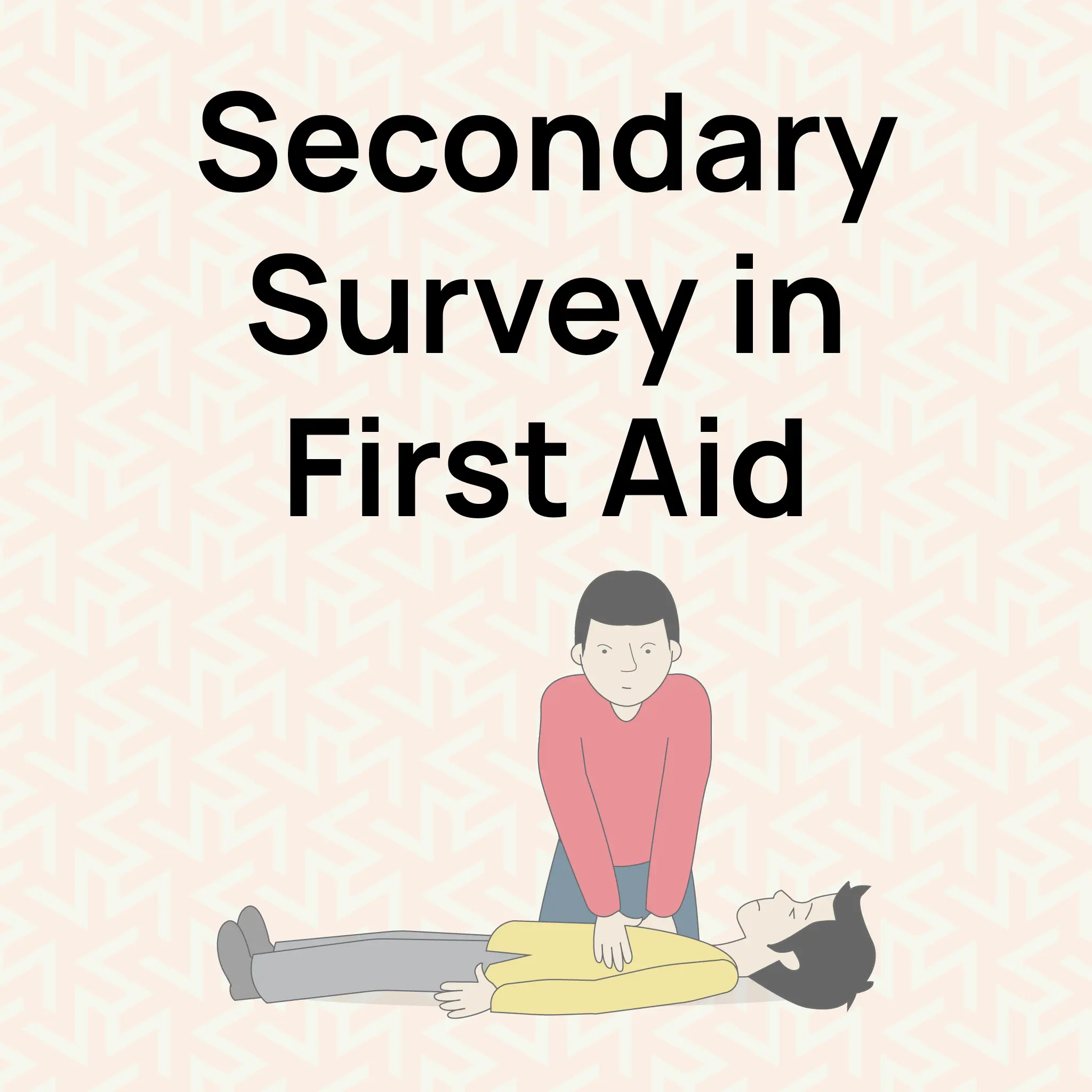
How To Conduct a Secondary Survey in First Aid
The secondary survey assesses the injuries of an awake, responsive person. It involves thoroughly examining the person's health history, assessing the four vital signs and conducting a systematic head-to-toe examination. If we discover any injuries, we administer first aid accordingly. Finally, we document all our actions and findings of the entire process. A secondary survey is performed after completing the primary steps of first aid (remembered as DRABC).What is the Difference Between a Primary and a Secondary Survey First, we always do a primary survey to quickly find and stop any life-threatening injuries. Once the person is more stable, we do a secondary survey. This is where we gather more information about what might have caused the person's injuries or illness. Primary Survey Secondary Survey� First examination Second examination� Assesses and stabilities a person in life threatening conditions� Diagnoses and treats major injuries after stabilisation�� Follows DRABC steps Follow AMPLE steps� Does not involves a head to toe examination� Involves a head to toe examination For responsive or unresponsive patients� Typically for responsive patients� Why Do We Perform the Secondary Survey in First AidIn a secondary survey, we look for injuries. We physically examine every part of the injured person's body from head to toe. We check the front, back, sides, underneath, and top. This survey includes looking at the airway again and checking the lungs again.When To Perform the Secondary Survey in First AidIf the person has more than one injuryIf it will take more than 20 minutes for medical help to arriveIf you're taking the person to get medical help .main{ border:3px solid #0f7c90; border-radius:20px; position: relative; font-family:roboto; font-weight: 400; color: #000; } .main-two{ position: absolute; top:-25px; left:45px; background-color:white; } .img-div{ border-radius : 100%; padding:2px 7px; background-color:#0f7c90; margin-right:5px; width: 50px; height: 50px; } .img{ width:30px; object-fit:contain; height:auto; border-radius : 100%; } @media only screen and (max-width: 600px) { .heading{ font-size:20px; } .img{ width:20px; object-fit:contain; height:auto; border-radius : 100%; } .img-div{ width: 40px; height: 40px; } .main-two{ left:25px; } } Ready to Learn More? Put your knowledge of the secondary survey into practice by enrolling in a course today! Our First Aid courses offer complete training to help you handle critical situations. Whether you want to improve your skills or workplace safety, these courses help build confidence and expertise. View our Emergency First Aid at Work (EFAW) and Level 3 First Aid at Work courses. These courses meet the UK legal requirements and help you keep people safe. How to Perform a Secondary Survey in First AidSAMPLE History TakingAsk questions to learn more about the person's medical background. Remember the word "SAMPLE" to help you remember what to ask:S stands for Symptoms: What the person feels, like pain or weakness.A stands for Allergy: Do they have any allergies? These could be to nuts or medicines like penicillin or aspirin.M is for Medication: Are they taking any medicines?P is for Previous medical history: Do they have any ongoing health conditions like diabetes or epilepsy? Have they had any surgeries or injuries before?L is for Last Meal: When did they last eat or drink?E is for Event history: What happened, and where did it happen? Was it because of an illness or an accident? Talk to anyone nearby to find out more, and look for any clues that could help understand what happened. Also, check if they have any special jewellery that might have medical information on it.Vital SignsCheck four critical things:Level of Consciousness: Are they awake and aware?Breathing: Are they breathing normally?Pulse: What's their heartbeat like?Skin Condition and Temperature: Is their skin normal, and are they warm enough?By conducting this secondary survey, we ensure that we've covered everything and helped the person in the best possible way.Check the Level of ConsciousnessChecking someone's level of consciousness (LOC) helps us understand how aware they are. We often use the letters AVPU to do this:A for Alert: If someone is alert, they're fully awake and can answer questions. They know who they are, where they are, and what time it is.V for Verbal: If they respond only when spoken to but aren't fully alert, they're in the verbal stage. They might seem confused and not know where they are or what's happening.P for Pain: If they only react when you give them a little pain, like pinching them, they're in the pain stage. They might move or make noises, but they cannot communicate appropriately.U for Unresponsive: If they're not reacting, even to pain, they're unresponsive. This is serious, and we need to act quickly to help them.Remember, another quick way to check is to look at their eyes, listen to what they say, and see if they can follow simple commands like squeezing your fingers.BreathingTo check someone's breathing, watch their chest rise and fall for 30 seconds. You can also gently place your hand on their stomach to feel it. Count how many breaths they take in that time, and then double it to know how many breaths they take per minute. Here's what's expected:For babies, breathing below 25 breaths is too slow, 30-50 is normal, and over 60 is too fast.For children: Below 15 is too slow, 20-30 is normal, and over 40 is too fast.For adults: Below 10 is too slow, 10-20 is normal, and over 30 is too fast. Normal Breathing Rated (no. of breaths)Infant30-50Child20-30Adult10-20�PulseYour pulse shows how often your heart beats in a minute. You can check it by feeling the person�s wrist, neck, or upper arm. Use two fingers and press gently until you feel the pulse. Count how many beats you feel in 30 seconds, then double it to get the beats per minute.Normal Pulse Rates:For babies: A normal pulse range is between 120 and 150 beats per minute.For children: It can vary between 80 and 150 beats per minute.For adults: The average pulse rate is usually between 60 and 100 beats per minute.Normal Pulse Rates (beats/min)Infant120-150Child80-50Adult60-100�Skin Condition and TemperatureWhen we check someone's skin, we're looking at a few things:Temperature: Is their skin warm or cold?Colour: Does their skin look normal or pale?Dryness: Is their skin dry or wet/sweaty?To check, gently feel their forehead and cheeks with your hand. If their skin is normal, it should feel warm and dry and be a regular colour. But if it's pale, cold, and sweaty, it could mean they're going into shock.Head-to-Toe ExaminationThis is a thorough check of the person's whole body for any injuries we might have missed earlier. Here's how to do it:Before you start, ask if they feel any pain and explain what you will do.Talk to them throughout, & watch their face for any signs of pain.Keep going, and even if you find something, make a note and continue.Be respectful and only expose areas you need to check.Look for any bumps, bruises, or anything unusual.If they're unconscious, look for any medical alert tags or jewellery.Always look before touching.Let's start at the head:Feel the skull for anything unusual.Check the ears for any fluid.Look at the eyes. Are the pupils the same size?Check the nose for any runny stuff.Look inside the mouth. Are the teeth okay? Are the lips a standard colour?Now, let's move to the neck:Check if the neck veins look big or bulging.See if they're wearing a necklace with medical info.Feel the collarbones.Check both shoulders.Now, onto the arms:Check each arm carefully.Squeeze each fingernail and see if the colour comes back quickly.Ask them to squeeze your fingers. Are they strong enough and equal on both sides?Next, let's look at the chest and underneath:Ask if it hurts when they breathe.Make sure the chest goes up and down as it should with each breath.Reach around to the back as far as you can.Let's check the tummy and underneath:Use your hands flat to feel the tummy gently.Don't press too hard. Just see if there's any pain, tenderness, or stiffness.Put your hand flat on their tummy and ask them to push against it. Does it hurt?Reach around to the back as far as you can.Now, let's look at the hips:Please put your hands on the hip bones and gently squeeze to check they're stable.Moving down to the legs, ankles, and feet:Check each leg one by one.See if one leg is shorter than the other.Check the kneecap and the area underneath carefully.Give a little pinch on the foot and ask if they felt it.Could you put your hands on their feet? Ask them to push and then pull against your hands. Are they equally strong on both sides? Ask them to wiggle their toes and see if they can do it.Check the circulation in their legs.Provide First-Aid for InjuriesOnce you've finished checking everything, it's time to give the right first aid for any injuries or illnesses you find. If the person has more than one injury, start with the most serious one.Pro Tip: Act quickly if you find serious injuries. Administer first aid immediately, even if you have not completed the survey. Keep the person's safety top priority.�DocumentationAfter you've given first aid, write down what you've found and what you've done. This information can help doctors or other medical staff who will care for the person later. It is important to know if the injury happened at work because it might need an investigation. You'll usually fill out forms provided for this purpose, and you should keep them as required by the rules in your area.First-Aid TrainingThe Emergency First Aid training course is designed for low-risk environments such as offices and small retail stores. It gives participants the fundamental knowledge and skills to manage emergencies in these settings effectively.On the other hand, First Aid Training at Work is one of the extensive first aid courses that meets the requirements specified in the Health and Safety Regulations (First Aid) 1981 and goes a step beyond the Emergency First Aid at Work (EFAW) course, qualifying you to work in high-risk workplaces. .banner { border-radius: 10px; overflow: hidden; border: 2px solid #ccc; box-shadow: 0 4px 8px rgba(0, 0, 0, 0.2); background-color: #fdf9ee; } .book-now { color: white; background-color: #DF3D52; border: none; padding: 15px 60px; border-radius: 5px; cursor: pointer; font-size: 20px; text-decoration: none; } .book-now:hover { /*text-decoration: none;*/ color: white; background-color: #c33f50; } Get Trained in All First-Aid Skills First Aid Courses Book Now Rated Excellent on major review sites FAQsWhat are the four vital signs for a secondary survey?The four vital signs of a secondary survey are checking the level of consciousness (LOC), breathing rate, pulse rate, skin condition and temperature.What does SAMPLE stand for in a secondary survey?SAMPLE stands for Symptom, Allergy, Medication, Previous medical record, Last meal and Events leading to the casualty. It is the order in which the history of the injured person is taken.What is the main aim of the secondary survey?The main aim of the secondary survey is to check for major injuries that might have been missed during the primary survey.What are the steps included in Emergency Scene Management?The steps included in ESM include scene survey, primary survey, secondary survey and ongoing casualty care.
The Importance of First Aid in Schools
Accidents and emergencies are bound to happen in a school's active environment, where children constantly learn, play, and grow. Having trained personnel and a structured first aid program can help maintain the safety and well-being of students and staff alike.Why First Aid Matters in SchoolsFirst aid is not just about addressing physical injuries; it includes a range of skills that can save lives. It helps prevent injuries from worsening and provides immediate care until professional help arrives. The importance of first aid in school includes the following:Immediate Response to AccidentsSchools carry out activities where accidents like cuts, falls, or burns can occur. Knowledge of first aid equips teachers and staff to respond promptly and appropriately.Life-Saving PotentialIn critical situations such as cardiac arrests, choking incidents, or severe allergic reactions, quick action through first aid techniques can help save lives.Promoting Safety AwarenessTeaching first aid creates a culture of safety awareness among students, encouraging them to take responsibility for their well-being and that of others.First Aid in School Policy as a Legal RequirementSchools are places where learning happens, but they must also be safe. When accidents or medical emergencies happen, having the right knowledge and tools for first aid can make a difference.Schools are legally required to ensure student safety. In the United Kingdom, laws require schools to have enough first aid supplies, medical staff, and training. But beyond laws, schools have a moral duty to keep students safe by being ready for medical emergencies.Under the Health and Safety (First Aid) Regulations 1981, first aid should always be available at schools and colleges. The availability applies on campus or during off-site activities like field trips. Regulations say employers must provide the right first aid equipment, facilities, and trained staff based on a first aid assessment. The basic first aid requirements for schools and colleges are:A suitable first aid kit is stocked according to the assessment, meeting minimum standards suggested by HSE.An appointed person or designated first aider(s) responsible for first aid.Information for staff about where to find equipment, facilities, and first aid personnel.How To Include First Aid in the School CurriculumTo ensure comprehensive coverage, schools can include first aid education into their curriculum through:Structured Training ProgramsFormal first aid courses are part of physical education or health classes.Simulation ExercisesConduct regular drills and simulations to practice emergency response scenarios.Continuous LearningProviding refresher courses and updates to keep skills current among staff and students. .banner { border-radius: 10px; overflow: hidden; border: 2px solid #ccc; box-shadow: 0 4px 8px rgba(0, 0, 0, 0.2); background-color: #fdf9ee; } .book-now { color: white; background-color: #DF3D52; border: none; padding: 15px 60px; border-radius: 5px; cursor: pointer; font-size: 20px; text-decoration: none; } .book-now:hover { /*text-decoration: none;*/ color: white; background-color: #c33f50; } Get Trained in All First-Aid Skills First Aid Courses Book Now Rated Excellent on major review sites What are the Types of First Aid Needed in SchoolsSchools should prepare for various types of first aid scenarios, including:Emergency First AidDealing with immediate, life-threatening situations such as cardiac arrest, severe bleeding, or unconsciousness.Basic First AidTreating minor injuries like cuts, bruises, sprains, and burns common among children during daily activities.Mental First AidAddressing emotional distress, anxiety, or panic attacks in students is increasingly recognised as essential alongside physical first aid.What Does First Aid Training in School Involve?First aid training in schools teaches students essential skills:calling emergency servicesassessing safetycommunicating with the injuredtreating cuts, bleeding, and burnsapplying bandagesassisting with fractures and CPRhandling head injuries, allergies, and nosebleedspreparing students to respond confidently in medical emergencies.The Department for Education made first aid training compulsory for students in England's state-funded schools in 2020. It is now part of children's health education and varies by age group. .main{ border:3px solid #0f7c90; border-radius:20px; position: relative; font-family:roboto; font-weight: 400; color: #000; } .main-two{ position: absolute; top:-25px; left:45px; background-color:white; } .img-div{ border-radius : 100%; padding:2px 7px; background-color:#0f7c90; margin-right:5px; width: 50px; height: 50px; } .img{ width:30px; object-fit:contain; height:auto; border-radius : 100%; } @media only screen and (max-width: 600px) { .heading{ font-size:20px; } .img{ width:20px; object-fit:contain; height:auto; border-radius : 100%; } .img-div{ width: 40px; height: 40px; } .main-two{ left:25px; } } Ready to Learn More? Put your knowledge of the importance of first aid in schools into practice by enrolling in a course today! Our First Aid courses offer complete training to help you handle critical situations. Whether you want to improve your skills or workplace safety, these courses help build confidence and expertise. View our Emergency First Aid at Work (EFAW) and Level 3 First Aid at Work courses. These courses meet the UK legal requirements and help you keep people safe. First Aid Learning for Primary School StudentsBasic first aid for common injuries, including head injuries.How to call emergency services.First Aid Learning for Secondary School StudentsBasic first aid for injuries and illnesses.Life-saving skills like CPR.How and when to use a defibrillator.What is the Importance of Mental Health First Aid at SchoolMental health first aid is like regular first aid but for mental health. It is often overlooked, but it is very important.Nowadays, young people struggle with mental health issues. School staff should know about mental health first aid and get trained.Studies show that 1 in 6 children aged 5-16 might have a mental health problem. And more than half of young� adults aged 16-25 have talked to their doctor about mental health issues.Mental health first aid teaches school staff how to spot signs that a young person might be having mental health problems. Staff must be able to notice these signs early and know how to help someone in a crisis. This training is especially important for staff in secondary schools.What should a School First Aid Kit Contain?A school first aid kit should contain everything needed for common accidents. It should include the following items:bandagesantiseptic wipesgauze for cuts and scrapessplintsice packsEpiPen for allergiessaline solution for washing wounds or eyesCPR face shieldsburn gelinhaler for anaphylactic shock.Checking and replacing items regularly keeps the kit ready for any emergency.Who can Administer First-Aid Training in Schools?First Aid Training in school is delivered by qualified people. Determining who should be responsible for first aid in schools is critical:Trained Personnel:Designated staff membersTeachersAdministratorsSchool NursesBefore delivering first aid training to pupils, they should undergo regular training and CPR certification.What are the Positive Impacts of First Aid in SchoolsAn effective first aid program in school has several benefits:Increased Safety: Immediate response reduces the severity of injuries and accidents, creating a safer school environment overall.Empowerment: Both staff and students feel empowered and confident in their ability to handle emergencies effectively.Community Engagement: Involving parents and the broader community in first aid workshops or training sessions leads to a collaborative approach to safety.What Qualifications are Required by a First Aider at School?First-aiders need to have specific qualifications:1. They must have a valid certificate in either:First aid at workEmergency first aid at workAny other suitable training based on what the school needs.It is a legal requirement for schools and early years providers that all staff have first-aid training. At least one person must have a current paediatric first-aid certificate. This person must be present whenever children are around and go on trips with them.ConclusionFirst aid is a life-saving practice. By prioritising first aid education and preparedness, schools improve safety and nurture a community where compassion and responsibility thrive. From physical injuries to mental health crises, the ability to respond promptly and effectively ensures that schools provide necessary protection and support. Introducing basic first aid skills into the curriculum empowers students to assist others and potentially save lives in emergencies.�
Differences Between Risk Control and Hazard Control
Identifying threats is one of the first tasks you must take when conducting a risk assessment. You can then evaluate the hazards after this. But how do hazards and risks differ from one another?Since the terms, risks and hazards are frequently used interchangeably, you are not alone in wondering what the distinction is.The two terms are synonymous. There is no risk if there is no hazard. But they differ, and comprehending those variations is crucial to risk analysis. Let�s examine the distinctions between hazards and risks and their relationships. What is a Hazard?Anything that has the potential to be harmful is a hazard. A risk can result in loss, harm, death, or other adverse outcomes.There are risks in almost every workplace, family, and setting. A material, piece of equipment, activity, working approach, or process could all be hazards. We are legally required to identify dangers at work when performing risk assessments.Let�s first define a risk before we examine the risk connected to this hazard. A forklift truck, for instance, could be a risk. Both individuals who use it and those who work close to it could be harmed by it.What is a Risk?A risk is a possibility that the hazard will cause harm to someone. A risk evaluates the likelihood and severity of a potential injury.The risk is evaluated based on the possibility of harm occurring and the severity of the injury. When these two criteria are taken into consideration, a risk may be large or low.The likelihood and severity are calculated to determine the risk level. When looking at how a risk assessment was conducted, you will frequently encounter a risk matrix, such as this:The degree of harm could be anything from minor, short-term damage to serious, permanently disabling injuries or death. The risk of harm from the danger can be anywhere between very rare to quite likely.Implementing Risk ControlGenerally speaking, there are six risk-controlling actions you can take:EliminateSubstituteIsolateEngineering controlsAdministrative controlsPersonal protective equipment (PPE)EliminationThe eradication of a hazard is not always possible, even though it will always be the best course of action. The risk of someone being exposed to a hazard is automatically eliminated if hazards can be removed entirely. An illustration of this would be the risk of lead poisoning that existed in the past for people working at gas stations and other occupations that required frequent contact with petroleum. Two initiatives�the self-service gas pump and the removal of lead from petroleum�have eliminated that risk.Substitution of the Hazard with Lesser RiskWhile replacing the risk may not eliminate all of the dangers connected to a given process or activity and may even introduce new risks, doing so should nevertheless lessen the overall risk of injury or adverse health impacts. For instance, painting a house�s gable end would need you to work at the top of a ladder while someone else supported the ladder below you. Scaffolding might be used in place of a ladder. While the sturdier platform wouldn�t remove the risk of falling, it would make working conditions much safer.Isolation of the HazardWhen isolating a hazard, this can be done by limiting access to plant and/or equipment, or in the case of poisonous or explosive materials, by putting them away in a safe container and doing so under stringent supervision. While installing noisy equipment in an inaccessible enclosure or room isolates the hazard from people, a fume cabinet can isolate the risk from people nearby if you�re utilising specific chemicals (s). The appropriate and secure storing of fireworks during a display is a prime illustration of this.Engineering ControlsThe term �engineering� here can be slightly misleading as we are not discussing mechanical or electrical engineering. What is meant by the use of the word �engineering� is as an alternative to the words� devising�, �designing� or �redesigning� a process to place a barrier between the person(s) and a hazard or removing the hazard entirely from the person�s vicinity, such as machinery guarding, proximity guarding, extraction systems or removing the operator to a remote location away from the hazard.Administrative ControlsWhen discussing administrative controls, we refer to how things are carried out and how individuals collaborate to finish a task. To reduce any risk of injury and/or adverse health impacts, administrative controls include implementing standard operating procedures, safe work practices, and/or providing adequate and sufficient training, teaching, or information (s).Personal Protective EquipmentGloves, glasses, earmuffs, aprons, safety shoes, and dust masks are a few examples of personal protection equipment (PPE), all intended to reduce exposure to specific risks. PPE is typically employed in conjunction with one or more of the other control measures discussed above and is typically considered the last line of defence. It is well known that single-use dust masks cannot consistently produce and maintain an effective seal around the nose and mouth, which can cause a harmful false sense of security and, as a result, an increased risk. This is an example of the ineffectiveness of this control strategy. When this is the case, a dust extraction system with fitting air respirators may be preferred, especially if utilising chemicals containing isocyanate poses a risk of severe health impacts even at extremely low exposure levels.Difference Between Hazard and RiskA risk can take many forms because danger may be harmful in various ways. For our example of a hazard, we employed a forklift. The operation of a forklift truck has the potential to cause harm in several ways, including:Contact with pedestriansOverturningContact with other vehicles or machinesDropping the loadUnauthorised useBy putting management practises in place, the risk can be reduced. Keep in mind that likelihood and severity determine the danger. To ensure that even if an employee was exposed, the amount would be so little that the consequences would be minimal, the severity may be decreased, for instance, by only permitting a very small amount of the material to be obtained. By establishing ventilation and exclusion zones, mandating the use of personal respiratory equipment, and enforcing these measures, the chance of dangerous exposure could also be decreased.To ensure that something with the potential to cause harm (the hazard) cannot actually cause harm or that the harm is minimised, a combination of control measures can drastically lower the risk level (the risk). A work may frequently be labelled as high risk when it is actually high hazard. A task or activity need not be high risk just because it entails risks. Hazardous work can be made safe if each risk is managed so that the activity may be completed without incident. The risk is still present, but it is under control.At Hurak, we specialise in offering online courses that cover a wide range of workplace health and safety topics. Feel free to contact us if you have any questions or want more information on any of these.
Health and Safety Officer: Key Roles and Responsibilities
Promoting health and safety in the workplace is crucial, given the predicted 38.8 million working days lost due to work-related illness in 2019�20.Health and safety officers assist their business in ensuring the workplace is safe and secure for their employees by working to prevent accidents, injuries, and any illnesses related to the workplace. This position is focused on controlling risks in addition to the obligation of the business and employees to protect health and safety at work.In this post, we look at how to become a health and safety officer and offer advice on the duties and obligations required, as well as suggestions to get you started. We also consider which laws should be followed while implementing policies and procedures so that you may make judgments that will ensure everyone�s safety.With our approved Health and Safety training courses, you can learn about common workplace dangers and find out how to keep everyone safe. These programmes are meant to provide you the knowledge you need to identify potential risks in your company.Health and Safety OfficerAs a health and safety officer, a qualified individual oversees and controls the organisation�s adherence to health and safety regulations. By ensuring that accident prevention and the proper health and safety procedures are followed at all times, you continuously promote safety awareness as a health and safety officer.Any organisation that wants to avoid avoidable accidents or injuries must maintain constant monitoring. Health and safety officers must be knowledgeable about the Health & Safety at Work Act of 1974 and other pertinent health and safety laws. They should know their general responsibilities, applicable laws and codes of conduct, enforcement methods, ways to access and disclose information, and requirements.A Health and Safety Officer plays a crucial role in mitigating construction claims by implementing proactive safety measures and ensuring strict adherence to regulatory guidelines. Their responsibilities include conducting thorough site inspections, identifying potential hazards, and fostering a culture of safety to minimize the risk of incidents that could lead to construction claims.They will be responsible for maintaining safety data, developing new practices, and bolstering current regulations in this capacity. Health and safety officers are crucial to keep workers safe and promote a more effective and productive workplace.Becoming familiar with current legislation may ensure a consistently safe workplace environment. Being a health and safety officer is a fulfilling career, whether you work in an office, school or even on a construction site.As a health and safety officer, you can focus on a particular subject, like first aid or fire safety, or you might decide to offer advice on all safety-related matters. Regardless of your path, you will be accountable for helping your business uphold a high health and safety standard and ensure that employees� welfare and well-being are always protected.Health and Safety Officer: Roles and ResponsibilitiesThe primary duty of a health and safety officer is to ensure everyone�s safety at all times. To do this, they will be responsible for a variety of tasks. Regarding safeguarding employees employed by the company and anybody else its operations might impact, there are specific obligations that the organisation must respect (e.g. members of the public). To assist their employer in maintaining the continued efficacy of the control measures put in place by the competent person, officers should be aware of their tasks and obligations (who may be the employer, the health and safety officer, or someone else).Health and safety officers frequently concentrate on examining workplace locations to guarantee adherence to pertinent legislation. It is part of their responsibility to get familiar with typical workplace dangers and to know how to deal with them if they become risks. In complex healthcare environments, this operational safety function is often overseen at a strategic level by a�Medical Directorship, which holds ultimate responsibility for clinical governance and patient safety protocols. Making decisions on creating and promoting successful policies can be aided by this foundational knowledge.Generally speaking, health and safety officers may be in charge of:Monitoring and evaluating dangerous or harmful situations.Drafting health and safety regulations that are specific to the tasks at hand.Putting health and safety measures into action.Doing risk analyses.Checking the electrical apparatus.Examining previous mishaps to determine what went wrong and how to avoid it.Keeping in touch with employees who cannot work due to illness or injury.Distributing pertinent information about preventing accidents.Assisting staff and setting up training as required.Communicating about provisions, such as first aid supplies, with the first aider and/or designated person.Taking current health and safety training to stay knowledgeable.Officers in charge of health and safety are in charge of implementing plans that follow the plan, do, check, and act method.PlanDoCheckActNo matter where you work, by following these four measures, you can guarantee that health and safety are always maintained efficiently.Your primary duty as a health and safety officer is to maintain everyone�s health and safety. However, keep in mind that it is the employer�s responsibility to establish this work environment, and it is your responsibility to assist them.Every employee has a right to work in a setting where risks to their health and safety are appropriately managed, and they will be in good physical and mental health. Workers have a responsibility to protect their health and safety as well as the health and safety of others, even though it is the health and safety officer�s role to assist in maintaining these measures. They must always follow all directions and their training and collaborate with everyone they work with, including their employers. They must speak with their health and safety officer immediately if they have any specific questions or concerns about health and safety at work. By taking these steps, you can guarantee that the workplace is always safe and healthy.Your health and safety officer duties may change depending on the setting you choose to work in. For instance, compared to individuals who work in education, healthcare, or an office, a health and safety officer on a construction site will have different duties.Health and Safety as a CareerAccidents do occur, regardless of the field you choose to work in or the workplace environment. As a health and safety officer, you will have the chance to collaborate with staff members to reduce risks and foster a pleasant work environment. In light of this, if you enjoy helping people, working as a health and safety officer could be immensely rewarding.Not only do you have the opportunity to save lives, but you also have the freedom to work in various industries for organisations of all shapes and sizes and travel the globe. You may benefit while fostering a strong culture of health and safety in your company if you have the necessary knowledge and abilities. If so, you must be familiar with the pertinent rules and regulations of the nation where the business is located.For instance, encouraging good health and safety in a school is significant to many individuals, including students, instructors, governors, and parents. A health and safety officer�s responsibility is to serve as the centre of the school�s health and safety management plans.A health and safety officer has a lot of duties to do. All environments can become safer, more productive places to work by promoting employee well-being and controlling workplace risks. Whether you want to work as an internal team member, on your own, or for a more prominent organisation, a health and safety officer is vital. Anyone with the necessary skills and skill set can work effectively as a health and safety officer.