
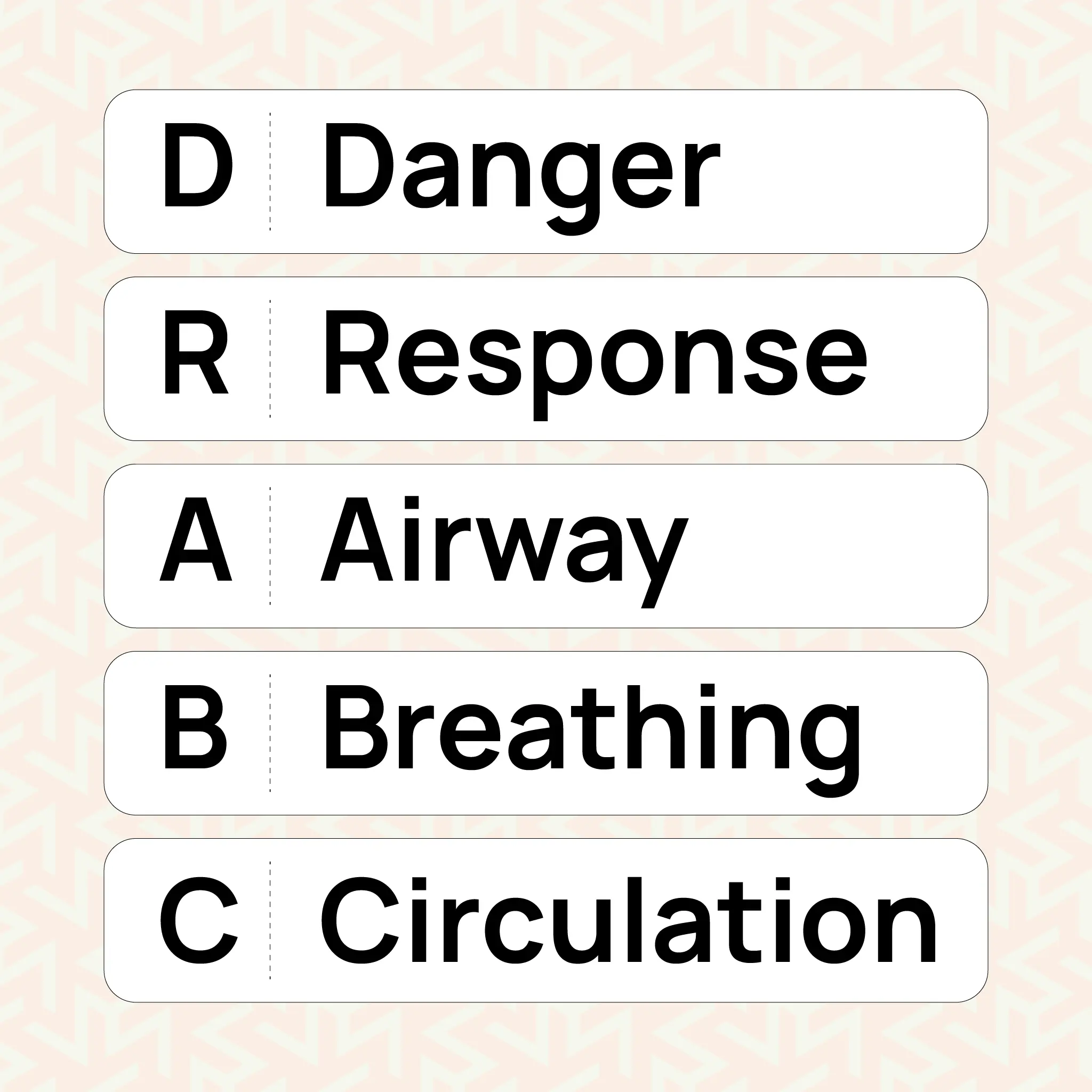
How To Perform the Primary Survey Using the DRABC Steps
When someone is unconscious, their life is in danger. Their airway might be blocked, they may not be breathing, and their blood circulation could have stopped. It is important to follow the primary survey steps to assess casualties in the order of DRABC: Danger, Response, Airway, Breathing, and Circulation. Remember to take quick action because brain damage or even death can happen quickly. A secondary survey is performed after completing the primary steps of first aid.Primary Survey in First Aid Using DRABCWhen helping someone in an emergency, you always start with the primary survey. This means you quickly assess what is happening and the person's needs.The primary survey uses the letters DRABC to help you remember the steps: Danger, Response, Airway, Breathing and Circulation.D - Danger: First, you check for danger around you, such as oncoming traffic or a falling object.R - Response: Next, see if the person responds. Gently shake their shoulders when you talk to them. Are they awake or unconscious?A - Airway: Then, make sure their airway is clear. That means checking if anything is blocking their breathing passage.B - Breathing: After that, check if they're breathing normally. Look, listen, and feel for any signs of breathing.C - Circulation: Finally, check for signs of circulation, like a pulse. This tells you if their heart is beating.Knowing what to do next could help save someone's life, so it's important to follow these steps in the correct order.DRABC StepsDANGER - 1st Step of the Primary Survey DRABCThe first thing to do in an emergency is to check for dangers. Look around to see if anything could harm you, the person needing help, or anyone nearby. This helps you decide if it's safe to go close to someone who needs help.WHAT TO DOIf you see any hazards, like live electricity, try to make the area safe first. For example, if there's electricity, turn it off. Otherwise, use an insulating object, such as wood or plastic, to move the person away. When there is a risk of electricity, do not touch them directly.When you are sure it is safe, you can approach the person who needs assistance. But if it's still not secure, don't go near them. Instead, get emergency medical helpRESPONSE - 2nd Step of the Primary Survey DRABCA person can lose consciousness when something disrupts the brain's normal functioning. Here are some signs that someone might be unconscious:They can't respond to simple questions or touch.They might not realise when they're in danger and can't protect themselves.They can't clear their airways by coughing or swallowing. This means saliva, blood, vomit, or objects could block their breathing tubes. The tongue, which becomes floppy, might also fall back and block the throat.WHAT TO DOFirst, try to determine whether the person is unconscious by asking simple questions or telling them to do something simple, such as "What's your name?" or "Open your eyes," and gently shake them. If they don't respond, they're probably unconscious. Don't shake them vigorously, especially if they're children or babies.Place the individual in the side position, and examine his airway, breathing and pulse.If the unconscious person is breathing and has a pulse, keep them in the side position. Ensure their airway remains open and clear, and monitor their breathing and pulse regularly until medical assistance arrives.�How to Keep the Unconscious Person in a Side PositionThis is also called the lateral, recovery, or stable side position.Kneel beside the person.Straighten their far arm out, perpendicular to their body. Bend their near arm at the elbow and place it across their chest, with the fingers near the far shoulder.Bend their near leg up to the right angle of their body.Hold the shoulder and hip closest to you, gently rolling them onto their side. Their top leg should rest on the ground with the thigh at a right angle and the calf parallel to the straight leg.Rest their uppermost, bent arm on the elbow of the straight arm.the person is a child older than 1 year, gently tilt their head back. Their face should be slightly downwards so any fluid can drain from their mouth, and their tongue can fall forward, away from the airway.Pro Tip:When someone is unconscious, act fast. Use DRABC: Danger, Response, Airway, Breathing, Circulation. Brain damage or death can happen quickly if you delay.AIRWAY - 3rd Step of the Primary Survey DRABCNow, ensure the person's airway is clear. If they're unconscious:Gently tilt their head back and lift their chin with your hand on their forehead.Peep in their mouth to check whether something is obstructing their passageway.What to Do: If the person is responsiveCheck whether anything is obstructing their airway and causing difficulty breathing.If you see something, encourage them to clear it by coughing or using their hands.For adults and kids, you can help them by giving back slaps or abdominal thrusts. For babies under a year old, you can help them with back blows or chest thrusts.Once the blockage is cleared, move on to the next step.What To Do: If the person is responsiveCheck whether anything is obstructing their airway and causing difficulty breathing.If you see something, encourage them to clear it by coughing or using their hands.For adults and kids, you can help them by giving back slaps or abdominal thrusts. For babies under a year old, you can help them with back blows or chest thrusts.Once the blockage is cleared, move on to the next step.What To Do: If the person is unresponsiveIf you see something, try to remove it carefully. But don't put your fingers in their mouth if you can't see anything, as you might push a blockage deeper.BREATHING - 4th Step of the Primary Survey DRABCBreathing should be regular, quiet, and easy. Tilt the head back, watch the chest for movement, and listen for breathing sounds. Do this for about ten seconds to see if air comes from the mouth or nose.WHAT TO DOIf they're unresponsive and not breathing normally, call emergency services immediately. If you know CPR, start with rescue breaths. If not, do chest compressions. If there's an AED nearby, ask someone to bring it.Giving Rescue BreathsMouth-to-mouth resuscitation is the best way to give rescue breaths. Mouth-to-nose resuscitation is used for a jaw injury or if the person needs to be revived in water. Mouth-to-mask resuscitation is done by trained people to avoid direct contact, especially if the person might have a disease like hepatitis or HIV.Typically, 30 compressions followed by 2 rescue breaths are performed in case of abnormal breathing.Mouth-Mouth ResuscitationKneel beside the person.Lay them on their back.Gently tilt their head back and support their jaw with your fingers. Don't press on their throat. Their mouth should be slightly open.Pinch their nose closed. Take a deep breath and cover their mouth with yours, sealing gaps.Keep their head tilted and give 2 breaths, enough to make their chest rise slightly.Start compressions as recommended.When they start breathing again, please put them in the side position and check their airway, breathing, and pulse regularly.Follow similar steps for mouth-to-nose and mouth-to-mask resuscitation but adjust for the different techniques.CIRCULATION - 5th Step of the Primary Survey DRABCIn this step, check the person for any significant bleeding.What To DoIf they're bleeding heavily, try to stop it by pressing directly on the wound with a clean cloth or dressing. Then, call emergency services for help.Stay with them until help arrives. Try to keep them calm and reassure them that help is coming. If they're not bleeding but still unresponsive, put them in the recovery position. This helps keep their airway clear if they vomit.Cardiopulmonary Resuscitation (CPR)If someone's heart has stopped, CPR is vital to keep them alive until help arrives. CPR is exhausting, so it's best if two people can take turns to keep the rhythm right. Remember, even if you're not trained, attempting CPR is better than doing nothing.What To Remember During an EmergencyPlease don't go near the person unless it's safe. Check for danger to yourself, others, and the injured person first.Stay as calm as possible, even though you might feel upset, and try to reassure the injured person.Time is significant.Don't move the person unless you have to for safety reasons.Please don't leave them alone. Get someone to call for medical help straight away. But if you're alone and help won't come soon, you'll need to go for help yourself. Call 999 or the emergency number in your area.Keep messages to the emergency services short: say where you are, what's happened, how many people are involved, and how badly they're hurt.Please don't give them anything to eat or drink.First-Aid TrainingThe Emergency First Aid training course is designed for low-risk environments such as offices and small retail stores. It gives participants the fundamental knowledge and skills to effectively manage emergencies in these settings.Get Trained in All First-Aid SkillsFirst Aid CoursesBook NowRated Excellenton major review sitesFAQsWhat does DRABC stand for in first aid?DRABC in the first-aid primary survey stands for Danger, Response, Airway, Breathing and Circulation.Should you carry out a primary survey on every casualty?Use a primary survey and apply the DRABC steps whenever you witness a casualty, such as an accident or a fall, provided it is safe to approach the injured person.What is the purpose of the primary survey?The purpose of the primary survey is to treat life-threatening casualties quickly. These accidents could include airway blockage, breathing difficulties, shock or a brain injury.How can you assess the responsiveness of a casualty?First, check if the person is unconscious by asking simple questions and gently shaking them. If they don't respond, they're likely unconscious. Avoid shaking them vigorously, especially if they're children or babies. Next, put the person in the side position and check their airway, breathing, and pulse.How many compressions must be performed in case of abnormal breathing?Typically, 30 compressions followed by 2 rescue breaths are performed in case of abnormal breathing.


Which First Aid training qualification should you choose
First aid training teaches employers and employees the skills to handle emergencies professionally. Selecting the right course depends on understanding your organisation�s specific needs, including the type of work, the level of risk (high or low), the number of employees, and the workplace size.How many First Aiders are Required for a WorkplaceThe Health and Safety Executive (HSE) provides the following recommendations:Low-risk workplaces (e.g., offices) with 25 to 50 employees: At least one person should be trained in Emergency First Aid at Work (EFAW).Low-risk workplaces with more than 50 employees: One person trained in First Aid at Work (FAW) is required for every 100 staff members.High-risk workplaces (e.g., construction sites or factories): Due to the increased likelihood of serious incidents, additional training and a greater number of first aiders are required.Providing first aid training is not only a legal obligation for employers in the UK but also an ethical one. Having trained staff can save lives, reduce workplace injuries, and create a safer working environmentWho is a First-Aider? A first aider is trained to help sick or injured people until professional medical help arrives. In emergencies, first aiders are often the first to respond, ensuring the safety and calmness of those involved until further help arrives. Anyone can become a first aider by learning these skills, making it a valuable way to contribute to the safety of their workplace or community.What are the Levels of First-Aid TrainingQualified first aiders undergo one of two main types of training; FAW and EFAW training. EFAW stand for Emergency First Aid at Work course and is for lower-risk workplaces like offices or retail shops.This one-day training covers basic CPR, managing bleeding and wounds, treating minor injuries, and handling choking incidents or other emergencies. Upon completion, participants receive a certificate valid for three years.The First Aid at Work qualification, or FAW course, is more detailed for higher-risk workplaces. This three-day training includes everything in EFAW, along with additional topics such as managing seizures, heart attacks, diabetic emergencies, and severe allergic reactions. FAW certification is also valid for three years.Health and safety regulations may not require a trained first aider in smaller businesses. Instead, a responsible person can be appointed to oversee first aid. While formal training isn�t compulsory for these roles, many take a Basic First Aid course to handle minor emergencies confidently. First aiders, regardless of their training level, play an important role in ensuring safety and providing immediate care during emergencies. .main{ border:3px solid #0f7c90; border-radius:20px; position: relative; font-family:roboto; font-weight: 400; color: #000; } .main-two{ position: absolute; top:-25px; left:45px; background-color:white; } .img-div{ border-radius : 100%; padding:2px 7px; background-color:#0f7c90; margin-right:5px; width: 50px; height: 50px; } .img{ width:30px; object-fit:contain; height:auto; border-radius : 100%; } @media only screen and (max-width: 600px) { .heading{ font-size:20px; } .img{ width:20px; object-fit:contain; height:auto; border-radius : 100%; } .img-div{ width: 40px; height: 40px; } .main-two{ left:25px; } } Ready to Learn More? Check which course is right for you by visiting Our First Aid courses offer complete training to help you handle critical situations. Whether you want to improve your skills or workplace safety, these courses help build confidence and expertise. View our Emergency First Aid at Work (EFAW) and Level 3 First Aid at Work courses. These courses meet the UK legal requirements and help you keep people safe. What is the Difference between EFAW and FAWEmergency First Aid at Work (EFAW) and First Aid at Work (FAW) are two levels of first aid training courses required for workplaces in the UK. Both courses provide employees with the skills and knowledge to handle workplace injuries and medical emergencies. However, there are key differences in the content and requirements of each course.FeatureEFAW (Emergency First Aid at Work)FAW (First Aid at Work)Duration1 day�3 days�Suitability�Low-risk workplaces with 25-50 workersHigh-risk workplaces or larger businesses with >50 workersTopics CoveredCPR, wound care, managing unconscious casualties, choking, bleeding, and shockAll EFAW topics plus fractures, burns, medical conditions, and advanced first aidLevel of TrainingLow-level basic first-aid training�High-level advanced first-aid trainingCertificationEmergency First Aider certificationFirst Aider certificationWhat Qualifications Does a First Aider Need in SchoolsIn schools, first aid requirements are specific to the unique needs of children. Schools and early years providers must ensure that staff are trained in first aid, and at least one person must hold a current Paediatric First Aid (PFA) certificate. This qualified individual must be present whenever children are on the premises or participating in school trips.This requirement ensures that schools are prepared to handle emergencies specific to children, such as choking or playground injuries.How Long Does a First Aid Course LastFirst-aiders should complete refresher training every three years to maintain their certification and skills. Regular refresher courses are important for several reasons:Maintaining Skills: First aid techniques can be forgotten over time. Refresher courses help first-aiders stay confident and effective in emergencies.Staying Updated: First aid guidelines and legal requirements can change. Refresher training ensures first aiders are up-to-date with the latest procedures and standards.By keeping training current, first-aiders can continue to perform their roles and meet legal requirements.Who should take up the Mental Health First Aid CourseMental Health First Aid (MHFA) is a level 2 first aid course for anyone who wants to learn how to help people struggling with mental health issues. It�s useful for those who work with others or in environments where mental health challenges might arise.Mental Health First Aid is useful for managers, HR professionals, teachers, healthcare workers, community leaders, and anyone interested in mental health. It helps people recognise mental health problems and provides the right support until professional help can be reached. .main{ border:3px solid #0f7c90; border-radius:20px; position: relative; font-family:roboto; font-weight: 400; color: #000; } .main-two{ position: absolute; top:-25px; left:45px; background-color:white; } .img-div{ border-radius : 100%; padding:2px 7px; background-color:#0f7c90; margin-right:5px; width: 50px; height: 50px; } .img{ width:30px; object-fit:contain; height:auto; border-radius : 100%; } @media only screen and (max-width: 600px) { .heading{ font-size:20px; } .img{ width:20px; object-fit:contain; height:auto; border-radius : 100%; } .img-div{ width: 40px; height: 40px; } .main-two{ left:25px; } } Check which course is right for you by visiting our First Aid courses that offer complete training to help you handle critical situations. Whether you want to improve your skills or workplace safety, these courses help build confidence and expertise. View our Emergency First Aid at Work (EFAW) and Level 3 First Aid at Work courses. These courses meet the UK legal requirements and help you keep people safe. FAQsWhat is the best first aid course for my workplace?The right first aid course depends on the type of work, the level of risk (high or low), the number of employees, and the workplace size. Low-risk workplaces may need an Emergency First Aid at Work (EFAW) course, while high-risk workplaces may require more detailed training like First Aid at Work (FAW).How many first-aiders do I need in my workplace?According to the HSE, workplaces with 25 to 50 employees in low-risk environments should have at least one trained first aider. For workplaces with more than 50 employees, one first aider should be trained for every 100 staff members. High-risk workplaces will need more first-aiders due to the greater potential for serious incidents.What is the role of a first aider?A first aider is trained to help sick or injured individuals until professional medical help arrives. They are often the first to respond in emergencies, ensuring safety and calmness until further help is available.What are the different types of first aid training available?The two main courses are Emergency First Aid at Work (EFAW), a one-day course for low-risk workplaces, and First Aid at Work (FAW), a three-day course for higher-risk environments. Both certifications are valid for three years.What does EFAW stand for?EFAW stands for Emergency First-Aid at Work.What does FAW stand for?FAW stands for First-Aid at Work.What qualifications do first aiders need in schools?Schools must have staff trained in Paediatric First Aid to handle child-specific emergencies, such as choking or injuries on the playground. At least one qualified individual with a Paediatric First Aid certificate must be present when children are at school or on trips.How often do first aiders need refresher training?First-aiders should complete refresher training every three years to maintain their certification and stay updated on new first-aid guidelines and legal requirements.Who should take a Mental Health First Aid course?The Mental Health First Aid (MHFA) course is ideal for anyone who wants to learn how to support individuals experiencing mental health challenges. It's useful for managers, HR professionals, teachers, healthcare workers, community leaders, and anyone working in environments where mental health issues might arise.ConclusionChoosing the right first aid qualification depends on your workplace's needs, risks, and size. Whether a basic Emergency First Aid at Work course is needed for a low-risk environment or a more detailed one for higher-risk settings, having trained staff can save lives and ensure a safer environment. In schools, Paediatric First Aid is necessary to handle emergencies involving children, while Mental Health First Aid courses are ideal for those wanting to support others with mental health issues. Regular refresher training helps keep skills up to date, ensuring first aiders are always ready to act in an emergency. No matter your role, first aid training is an important investment in both safety and well-being, providing skills that can make a difference when it matters most.
Challenges Faced by Managers on Construction Sites
AnalysisTaking charge of a building project is no easy task. A construction project might run into a lot of difficulties. Project managers face numerous difficulties because of the project�s broad scope, many participants, and inherent hazards. It is the responsibility of project managers to maintain a site�s efficiency, safety, timeliness, and budget. This request can be very challenging at times. Here are a few challenges project managers regularly deal with in the building industry.One survey claims that 77% of construction projects have severe delays and that 98% of projects come in over budget.Shortage of Skilled LabourDespite advancements in technology, manual labour still dominates the construction sector. However, several factors are exerting pressure on construction firms as they try to recruit competent labour. These are most frequently:As workers retire, the ageing workforce depletes the sector�s present skills.Younger generations don�t find the construction industry to be particularly appealing. Brexit is making it more difficult for construction companies to hire people from the EU.City & Guilds reported in 2018 to Open Access Government that 87% of firms in the UK construction sector were having trouble obtaining skilled workers for construction employment.The shortage of skilled labour can be resolved if labourers enrol in CSCS Green Card (Labourers Card) Course, which is the first step towards getting your CSCS Labourers Card. It serves as evidence that the worker in possession of it is aware of the health and safety risks and hazards prevalent at a construction site.Lack of Well-Defined GoalsPoorly stated project objectives are one of the first difficulties that project managers encounter in the construction industry. Project managers� primary objective is to see a project through to completion; however, fulfilling this goal can be challenging. Every project has inherent constraints that make it distinct when creating goals for the timetable, work distribution, and final delivery. Multiple people may be involved in a single construction project, and their lack of coordination will result from a lack of a defined purpose.This problem is simple to solve. To ensure everyone is on the same page, project managers should exercise due diligence and ask the customers and contractors the necessary questions.Budget LimitationsThe management of funds is a challenge for projects in the construction industry, just like it is for any other project. It can be simple to go over the authorised budget due to the size of building projects and the time it takes to accomplish them.You can overcome this project management difficulty by lowering stakeholder expectations. Project managers should ensure that deliverables are correctly recognised to have accurate cost estimates. The budget should also account for circumstances beyond the project manager�s control, such as issues with the supply chain, labour shortages, and, more recently, the possibility that the COVID-19 epidemic will have an adverse effect on the operations of numerous project partners. The budget should constantly be reviewed, but more so if there are change orders or scope creep because those things might cause costs to spiral out of hand.Minimising DelaysDealing with time restrictions is one of the major difficulties project managers in the construction industry encounter. Delays brought on by incomplete work, scheduling difficulties, and workplace accidents can snowball into additional delays and costs.Unfortunately, construction projects include a lot of risk and uncertainty, making delays unavoidable. Project managers should set up processes for project scheduling and tracking to ensure everything is moving forward. Project managers can also spot flaws, errors, and workflow problems that could cause delays by watching the job through construction cameras.Unreasonable RequestsSpeaking about managing expectations, many project managers in the construction industry occasionally have to deal with unreasonable timelines and demands from clients and stakeholders. Even though this is not as serious of an issue as project delays and cost overruns, it nevertheless impacts a construction team�s productivity and morale. Construction is a highly competitive market; thus, it is a sense that stakeholders would defend their commercial interests.However, project managers should use their communication abilities to control their superiors� expectations and provide feedback when they believe a client�s request is unreasonable. They ought to be able to adequately justify why and offer more logical options that everyone can accept.Time ManagementMany stakeholders believe that one of the major problems that contribute to poor designs, high accident rates, and income loss is time restrictions. Contractors may cut corners to make up for missed deadlines and scheduling issues. This might further snowball into greater delays and higher costs as they try to uncover and remedy flaws or risk contractual penalties.Due to these factors, building project managers must address various delay-causing factors and create procedures that guarantee that requirements are always satisfied. Tracking suppliers and subcontractors allow you to account for lead times, labour, and paperwork, and using an effective time tracking system can help ensure every task stays on schedule. Additionally, unforeseen events like weather changes should be taken into account. Project scheduling and tracking techniques can address all of these time management challenges.Project managers� difficulties differ depending on the type of building project. They do; however, they all share a characteristic. To achieve successful delivery, all of these tasks necessitate tactical knowledge, strategic insight, and effective communication on the side of project managers.

Differences between a Banksman and Slinger Signaller
Who is a Banksman?A banksman, also known as a traffic marshal, directs and supervises vehicles like excavators, bulldozers, cranes, and dump trucks used on construction sites to carry personnel and building materials. Modern sites may use software for dump trucks to help banksmen monitor movement and improve efficiency. Marshals ensure the safe guidance of the vehicles and the people as it drives around the building site.On a construction site, a banksman works with plant operators and vehicle drivers to design safe traffic arrangements, communicate correctly to guide vehicle movement and manage traffic flow. The banksman should be aware of the hazards and risks associated with on-site cars and conduct their tasks to minimise risk.To get a comprehensive overview of banksman, read our blog.Who is a Slinger Signaller?A slinger signaller is a specific type of banksman. A slinger signaller�s main job is supervising and directing crane operators� instructions during lifting operations. Their job entails working with the lifting team and crane operators.A crane operator has a limited view of what is happening on the ground when seated in the cab. The slinger signaller provides clear instructions in the form of prescribed hand signals to assist them in safely lifting, moving, and setting down the crane�s load.SimilaritiesBoth banksman and slinger signaller must be aware of the risks and hazards in lifting operations.They tend to the people and equipment and make the site safer by minimising risks.They communicate using hand signals and radio equipment as instructed in Health and Safety (Signs and Signals) Regulations 1996.Both of them direct crane operations.The uniforms they wear are the same.DifferencesA banksman directs traffic and vehicles around a workplace.A signaller works in the lifting department only.Production of modular buildings is also a part of a slinger�s job description.How to become a Signaller?Enrol and complete Hurak�s Traffic Banksman course.Pass the multiple-choice question exam at the end of the course.Receive a 3-year valid certificate and ID card after passing the exam..How to become a Signaller?1. Must have accomplished the Health, Safety and Environment (HSE) exam for Operators within two years of enrolling for an accredited Slinger Signaller course.2. Enrol and complete an accredited training course on Slinger Signaller. The two most popular and demanded courses are:Construction Plant Competence Scheme (CPCS)National Plant Operator Registration Scheme (NPORS)Offers accredited training courseOffers accredited training courseWidely recognisedBecoming an alternative to CPCSExpensiveCost EffectiveIt takes a longer duration to completeCompletes within ten daysCertified centresFlexible learning3. Apply for a Red Trained Operator Card.
A Workplace Guide for Traffic Banksmen
�Crane lifts, traffic management, traffic flow, and directing vehicular operations are just a few of the operations that a traffic banksman, also known as traffic marshal, is crucial in making sure happen safely on the job site. The functions and responsibilities of the banksmen, their role in safeguarding the health and safety of people present, and the various duties and work environment they employ will all be covered in as a workplace guide for Traffic Banksman.Job Description of a Traffic BanksmanDirecting Vehicle MovementA traffic banksman is responsible for controlling traffic and ensuring accidents don�t occur at the work sites. They aid operators and drivers in their manoeuvres with hand gestures and communication tools. For instance, they can signal a vehicle to stop and move just in time when they reverse or make a turn. By monitoring their movements on the main road, banksmen direct cranes and trucks onto the site and ensure that heavy vehicles leave the area safely.Managing TrafficTraffic marshals manage the flow of traffic within a workspace as a banksman. They direct the drivers to the truck parking areas on the site. The traffic control system should ensure no other trucks are blocking the entries or exits. Additionally, large vehicles should have enough room to leave the site or travel to the loading zones. The roadways must be designed and laid out for particular vehicles to ensure efficient operation.Identifying Unsafe AreasA banksman should be aware of potential accident-causing difficulty spots in construction zones. To prevent damage to cars or equipment during manoeuvres, they also clear away impediments and clutter from the routes.Taking Care of Signalling EquipmentA traffic banksman should frequently examine the radio gear and other communication tools as a banksman to ensure they are operating as intended. A driver cannot hear them in a busy workplace, and giving directions is challenging without a communication line.Teaching Hand Signals to DriversTo prevent misunderstandings, it�s crucial to ensure drivers can comprehend the hand gestures of a banksman. They should meet with novice drivers to discuss traffic signals and communication techniques.Assisting in Loading and UnloadingA banksman typically works alongside other employees to do loading and unloading tasks. They may occasionally use the loading equipment to reduce traffic jams brought on by delayed loading.Work Environment of a Traffic BanksmanA traffic banksman works on building sites, loading and unloading ports, and factories. Trucks, cranes, lorries, cement mixers, bulldozers, and trucks are frequently seen in these situations. They spend most of their time working outside in all types of weather, so they must dress appropriately and have the necessary safety gear. Most banksmen dress in high-visibility clothing so that cars can see them both during the day and at night. The noise level at work is quite high on construction sites. For this reason, they require radio communication equipment to direct the drivers and alert the loading team when a truck arrives. Additionally, their responsibility is to maintain the office spotless and ensure efficient operation.Coworkers of a BanksmanDepending on the industry, a traffic banksman coworkers may include signallers, riggers, and warehousing workers. Workers in the warehouse help load and unload as riggers secure items to cranes. Additionally, banksmen might collaborate with project managers, civil engineers, ground labourers, truck drivers, and other specialists.Work Schedule of a BanksmanThe work schedule of a banksman differs depending on the employer and the conditions of their employment. For instance, delivery to building sites typically occurs in the early morning or late evening when there aren�t many people present. They will therefore start early and end late. On the other hand, warehouses are active during the day, when they finish most of their duties. A bankman typically puts in 35 to 40 hours a week, including weekends and evenings as needed when they work a full-time schedule. A traffic banksman can also work on temporary or part-time contracts.Traffic Marshal CourseWhen properly completed, a traffic banksman training course, also known as a traffic marshal course, entitles participants to serve as traffic marshals. By planning and setting out the roads that vehicles will use to pass through a location, they are able to safely govern the movement of vehicles there. To maintain safe segregation, a traffic marshal will make an effort to construct a one-way traffic system that will facilitate the flow of a vehicle at work through the site. They will also aim to avoid pedestrian crossings.When traffic is high, they may personally direct cars to prevent excessive queuing.
6 Benefits of First-Aid Training And its Importance
First aid is the help you give to someone hurt or sick. This help happens before doctors or medical professionals arrive. It is very important because it can save lives and stop injuries from getting worse.Most First-Aid situations are minor, like cuts, burns, or bruises. These often happen in places like hospitals, hotels, and schools. Sometimes, more serious injuries can occur, so it is good to be ready to handle them if needed.What is the Importance of First-Aid Training?In First Aid training, you practise important skills to help in emergencies.CPR (Cardiopulmonary Resuscitation): You learn to perform chest compressions and rescue breaths. This helps restart someone's heart or breathing if they stop.Using a First Aid Kit: You practise using items in a first aid kit, such as bandages, antiseptics, and scissors. This helps you treat minor injuries and keep wounds clean.Primary Survey in First Aid Using DRABC: When helping someone in an emergency, always start with the primary survey. This means you quickly assess what is happening and the person's needs.Secondary Survey in First Aid: The secondary survey assesses the injuries of an awake, responsive person. It involves thoroughly examining the person's health history, assessing the four vital signs, and conducting a systematic head-to-toe examination.Basic Skills: You also learn other useful techniques, such as how to stop bleeding, how to treat burns, and how to handle broken bones.The main goal of first aid training is to provide immediate and effective help in an emergency. This help can make a big difference before doctors or other medical professionals arrive.Why is the Mental Health First Aid course important?The Mental Health First Aid Training course teaches how our mental well-being impacts our decision-making and progress in life. Particularly in the workplace, it is important to be aware of our certain triggers and how to stabilise them using emotional regulation. This is useful for employee productivity and overall job satisfaction.Six Key Benefits of First Aid Training at WorkEmployers must ensure their workplace has adequate and up-to-date first aid measures. The six important benefits of first-aid training for your staff are:Saving LivesFirst aid training can save lives. A British Red Cross study shows that up to 59% of injury-related deaths might have been prevented with immediate first aid. Training gives your staff the skills to act quickly in emergencies like choking, heart attacks, poisoning, or severe allergic reactions.Preventing the Situation from WorseningTrained first aiders can help prevent an injured person�s condition from worsening and stabilise the person until professional help arrives.Relieving PainFirst aid training helps staff relieve pain from injuries. They can use first aid kit items or cool burns with cold water. They also offer emotional support, which can ease anxiety and stress.Helping Communicate with Emergency ServicesTrained staff can provide accurate information to emergency services. This helps them give the right advice and decide on the next steps.Reducing Recovery TimeQuick first aid can save a life and speed up recovery, which means employees can return to work sooner.Helping with Legal ComplianceEmployers must follow health and safety laws, including providing first aid. Training helps meet these legal requirements and ensure a safe workplace.Ready to Learn More?Put your knowledge of the benefits of first aid training into practice by enrolling in a course today! Our First Aid courses offer complete training to help you handle critical situations. Whether you want to improve your skills or workplace safety, these courses help build confidence and expertise. View our Emergency First Aid at Work (EFAW) and Level 3 First Aid at Work courses. These courses meet the UK legal requirements and help you keep people safe.Which First Aid Course is Right for Me?First aid training helps both employers and employees learn how to handle emergencies. To choose the right course, your organisation should assess its needs. This includes looking at the type of work, whether high-risk or low-risk, the number of employees, and the workplace size.Here are some guidelines from the HSE:For low-risk workplaces with 25 to 50 employees: At least one person should be trained in Emergency First Aid at Work (EFAW).For low-risk workplaces with more than 50 employees: One person should be trained in First Aid at Work (FAW) for every 100 staff members.In high-risk environments, the requirements are higher.Employers must provide first aid training in the UK to meet legal and ethical obligations. Having trained staff benefits the organisation and could be important in emergencies.Get Trained in All First-Aid SkillsFirst Aid CoursesBook Now TrustpilotWhat Qualifications Does a First Aider Need at School?First aiders in schools need special qualifications. Schools and early years providers must have staff with first aid training. At least one person must have a current paediatric first aid certificate. This person must be present whenever children are at school or on trips.How often should first-aid training be refreshed?Most first-aiders should take refresher training every three years. This training is important for several reasons:Maintain Skills: Refresher courses help first aiders keep their skills sharp. Regular practice helps them effectively perform first aid when needed.Stay Updated: First aid guidelines and legal requirements can change. Refresher training helps first aiders stay informed about any new procedures or laws.