
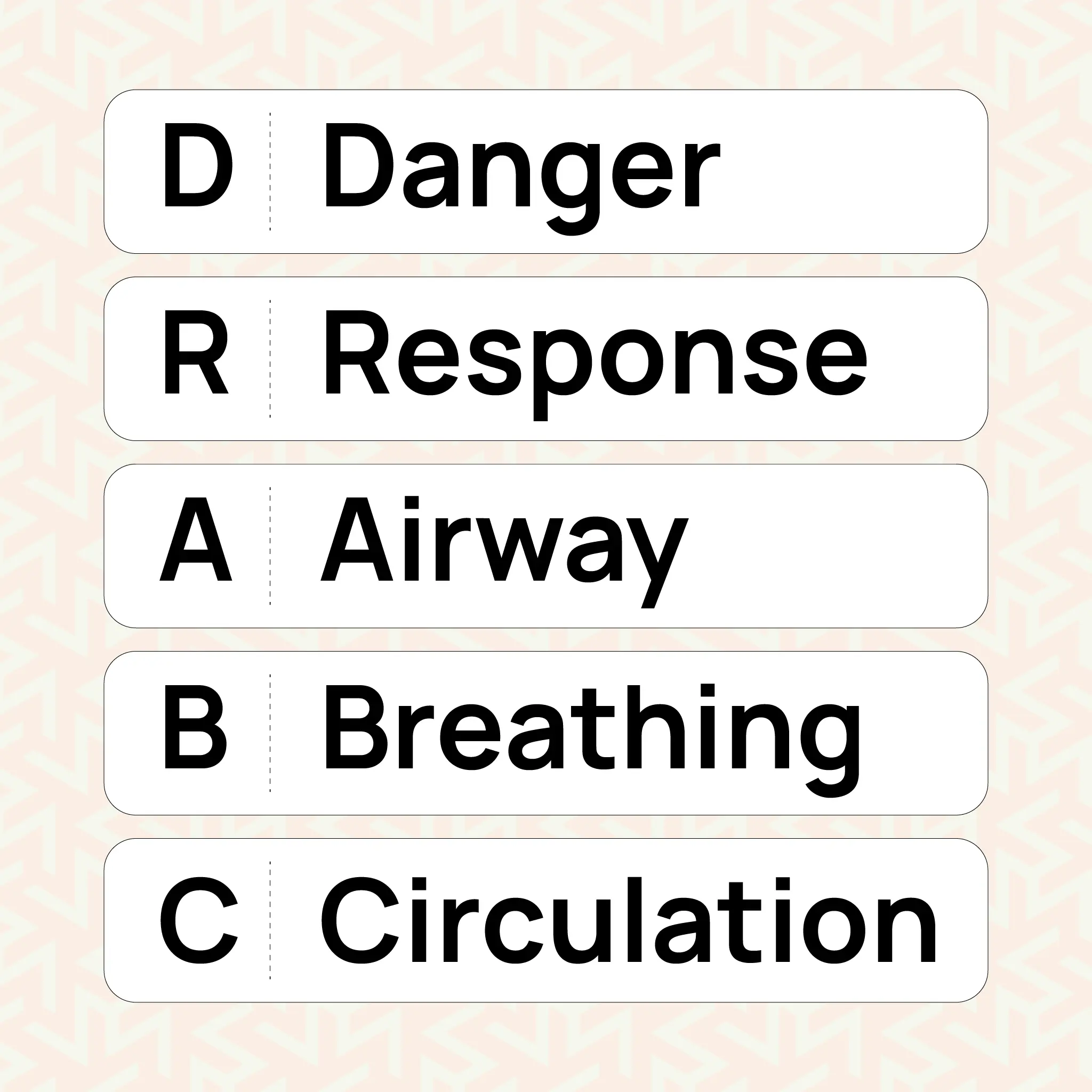
How To Perform the Primary Survey Using the DRABC Steps
When someone is unconscious, their life is in danger. Their airway might be blocked, they may not be breathing, and their blood circulation could have stopped. It is important to follow the primary survey steps to assess casualties in the order of DRABC: Danger, Response, Airway, Breathing, and Circulation. Remember to take quick action because brain damage or even death can happen quickly. A secondary survey is performed after completing the primary steps of first aid.Primary Survey in First Aid Using DRABCWhen helping someone in an emergency, you always start with the primary survey. This means you quickly assess what is happening and the person's needs.The primary survey uses the letters DRABC to help you remember the steps: Danger, Response, Airway, Breathing and Circulation.D - Danger: First, you check for danger around you, such as oncoming traffic or a falling object.R - Response: Next, see if the person responds. Gently shake their shoulders when you talk to them. Are they awake or unconscious?A - Airway: Then, make sure their airway is clear. That means checking if anything is blocking their breathing passage.B - Breathing: After that, check if they're breathing normally. Look, listen, and feel for any signs of breathing.C - Circulation: Finally, check for signs of circulation, like a pulse. This tells you if their heart is beating.Knowing what to do next could help save someone's life, so it's important to follow these steps in the correct order.DRABC StepsDANGER - 1st Step of the Primary Survey DRABCThe first thing to do in an emergency is to check for dangers. Look around to see if anything could harm you, the person needing help, or anyone nearby. This helps you decide if it's safe to go close to someone who needs help.WHAT TO DOIf you see any hazards, like live electricity, try to make the area safe first. For example, if there's electricity, turn it off. Otherwise, use an insulating object, such as wood or plastic, to move the person away. When there is a risk of electricity, do not touch them directly.When you are sure it is safe, you can approach the person who needs assistance. But if it's still not secure, don't go near them. Instead, get emergency medical helpRESPONSE - 2nd Step of the Primary Survey DRABCA person can lose consciousness when something disrupts the brain's normal functioning. Here are some signs that someone might be unconscious:They can't respond to simple questions or touch.They might not realise when they're in danger and can't protect themselves.They can't clear their airways by coughing or swallowing. This means saliva, blood, vomit, or objects could block their breathing tubes. The tongue, which becomes floppy, might also fall back and block the throat.WHAT TO DOFirst, try to determine whether the person is unconscious by asking simple questions or telling them to do something simple, such as "What's your name?" or "Open your eyes," and gently shake them. If they don't respond, they're probably unconscious. Don't shake them vigorously, especially if they're children or babies.Place the individual in the side position, and examine his airway, breathing and pulse.If the unconscious person is breathing and has a pulse, keep them in the side position. Ensure their airway remains open and clear, and monitor their breathing and pulse regularly until medical assistance arrives.�How to Keep the Unconscious Person in a Side PositionThis is also called the lateral, recovery, or stable side position.Kneel beside the person.Straighten their far arm out, perpendicular to their body. Bend their near arm at the elbow and place it across their chest, with the fingers near the far shoulder.Bend their near leg up to the right angle of their body.Hold the shoulder and hip closest to you, gently rolling them onto their side. Their top leg should rest on the ground with the thigh at a right angle and the calf parallel to the straight leg.Rest their uppermost, bent arm on the elbow of the straight arm.the person is a child older than 1 year, gently tilt their head back. Their face should be slightly downwards so any fluid can drain from their mouth, and their tongue can fall forward, away from the airway.Pro Tip:When someone is unconscious, act fast. Use DRABC: Danger, Response, Airway, Breathing, Circulation. Brain damage or death can happen quickly if you delay.AIRWAY - 3rd Step of the Primary Survey DRABCNow, ensure the person's airway is clear. If they're unconscious:Gently tilt their head back and lift their chin with your hand on their forehead.Peep in their mouth to check whether something is obstructing their passageway.What to Do: If the person is responsiveCheck whether anything is obstructing their airway and causing difficulty breathing.If you see something, encourage them to clear it by coughing or using their hands.For adults and kids, you can help them by giving back slaps or abdominal thrusts. For babies under a year old, you can help them with back blows or chest thrusts.Once the blockage is cleared, move on to the next step.What To Do: If the person is responsiveCheck whether anything is obstructing their airway and causing difficulty breathing.If you see something, encourage them to clear it by coughing or using their hands.For adults and kids, you can help them by giving back slaps or abdominal thrusts. For babies under a year old, you can help them with back blows or chest thrusts.Once the blockage is cleared, move on to the next step.What To Do: If the person is unresponsiveIf you see something, try to remove it carefully. But don't put your fingers in their mouth if you can't see anything, as you might push a blockage deeper.BREATHING - 4th Step of the Primary Survey DRABCBreathing should be regular, quiet, and easy. Tilt the head back, watch the chest for movement, and listen for breathing sounds. Do this for about ten seconds to see if air comes from the mouth or nose.WHAT TO DOIf they're unresponsive and not breathing normally, call emergency services immediately. If you know CPR, start with rescue breaths. If not, do chest compressions. If there's an AED nearby, ask someone to bring it.Giving Rescue BreathsMouth-to-mouth resuscitation is the best way to give rescue breaths. Mouth-to-nose resuscitation is used for a jaw injury or if the person needs to be revived in water. Mouth-to-mask resuscitation is done by trained people to avoid direct contact, especially if the person might have a disease like hepatitis or HIV.Typically, 30 compressions followed by 2 rescue breaths are performed in case of abnormal breathing.Mouth-Mouth ResuscitationKneel beside the person.Lay them on their back.Gently tilt their head back and support their jaw with your fingers. Don't press on their throat. Their mouth should be slightly open.Pinch their nose closed. Take a deep breath and cover their mouth with yours, sealing gaps.Keep their head tilted and give 2 breaths, enough to make their chest rise slightly.Start compressions as recommended.When they start breathing again, please put them in the side position and check their airway, breathing, and pulse regularly.Follow similar steps for mouth-to-nose and mouth-to-mask resuscitation but adjust for the different techniques.CIRCULATION - 5th Step of the Primary Survey DRABCIn this step, check the person for any significant bleeding.What To DoIf they're bleeding heavily, try to stop it by pressing directly on the wound with a clean cloth or dressing. Then, call emergency services for help.Stay with them until help arrives. Try to keep them calm and reassure them that help is coming. If they're not bleeding but still unresponsive, put them in the recovery position. This helps keep their airway clear if they vomit.Cardiopulmonary Resuscitation (CPR)If someone's heart has stopped, CPR is vital to keep them alive until help arrives. CPR is exhausting, so it's best if two people can take turns to keep the rhythm right. Remember, even if you're not trained, attempting CPR is better than doing nothing.What To Remember During an EmergencyPlease don't go near the person unless it's safe. Check for danger to yourself, others, and the injured person first.Stay as calm as possible, even though you might feel upset, and try to reassure the injured person.Time is significant.Don't move the person unless you have to for safety reasons.Please don't leave them alone. Get someone to call for medical help straight away. But if you're alone and help won't come soon, you'll need to go for help yourself. Call 999 or the emergency number in your area.Keep messages to the emergency services short: say where you are, what's happened, how many people are involved, and how badly they're hurt.Please don't give them anything to eat or drink.First-Aid TrainingThe Emergency First Aid training course is designed for low-risk environments such as offices and small retail stores. It gives participants the fundamental knowledge and skills to effectively manage emergencies in these settings.Get Trained in All First-Aid SkillsFirst Aid CoursesBook NowRated Excellenton major review sitesFAQsWhat does DRABC stand for in first aid?DRABC in the first-aid primary survey stands for Danger, Response, Airway, Breathing and Circulation.Should you carry out a primary survey on every casualty?Use a primary survey and apply the DRABC steps whenever you witness a casualty, such as an accident or a fall, provided it is safe to approach the injured person.What is the purpose of the primary survey?The purpose of the primary survey is to treat life-threatening casualties quickly. These accidents could include airway blockage, breathing difficulties, shock or a brain injury.How can you assess the responsiveness of a casualty?First, check if the person is unconscious by asking simple questions and gently shaking them. If they don't respond, they're likely unconscious. Avoid shaking them vigorously, especially if they're children or babies. Next, put the person in the side position and check their airway, breathing, and pulse.How many compressions must be performed in case of abnormal breathing?Typically, 30 compressions followed by 2 rescue breaths are performed in case of abnormal breathing.


Challenges in Construction Projects
There are many different approaches to handling difficulties in the construction industry. For instance, the sluggish adoption of technology is sometimes addressed as a single significant barrier and several specific problems, such as communication, scheduling, documentation, etc.Now, we will move on to the most pressing issues affecting the construction industry. The first is compliance in a setting where laws and regulations are constantly changing. Other subjects will also be covered.Compliance RegulationsRules and regulations must change and evolve to keep up with the rapid advancement of technology. Maintaining compliance with that is challenging, particularly given that numerous layers of rules impact numerous businesses. This covers international compliance standards, nation-specific laws and ordinances, or even incredibly local and particular to one state or city.Regulation update communications frequently get lost and ignored in the daily deluge of work-related correspondence. Nevertheless, compliance violations brought on by unforeseen changes can quickly become catastrophic for most businesses.Inadequate Risk ManagementProject managers frequently implement precautions for long-term risk. But frequently, short-term problems are not taken into consideration. These problems have the potential to grow quickly and seriously affect the bottom line.Any seemingly little problem, such as unreliable subcontractors, scheduling difficulties, or shifting stakeholder preferences, has the potential to sabotage a project. Therefore, it�s necessary to have contingency preparations. Schedule some flexibility, and invest in safety training initiatives to prevent potential problems.Poor CommunicationCommunication is a critical skill in any job, but it becomes much more crucial when work is divided among several people. Without efficient communication, crucial activities may be overlooked, and problems could go unnoticed until it is too late to fix them. As a result, project managers must establish precise rules.At the end of each day, there should be communication up a distinct ladder informing the team of any advancements or challenges. Problems can be proactively solved in this way. Using various software could be a great alternative if face-to-face meetings are not an option.Shortage of Skilled WorkforceThis could be one of the major issues being faced by the construction sector right now. And this problem also gets worse every year, as fewer and fewer young people are interested in working in the construction industry and as more and more elderly workers are getting ready to retire.The problem is essentially global, and the need keeps steadily rising. It is conceivable for genuine building companies to try and lessen the effects of this issue for themselves, even though specific initiatives are made to address it on that level.If workers enrol in the CSCS Green Card (Labourers Card) Course, the first step in obtaining your CSCS Labourers Card, the skilled labour shortage can be resolved. It shows that the worker who has it is aware of the dangers and threats to their health and safety that are common at construction sites. You can also enrol in an online CSCS labourers card course and study from the comfort of your home. .second-cta-block .main-heading { font-weight: bold; font-size: 22px; } .second-cta-block .book-now { background: #DF3D52; color: #FFFFFF !important; border-radius: 8px; } .second-cta-block .second-heading { font-size: 17px; } .second-cta-block .card { border: 0 !important; } .second-cta-block .card-body { border: 1px solid #909090; box-shadow: rgba(0, 0, 0, 0.16) 0px 1px 4px; border-top-right-radius: 100px; border-bottom-right-radius: 100px; background: #ECECEC; } .second-cta-block .image-wrapper { height: 134px; position: absolute; right: -100px; top: calc(50% - 67px); /* Center the image vertically */ } .second-cta-block .image-wrapper img { height: 100%; } .second-cta-block .trustpilot-widget { width: 256px; } .cta-heading-section { width: 75%; } @media screen and (max-width:991px) { .second-cta-block { padding-top: 100px; } .second-cta-block .card-body { border: 1px solid #909090; box-shadow: rgba(0, 0, 0, 0.16) 0px 1px 4px; border-radius: 19px; border-radius: 14px; background: #ECECEC; } .cta-heading-section { width: 100%; padding-top: 50px; } .second-cta-block .image-wrapper { height: 134px; right: 0; position: absolute; left: calc(50% - 108px); top: calc(50% - 203px); } } RQF LEVEL 1 COURSE for CSCS GREEN CARD Check the Course Rated Excellent on major review sites Reliable Contractors�This construction issue needs to be resolved primarily through networking and referrals. It could be challenging to select a subcontractor for the work based just on looks, given the abundance of possible subcontractors. Asking for recommendations from your vendors or material suppliers is a great way to steer clear of hiring a shady contractor. Asking subcontractors you�ve dealt with in the past could be an excellent strategy to find reliable communications.It is advisable to confirm the subcontractors� licences, general liability insurance, and your inclusion as an additional insured on their policy before engaging them.Managing DocumentsIt should be no surprise that the construction industry generates a significant amount of paperwork, including contracts, material orders, certificates, invoices, insurance, etc. Dealing with all that often causes the document management process sluggish and raises the possibility of human error.Getting your entire company to operate primarily paperlessly should have been done long ago. Regarding categorization, due dates, project deadlines, and other aspects of document management, a wide range of methods and solutions can be helpful. To improve visibility and streamline operations, many firms adopt digital reporting tools, such as dashboards for Sage 300 CRE, which provide real-time insights into project documents, financials, and workflows.Unrealistic ExpectationsWhile a competent project manager can accomplish some tasks, others are impossible. Some clients and stakeholders may make significant requests. There may be difficulties associated with their expectations, whether they want a project finished quickly or on a tight budget. Spending toward impossible goals can reduce productivity; why put yourself through unnecessary stress by working extra hours when you still fail?The foundation for a successful project can be laid by managing expectations upfront. Some of these expectations were created as a result of poor forecasting. It�s possible that this forecasting, like risk management, places more emphasis on the long term than the short term. To determine whether those predictions are attainable, break them down into monthly, weekly, and daily objectives. Then, if necessary, inform the parties involved of the problems. Give them a backup strategy so they can see your ambitious but realistic timeframe or budget.Lack of StructureIt�s tough to complete tasks effectively without defined goals. Holding people responsible for contributing to a project without objectives is also challenging. If they don�t have a clear goal they are trying to achieve, a construction project can quickly go over budget, fall behind schedule, or even both.A crucial component of project management is performance management. They all need to have specific tasks to complete to accomplish this and keep everyone focused. Break down larger, project-wide goals into more manageable daily objectives for people to complete. If something isn�t done today, it will just get worse tomorrow. Ensure accountability by using predetermined procedures. Doing this can prevent the project as a whole from collapsing beneath you.Delayed Cash FlowInvoicing is a common but occasionally archaic practice in the construction industry. As a result, funding sources for other projects may run dry, and there may be delays. Also, late payments could negatively affect a company�s financial flow.As a result, invoicing procedures must change. Construction businesses may ensure that cash flow does not adversely influence other projects by using enhanced software and sufficient follow-through.Equipment Maintenance and ReplacementBuilding equipment is typically expensive, which can easily lead to decreased project earnings. Many firms usually forget the expenditures connected with construction equipment, particularly the maintenance and replacement prices. The additional expenditures involved with upgrading your equipment in the middle of construction are also one of the principal reasons for project cost overruns.You can address this issue by keeping an eye on equipment that suddenly starts to malfunction and acting quickly if your equipment malfunctions in the middle of a project.

Challenges Faced by Managers on Construction Sites
AnalysisTaking charge of a building project is no easy task. A construction project might run into a lot of difficulties. Project managers face numerous difficulties because of the project�s broad scope, many participants, and inherent hazards. It is the responsibility of project managers to maintain a site�s efficiency, safety, timeliness, and budget. This request can be very challenging at times. Here are a few challenges project managers regularly deal with in the building industry.One survey claims that 77% of construction projects have severe delays and that 98% of projects come in over budget.Shortage of Skilled LabourDespite advancements in technology, manual labour still dominates the construction sector. However, several factors are exerting pressure on construction firms as they try to recruit competent labour. These are most frequently:As workers retire, the ageing workforce depletes the sector�s present skills.Younger generations don�t find the construction industry to be particularly appealing. Brexit is making it more difficult for construction companies to hire people from the EU.City & Guilds reported in 2018 to Open Access Government that 87% of firms in the UK construction sector were having trouble obtaining skilled workers for construction employment.The shortage of skilled labour can be resolved if labourers enrol in CSCS Green Card (Labourers Card) Course, which is the first step towards getting your CSCS Labourers Card. It serves as evidence that the worker in possession of it is aware of the health and safety risks and hazards prevalent at a construction site.Lack of Well-Defined GoalsPoorly stated project objectives are one of the first difficulties that project managers encounter in the construction industry. Project managers� primary objective is to see a project through to completion; however, fulfilling this goal can be challenging. Every project has inherent constraints that make it distinct when creating goals for the timetable, work distribution, and final delivery. Multiple people may be involved in a single construction project, and their lack of coordination will result from a lack of a defined purpose.This problem is simple to solve. To ensure everyone is on the same page, project managers should exercise due diligence and ask the customers and contractors the necessary questions.Budget LimitationsThe management of funds is a challenge for projects in the construction industry, just like it is for any other project. It can be simple to go over the authorised budget due to the size of building projects and the time it takes to accomplish them.You can overcome this project management difficulty by lowering stakeholder expectations. Project managers should ensure that deliverables are correctly recognised to have accurate cost estimates. The budget should also account for circumstances beyond the project manager�s control, such as issues with the supply chain, labour shortages, and, more recently, the possibility that the COVID-19 epidemic will have an adverse effect on the operations of numerous project partners. The budget should constantly be reviewed, but more so if there are change orders or scope creep because those things might cause costs to spiral out of hand.Minimising DelaysDealing with time restrictions is one of the major difficulties project managers in the construction industry encounter. Delays brought on by incomplete work, scheduling difficulties, and workplace accidents can snowball into additional delays and costs.Unfortunately, construction projects include a lot of risk and uncertainty, making delays unavoidable. Project managers should set up processes for project scheduling and tracking to ensure everything is moving forward. Project managers can also spot flaws, errors, and workflow problems that could cause delays by watching the job through construction cameras.Unreasonable RequestsSpeaking about managing expectations, many project managers in the construction industry occasionally have to deal with unreasonable timelines and demands from clients and stakeholders. Even though this is not as serious of an issue as project delays and cost overruns, it nevertheless impacts a construction team�s productivity and morale. Construction is a highly competitive market; thus, it is a sense that stakeholders would defend their commercial interests.However, project managers should use their communication abilities to control their superiors� expectations and provide feedback when they believe a client�s request is unreasonable. They ought to be able to adequately justify why and offer more logical options that everyone can accept.Time ManagementMany stakeholders believe that one of the major problems that contribute to poor designs, high accident rates, and income loss is time restrictions. Contractors may cut corners to make up for missed deadlines and scheduling issues. This might further snowball into greater delays and higher costs as they try to uncover and remedy flaws or risk contractual penalties.Due to these factors, building project managers must address various delay-causing factors and create procedures that guarantee that requirements are always satisfied. Tracking suppliers and subcontractors allow you to account for lead times, labour, and paperwork, and using an effective time tracking system can help ensure every task stays on schedule. Additionally, unforeseen events like weather changes should be taken into account. Project scheduling and tracking techniques can address all of these time management challenges.Project managers� difficulties differ depending on the type of building project. They do; however, they all share a characteristic. To achieve successful delivery, all of these tasks necessitate tactical knowledge, strategic insight, and effective communication on the side of project managers.
Differences between a Banksman and Slinger Signaller
Who is a Banksman?A banksman, also known as a traffic marshal, directs and supervises vehicles like excavators, bulldozers, cranes, and dump trucks used on construction sites to carry personnel and building materials. Modern sites may use software for dump trucks to help banksmen monitor movement and improve efficiency. Marshals ensure the safe guidance of the vehicles and the people as it drives around the building site.On a construction site, a banksman works with plant operators and vehicle drivers to design safe traffic arrangements, communicate correctly to guide vehicle movement and manage traffic flow. The banksman should be aware of the hazards and risks associated with on-site cars and conduct their tasks to minimise risk.To get a comprehensive overview of banksman, read our blog.Who is a Slinger Signaller?A slinger signaller is a specific type of banksman. A slinger signaller�s main job is supervising and directing crane operators� instructions during lifting operations. Their job entails working with the lifting team and crane operators.A crane operator has a limited view of what is happening on the ground when seated in the cab. The slinger signaller provides clear instructions in the form of prescribed hand signals to assist them in safely lifting, moving, and setting down the crane�s load.SimilaritiesBoth banksman and slinger signaller must be aware of the risks and hazards in lifting operations.They tend to the people and equipment and make the site safer by minimising risks.They communicate using hand signals and radio equipment as instructed in Health and Safety (Signs and Signals) Regulations 1996.Both of them direct crane operations.The uniforms they wear are the same.DifferencesA banksman directs traffic and vehicles around a workplace.A signaller works in the lifting department only.Production of modular buildings is also a part of a slinger�s job description.How to become a Signaller?Enrol and complete Hurak�s Traffic Banksman course.Pass the multiple-choice question exam at the end of the course.Receive a 3-year valid certificate and ID card after passing the exam..How to become a Signaller?1. Must have accomplished the Health, Safety and Environment (HSE) exam for Operators within two years of enrolling for an accredited Slinger Signaller course.2. Enrol and complete an accredited training course on Slinger Signaller. The two most popular and demanded courses are:Construction Plant Competence Scheme (CPCS)National Plant Operator Registration Scheme (NPORS)Offers accredited training courseOffers accredited training courseWidely recognisedBecoming an alternative to CPCSExpensiveCost EffectiveIt takes a longer duration to completeCompletes within ten daysCertified centresFlexible learning3. Apply for a Red Trained Operator Card.
A Workplace Guide for Traffic Banksmen
�Crane lifts, traffic management, traffic flow, and directing vehicular operations are just a few of the operations that a traffic banksman, also known as traffic marshal, is crucial in making sure happen safely on the job site. The functions and responsibilities of the banksmen, their role in safeguarding the health and safety of people present, and the various duties and work environment they employ will all be covered in as a workplace guide for Traffic Banksman.Job Description of a Traffic BanksmanDirecting Vehicle MovementA traffic banksman is responsible for controlling traffic and ensuring accidents don�t occur at the work sites. They aid operators and drivers in their manoeuvres with hand gestures and communication tools. For instance, they can signal a vehicle to stop and move just in time when they reverse or make a turn. By monitoring their movements on the main road, banksmen direct cranes and trucks onto the site and ensure that heavy vehicles leave the area safely.Managing TrafficTraffic marshals manage the flow of traffic within a workspace as a banksman. They direct the drivers to the truck parking areas on the site. The traffic control system should ensure no other trucks are blocking the entries or exits. Additionally, large vehicles should have enough room to leave the site or travel to the loading zones. The roadways must be designed and laid out for particular vehicles to ensure efficient operation.Identifying Unsafe AreasA banksman should be aware of potential accident-causing difficulty spots in construction zones. To prevent damage to cars or equipment during manoeuvres, they also clear away impediments and clutter from the routes.Taking Care of Signalling EquipmentA traffic banksman should frequently examine the radio gear and other communication tools as a banksman to ensure they are operating as intended. A driver cannot hear them in a busy workplace, and giving directions is challenging without a communication line.Teaching Hand Signals to DriversTo prevent misunderstandings, it�s crucial to ensure drivers can comprehend the hand gestures of a banksman. They should meet with novice drivers to discuss traffic signals and communication techniques.Assisting in Loading and UnloadingA banksman typically works alongside other employees to do loading and unloading tasks. They may occasionally use the loading equipment to reduce traffic jams brought on by delayed loading.Work Environment of a Traffic BanksmanA traffic banksman works on building sites, loading and unloading ports, and factories. Trucks, cranes, lorries, cement mixers, bulldozers, and trucks are frequently seen in these situations. They spend most of their time working outside in all types of weather, so they must dress appropriately and have the necessary safety gear. Most banksmen dress in high-visibility clothing so that cars can see them both during the day and at night. The noise level at work is quite high on construction sites. For this reason, they require radio communication equipment to direct the drivers and alert the loading team when a truck arrives. Additionally, their responsibility is to maintain the office spotless and ensure efficient operation.Coworkers of a BanksmanDepending on the industry, a traffic banksman coworkers may include signallers, riggers, and warehousing workers. Workers in the warehouse help load and unload as riggers secure items to cranes. Additionally, banksmen might collaborate with project managers, civil engineers, ground labourers, truck drivers, and other specialists.Work Schedule of a BanksmanThe work schedule of a banksman differs depending on the employer and the conditions of their employment. For instance, delivery to building sites typically occurs in the early morning or late evening when there aren�t many people present. They will therefore start early and end late. On the other hand, warehouses are active during the day, when they finish most of their duties. A bankman typically puts in 35 to 40 hours a week, including weekends and evenings as needed when they work a full-time schedule. A traffic banksman can also work on temporary or part-time contracts.Traffic Marshal CourseWhen properly completed, a traffic banksman training course, also known as a traffic marshal course, entitles participants to serve as traffic marshals. By planning and setting out the roads that vehicles will use to pass through a location, they are able to safely govern the movement of vehicles there. To maintain safe segregation, a traffic marshal will make an effort to construct a one-way traffic system that will facilitate the flow of a vehicle at work through the site. They will also aim to avoid pedestrian crossings.When traffic is high, they may personally direct cars to prevent excessive queuing.

CSCS Card Price - How much is a CSCS card?
Are you planning on getting a CSCS card but are confused about its cost? Well, you�re not alone! With the different costs associated with applying for the different types of CSCS cards, CITB tests, and training and certifications, it can be puzzling to figure out the exact amount of the card.In this blog post, I�ll walk you through the CSCS card cost in the United Kingdom with a complete breakdown of the costs associated with obtaining a CSCS card. Moreover, you will also learn about the CSCS card renewal process and the replacement fees.How much is a CSCS card?The cost of a CSCS card is only �36. The price is the same for all card types. However, you need to pass the CITB Health and Safety test, which costs �23.50, and hold a relevant qualification to get the card.We can divide the cost of the CSCS card into three parts:Part 1 - The Cost of a CSCS Card:The cost of getting a CSCS card is currently �36, paid to CSCS, which issues the card under the Construction Skills Certification Scheme. This cost is the same for all CSCS card types.Part 2 - The Cost of a CITB Test:The cost of taking the CITB Health, Safety and Environment test is currently �23.50. As it�s mandatory for you to take the relevant CITB test before you can apply for your CSCS card, you will have to bear this cost.At Hurak Learning, our focus is on delivering a booking process that's smooth and stress-free. We manage everything to secure your CITB test reservation on your behalf. Book Now!Part 3 - The Cost of a Qualification:You will also need to pay the cost of any additional qualifications you may require for your specific CSCS card. For example, if you want a Green CSCS Labourer Card, you must complete the Level 1 Award in Health and Safety in a Construction Environment course. .second-cta-block .main-heading { font-weight: bold; font-size: 22px; } .second-cta-block .book-now { background: #DF3D52; color: #FFFFFF !important; border-radius: 8px; } .second-cta-block .second-heading { font-size: 17px; } .second-cta-block .card { border: 0 !important; } .second-cta-block .card-body { border: 1px solid #909090; box-shadow: rgba(0, 0, 0, 0.16) 0px 1px 4px; border-top-right-radius: 100px; border-bottom-right-radius: 100px; background: #ECECEC; } .second-cta-block .image-wrapper { height: 134px; position: absolute; right: -100px; top: calc(50% - 67px); /* Center the image vertically */ } .second-cta-block .image-wrapper img { height: 100%; } .second-cta-block .trustpilot-widget { width: 256px; } .cta-heading-section { width: 75%; } @media screen and (max-width:991px) { .second-cta-block { padding-top: 100px; } .second-cta-block .card-body { border: 1px solid #909090; box-shadow: rgba(0, 0, 0, 0.16) 0px 1px 4px; border-radius: 19px; border-radius: 14px; background: #ECECEC; } .cta-heading-section { width: 100%; padding-top: 50px; } .second-cta-block .image-wrapper { height: 134px; right: 0; position: absolute; left: calc(50% - 108px); top: calc(50% - 203px); } } RQF LEVEL 1 COURSE for CSCS GREEN CARD Check the Course Rated Excellent on major review sites Total Cost of Getting a CSCS Card in the United KingdomThe total cost of getting your CSCS card, including the cost of your card and the CITB test, is �58.50. Additionally, you must pay for the required qualification.Before you attempt the real CITB HS&E test, you must practise by taking this free CSCS mock test. It will help you understand what the real test would look like. You can also test your knowledge and evaluate whether you need more preparation.The Cost of a Replacement CSCS CardJust like any other object, you may damage or lose your CSCS card, and in some cases, it may even get stolen. This can be frustrating because you need your CSCS card to gain access to a construction site.But don�t worry, you can apply for a replacement card quite easily. However, you will be required to again pay the CSCS card fee of �36 for your replacement card. The new card will be an exact copy of your previous CSCS card and be acceptable on-site, just like your old card.Learn more about a replacement CSCS card with our blog, �Lost Your CSCS Card? Tips for Getting a Quick Replacement.�Process of Getting a CSCS Replacement CardCall the CSCS Contact Centre at 0344 994 4777 from 8 am to 6 pm, Monday to Friday, to order a replacement card. You will be asked for your CSCS registration number or National Insurance number.How Much Does a CSCS Card Renewal Cost?The cost of renewing your CSCS card is �36. Your CSCS card requires renewal after a certain time. Most CSCS cards expire after 5 years.Remember, to see when your card expires, you can always check the expiry date on the front of your CSCS card.There are two ways to renew your CSCS card, i.e., the online renewal process and the postal renewal process.Our blog on All You Need to Know About the Renewal of Your CSCS Card is a detailed guide on the CSCS card renewal process, including everything from the CSCS Card renewal process and requirements to tips for a hassle-free experience.CSCS Card Verification and ValidationYou can verify your CSCS card and check its validity by using a CSCS Card Checker. This tool helps to check if your CSCS card is valid and when it requires renewal.Learn more about this tool by reading our blog, �Why is a CSCS Card Checker Important? A Complete Guide.�Let Us Apply for Your CSCS CardThere are many companies online that can help with the processing of your CSCS card application. However, these organisations have different rates, charging additional fees for their services. So you must review their charges before you apply for a card on their website. Alternatively, you can apply for it directly through the CSCS website, as the application process is quite simple.If you still need help applying for your CSCS card, we can apply on your behalf, just click on this page for more information. Also, check what is required for a CSCS card to ensure you meet all the necessary requirements to get a desired CSCS card. div.wpforms-container-full .wpforms-form label.wpforms-error{ display: none; } /* The Modal (background) */ .ebook-modal { display: none; /* Hidden by default */ position: fixed; /* Stay in place */ z-index: 1; /* Sit on top */ padding-top: 100px; /* Location of the box */ left: 0; top: 0; width: 100%; /* Full width */ height: 100%; /* Full height */ overflow: auto; /* Enable scroll if needed */ background-color: rgb(0,0,0); /* Fallback color */ background-color: rgba(0,0,0,0.4); /* Black w/ opacity */ } div.wpforms-container-full .wpforms-form input[type=submit], div.wpforms-container-full .wpforms-form button[type=submit], div.wpforms-container-full .wpforms-form .wpforms-page-button { border: 1px solid #ddd; font-size: 1em; font-family: inherit; padding: 9px 31px; background: #0f7c90; color: white; /* display: flex; */ /* width: 100%; */ position: absolute; bottom: -418px; right: -150px; /* margin: auto; */ justify-content: center; align-items: center; } /* Modal Content */ .ebook-modal-content { display: flex; flex-direction: column; justify-content: space-between; align-items: baseline; background-color: #fefefe; margin: auto; padding: 31px; border: 1px solid #888; width: 30%; position: relative; } /* The Close Button */ .ebookModal-close { color: #aaaaaa; float: right; font-size: 20px; font-weight: bold; cursor: pointer; position: absolute; right: 21px; top: 10px; } .ebookModal-close:hover, .ebookModal-close:focus { color: #000; text-decoration: none; cursor: pointer; } div.wpforms-container-full { margin: 0px auto 20px;!important } .ebookModal-header{ color:#0f7c90;font-size:30px;margin:0 30px } @media (max-width:576.888px){ .ebook-modal-content { width: 90%; } } @media (max-width:768.888px){ .ebook-modal-content { width: 70%; } .ebookModal-header{ font-size:20px!important; margin:0 } } @media (min-width:768.888px){ .ebook-modal-content { width: 50%; } } @media (max-width:1024.888px){ div.wpforms-container-full .wpforms-form input[type=submit], div.wpforms-container-full .wpforms-form button[type=submit], div.wpforms-container-full .wpforms-form .wpforms-page-button { width: 100%; position: static; } .ebookModal-header{ margin:0; font-size: 25px; } } @media (max-width:1280.888px){ .ebookModal-header{ margin:0; font-size: 30px; } } @media (min-width:992px){ .wpforms-submit-spinner{ max-width: 100%!important; position: absolute!important; top:250px!important; left:150px!important; transform: translate(-50%,-50%)!important; } @media (min-width:1280.888px){ div.wpforms-container-full .wpforms-form input[type=submit], div.wpforms-container-full .wpforms-form button[type=submit], div.wpforms-container-full .wpforms-form .wpforms-page-button { border: 1px solid #ddd; font-size: 1em; font-family: inherit; padding: 9px 31px; background: #0f7c90; color: white; /* display: flex; */ /* width: 100%; */ position: absolute; bottom: -380px; right: -150px; /* margin: auto; */ justify-content: center; align-items: center; } } Download our CITB Operatives and Specialists Test Prep Book for free! × [wpforms id="14869" title="false"] #myImg{ cursor: pointer; } What are the Different Factors that Can Affect the Cost of a CSCS Card?Various factors can affect the cost of getting a CSCS card.The Level of Certification Higher levels of certification require additional training and assessment fees, which also changes the cost of your CSCS card. For example, an applicant seeking an NVQ (National Vocational Qualification) may need to complete a training course, which can add to the overall cost.Method of Applying Another factor to consider is how you apply for your CSCS card. Applying online can be cheaper than applying by post, as there are often additional fees for processing and handling paper applications.Employment StatusSome employers prefer applying for their employees� CSCS cards themselves. And for that, they often opt for group applications. When these applications are submitted in bulk, they are eligible for discounts.Tips for Reducing the Cost of Getting a CSCS CardIf you plan to get a CSCS card, you may wonder how to keep costs down. Check out some tips below:Choosing the Right Type of CardThe first and foremost thing you must consider is choosing the right type of CSCS card. Doing so can prevent you from wasting money on the application for the wrong card.Applying OnlineAs there are several ways to apply for your CSCS card, applying online is a cost-saving option. Applying online is a relatively faster and cheaper process compared to other ways.Getting a Group DiscountCSCS (Construction Skills Certification Scheme) offers discounts if you apply as a group. In some organisations, CSCS cards for employees are applied together as a group, which can also reduce the cost of getting a CSCS card.Taking Advantage of Government Funding SchemesYou can also look for government funding schemes, as these schemes can help cover your CSCS card price, at least partially, if not fully.Frequently Asked Questions (FAQs)Is there a different fee for different CSCS cards?The fee for applying for all the CSCS cards is the same, regardless of the type of card you apply for. Currently, the fee for a CSCS card is �36. However, the training and qualifications required for different CSCS cards have different fees. Considering that, the total cost for different CSCS cards can vary.Is the cost of the CITB test included in the CSCS card price?No, the fee paid for the CITB (Construction Industry Training Board) test is separate from the CSCS card fee. The fee for the CITB test is currently �23.50.Can I save money by applying for a CSCS card online?Yes, applying online for a CSCS card is the cheapest option, it�s also the fastest method of applying. Applying online can also cut additional costs, such as postage and printing fees.ConclusionWith the CSCS card becoming an important requirement for individuals working in the construction industry, it�s important to understand the overall cost of getting a CSCS card. Please note that the cost of the CSCS card varies depending on the type of card, qualifications required, and associated costs such as CITB tests and training.However, by choosing the right type of CSCS card, applying online, and taking advantage of in the United Kingdom�s government funding schemes, you can reduce the cost of obtaining a CSCS card. By understanding the costs involved and taking steps to reduce them, you can get a CSCS card without breaking the bank.

Tips to Write First CV
Your CV is an effective job-search tool regardless of where you are in your career, but as a recent graduate or school dropout, your initial CV must be well-planned and written. Ensuring your CV is meticulously crafted and structured is paramount, making a CV maker indispensable.An employer can get a quick overview of your abilities, traits, relevant work experience, and hobbies from your CV.In this post, we�ll give you practical advice on organising your CV, what information it should contain, and how to make sure it�s relevant to the required position.Importance of CVThe Latin curriculum vitae, or �course of life,� is shortened to �CV� in English. Your CV will serve as a map for your professional path as your career develops.�When crafting your first CV, consider seeking professional book writing services or professional ghostwriting services effectively showcase your qualifications and stand out from the competition,�Similarly, tools that humanize AI can help personalise content, making your application more engaging and tailored.Your resume will highlight the pertinent abilities and experiences you may apply to the new position. In today's competitive job market, leveraging advanced recruiting software can significantly amplify the impact of your resume.This is why resumes are crucial when applying for jobs and should always be included. Even when completing an online application form, you will typically have the option to attach your resume as a supporting document; you should always take advantage of this opportunity. With the introduction of AI recruitment tools such as cover letter checkers, recruiters now exhibit a preference for resumes that are meticulously completed and adhering to a structured format.Elements of a CVYour CV must provide a good first impression because recruiting experts estimate that recruiters examine a CV for five to ten seconds on average. It should demonstrate why you are a strong candidate for the position in question and, ideally, lead to your being chosen for an interview.Including the necessary information is crucial because a CV should only take up one or two pages of A4 paper.Personal InformationIt is a good idea to use the header feature to include your name, address, and contact information (email and phone number), since it saves space and makes the information simple to discover for the recruiter.Including additional personal information like age, marital status, or even a picture was once in vogue, but it is unnecessary. It is a waste of valuable space and could encourage prejudice.Personal StatementYou can quickly introduce yourself by including a personal statement or profile at the start of your CV.This should summarise your qualifications for the position, including a few sentences about you. While providing as much information as feasible, it must be concise.Every time you send your CV to a prospective employer, be sure to take the time to rewrite it. You can mention their business in the statement by customising it once more for their application. Consider this a chance to promote yourself.SkillsFor your first CV, adding a skills section is very helpful because it enables you to highlight your abilities, which might not necessarily be related to work experience.You will be able to identify the essential qualifications that the hiring managers are searching for by carefully reading the position�s job description and person specification.As you concentrate on three crucial areas: foundations, principles, and practice, effective coaching and mentoring can help you improve your communication abilities. In the same way, when preparing written applications like cover letters or CVs, using tools that shorten my essay can be valuable for condensing information while maintaining clarity and impact. Using a grammarly ai checker can further refine your CV by correcting tone and grammar, ensuring clarity and professionalism before submission to employers.The following are some examples of general skills that could be highlighted and discussed:Communication skills.IT skills.Leadership skills.Problem-solving skills.Organisational skills.Interpersonal skills.Collaborative skills.Limiting the number of skills you highlight to four or five is wise. This can take the shape of a brief list with bullet points. For each, compose a brief sentence demonstrating your proficiency in that area, like �I have substantial IT skills, which I further enhanced by building and maintaining my website�.Keep in mind that your hobbies and voluntary work will demonstrate specific skills. Despite not being related to former employment, these transferable talents may be helpful in the open position.Consider your transferable abilities carefully. Participating in organised sports might have acquired teamwork abilities, punctuality skills, or resilience. Alternatively, making YouTube videos in your free time could demonstrate your proficiency in IT, public speaking, or communication.If you are drafting a CV after taking a career sabbatical, taking transferrable talents into account is equally crucial. Consider your activities since leaving your previous position and the skills you have learned and routinely used. For instance, if you were providing child care during this time, you likely used a variety of abilities that may be listed on your resume.Education and Training DetailsInclude a section outlining any certifications you have obtained, listed in reverse chronological order, with the most recent first.Mention the high school, college, or university you attended, your educational background, and the grade you earned. If you are still awaiting the results, you might indicate �grade pending� or, if appropriate, offer expected grades.You might include any relevant academic courses you have taken if you are a recent graduate.You could also list any other courses you have taken in this section. Taking proactive steps to acquire some industry-relevant training might demonstrate drive and dedication if you are seeking a job in a competitive market.For instance, you might think about finishing a paediatric first aid course if you�re searching for work in a nursery.Work ExperienceYour employment history is usually listed in reverse order in the work experience section. The following information for each entry:The name of the company/institution you were employed.Your position title.Your employment dates there.A brief rundown of the tasks you completed.This section will probably be brief if you�re looking for your first job, but you should nonetheless list any examples of paid weekend or holiday work, work experience, or volunteer work.Hobbies and InterestsIf your passions and hobbies are applicable to the position and strengthen your application, you should include a section on them.Remember that you want to find things that will support your abilities. These might consist of the following:Sports.Art.Blogging or vlogging.Volunteering.Music.Drama.Travelling.Avoid using general terms that don�t truly convey anything about you to the employer. �Socialising with friends� is too general, but �completing escape rooms� could be a sign of initiative, teamwork, and problem-solving skills (as well as giving employers valuable insight into your personality).Finally, review your CV thoroughly (a few times, then once more!). Verify the grammar and spelling. You must proofread for clarity, catch mistakes, and ensure formatting uniformity.A second set of eyes is often helpful, so you may ask someone else to review it.�
Importance of Digital Skills in the Workplace
AnalysisThe need for digital abilities in the workplace has never been higher, and learning these skills can significantly improve your life in a world that is becoming increasingly digital. Being proficient in a wide range of these abilities is essential for your career since an increasing number of individuals are working remotely, and 82% of all jobs in the UK identify digital skills as a criterion.While it�s simple to assume that digital literacy is sufficient for the workplace, a recent study found that 52% of workers lack critical digital skills. In this post, we�ll define digital skills, give examples, discuss why they�re essential in the workplace today, and advise on developing them.Digital Skills for the WorkplaceThe phrase �digital skills� might be challenging to define because it covers a wide range of competencies and skills according to corporate input. In a nutshell, it refers to any abilities required to function successfully in a world that is becoming more digital.According to UNESCO, having digital skills is being able to access and manage information using digital tools, communication programmes, and networks. Although they can be data and IT-focused, it�s crucial to remember that these talents span a wide range and include fundamental problem-solving and communication abilities. They make it possible for us to instantly and worldwide interact, communicate, and create content.While they might range from basic functions to more complex capabilities, all digital skills are highly transferable and are now considered essential to employability. Transferable skills, especially those in the digital sector, are rising in demand as digital technology and automation transform the jobs market.The Digital Skills GapDespite increasing technology use, there remains a sizable digital skills gap leading to many problems. Lack of digital skills prevents people from getting employment and advancing in their careers and has a detrimental effect on the UK economy�s general development and productivity.Furthermore, and maybe unexpectedly, this impacts people of all ages. Only 1 in 5 teenagers believe they possess the advanced digital abilities that employers demand.We must do more to ensure more people acquire the digital skills necessary for the workplace. When you consider that employers� expectations for digital abilities are continually evolving to keep up with technological breakthroughs, it becomes evident that more needs to be done.Essential Digital SkillsThe digital abilities you require will vary depending on the career path you choose, but a few fundamentals are becoming increasingly important in practically every position. Everyone should work to improve these abilities.Social mediaEmail and instantmessagingWord processingWeb-based researchData entry and handlingAdvanced Digital SkillsFurthermore, mastering more complex digital abilities could help you stand out in technological fields like marketing, design, programming, and data science. Employers will continue to require these more advanced technological abilities as 85 million jobs are anticipated to be eliminated and another 97 million created by 2025, many of which will be technical employment.User experience designCodingProgramming, web, and appWebsite Design and Website developmentSEO, SEM and content writingcreationData analysisImportance of Digital Skills for WorkTechnology today has a significant impact on both the economy and society as a whole. In order for businesses to remain competitive, they must keep up with the rapidly evolving digital landscape. As a result, there is a great need for abilities that weren�t even possible a few years ago. In order to remain employed, people must continually improve their skills.The benefit of Digital Skills for EmployersHaving a workforce with various digital skills has many advantages for your business. Adopting new technology in the workplace helps streamline working processes and frees up staff to concentrate on higher-value work that helps you and your employees achieve your goals by reducing time spent on repetitive tasks.Overall, the increase in productivity brought about by digital technology makes room for organisations to be more innovative and collaborative. As a result, a fun and an effective work atmosphere is created, which improves worker retention and recruitment. In addition, businesses can leverage the talents of�UGC creators�to further enhance their digital presence. These creators generate authentic and engaging content that resonates with audiences, driving innovation and fostering deeper brand collaboration.Given these multiple advantages, it should come as no surprise that businesses demand that the bulk of their staff possess the digital competencies necessary to embrace the usage of cutting-edge technology.The benefit of Digital Skills for EmployeesWhile digital skills are crucial for businesses, they also have significant advantages for employees. It may be immensely empowering to have the essential digital skills to move a firm forward. It also makes people feel more assured and safe in their jobs. Organizations can use digital marketing assessment to upskill their employees. Understanding the different types of digital marketing can further enhance this process, helping teams adopt strategies that align with current trends and leverage digital tools to drive business growth and employee development.�However, research suggests that having the correct digital skills can help workers lower the danger of their employment becoming automated by 59%. In the modern world, people who have historically performed professions are progressively being replaced by automation software and robotic process automation tools.Additionally, having a wide range of digital talents translates into a higher wage, with occupations needing digital skills typically paying 29% more than roles that do not. Therefore, acquiring digital skills for the workplace generally boosts one�s financial situation in addition to helping one�s employability, job security, and professional advancement.Furthermore, employees with digital skills can use various tools to simplify their tasks and boost efficiency. For example, using OCR based tools like picturetotext.io that extract text from image or or perform pdf data extraction, helps convert scanned documents into editable text quickly. Alongside this, file converters and cloud-based platforms are also widely used to streamline daily workflows and collaboration.The benefit of Digital Skills for StudentsDigital abilities could be the difference-maker for job seekers trying to stand out from the crowd of other qualified applicants. One of the best methods to improve your chances of getting hired for your preferred profession is to learn various digital skills required for the vast majority of job openings.Today, a lot of jobs are exclusively listed online. Job applications show your level of digital proficiency even before the interview stage, and companies are on the lookout for this. To assess your talents before an interview, many applications now include a range of online tests and forms. Gaining the necessary digital skills could help pass these entrance exams and continue to the next stage of the application process.Improve Essential Digital SkillsIt is obvious that possessing various digital abilities is necessary to succeed in today�s workplace, but how do you acquire and enhance these vital talents?Fortunately, several affordable and quick ways to broaden your knowledge of digital technologies exist. There are many chances to learn new digital skills and upskill oneself, whether online, through face-to-face training, or while learning on the job. To get started, employ these techniques:Digital Skills in the Modern CoworkplaceIn today�s professional landscape, many teams collaborate across hybrid setups that blend remote and shared offices. A modern�coworkplace�relies heavily on digital tools such as cloud storage,�visitor management software, and virtual communication platforms. Coworking management software and virtual communication platforms help organizations streamline bookings, manage memberships, track occupancy, and boost workplace efficiency. Developing strong digital skills ensures professionals can work efficiently, stay connected, and contribute effectively regardless of location.Improve your Digital PresenceSpending more time online and becoming familiar with the most often used features of the internet is one of the best methods to develop your digital abilities.Creating a social media profile can help you keep up with the most recent online trends, and email or instant messaging services can help you communicate better and work more effectively online.You can also strengthen your professional presence by learning the basics of email design, which allows you to create clean, visually appealing emails that improve engagement�especially useful for marketing, outreach, or personal branding.Additionally, exploring tools like Android video editor or a free video converter can enhance your multimedia skills, allowing you to easily convert and edit videos for various digital platforms. Using an online logo maker can also boost your creative skills, helping you design logos for personal projects, social media branding, or small businesses.Your digital skills will develop naturally the more time you spend in the digital world and the more at ease you�ll feel navigating it.Online Training CoursesOnline learning is a quick and convenient approach to acquiring and retaining information if you�re trying to pick up a new skill to help you advance in your career.Online training is becoming increasingly popular since it is thought to be a more efficient learning method than conventional face-to-face instruction. It�s not difficult to understand why 79% of learning and development professionals expect to spend more on e-learning than 3 years ago.With e-learning, you may learn more quickly and flexibly from any place using any device. According to a recent study, those who completed courses on their smartphones did so 45% faster than they would have otherwise without sacrificing the quality of their learning. The estimated additional productivity is 4,270 hours as a result. PT training has seen a surge in popularity with the rise of online learning, offering flexible options for advancing your career.Access Free Guides and ResourcesWhile it�s common to assume that gaining new knowledge and skills will cost money, many excellent free online resources can assist you in learning various digital skills without spending any money.Your employment prospects, employability, and ability to use contemporary technology can all be improved by acquiring digital skills. It�s crucial to have various fundamental digital skills in an increasingly digital environment, and it�s a good idea to expand your knowledge to more advanced ones to upskill yourself and close the digital skills gap.
Meeting Management Tips
AnalysisMeetings exist primarily to accomplish one goal: to complete a task. The personnel can be organised, plans can be made, and tasks can be planned effectively through meetings. However, meetings can occasionally be a waste of time, resources, and energy, especially if they are poorly planned and conducted.To make a meeting productive, make sure you follow the management tips:Have a Specific AimMeetings should only be scheduled if it has a specific goal. If not, you run the danger of making everyone�s time indecisive. You�ll probably emerge from the meeting in the same state you entered.If you frequently have meetings planned but have nothing concrete to talk about, call a halt to the meeting. Although staff meetings help foster effective communication, you need to strike a balance between this goal and time spent doing beneficial things.ParticipantsThis is not to say that you should be particular about who you invite. Instead, you should ask yourself, �Does the meeting need all of these people there?�People might be spending their time more effectively elsewhere if they weren�t attending meetings just for its sake.Set ObjectivesBefore the meeting, you should decide what results you hope to get from it. You should then designate these items as meeting objectives once the meeting has been scheduled.The specific topics you wish to cover at the meeting should emphasise your objectives, such as �Decide how we�re going to sell our new product.�Share an AgendaWriting and distributing an agenda before the meeting is crucial to efficient meeting management. This should contain the goals, so everyone attending the meeting knows what to expect.Having an agenda helps focus clearly and stay on topic. Additionally, you can inform attendees of any necessary preparation by providing an agenda.Realistic goals should be on your agenda; it makes no sense to have a long list of objectives if you only have 20 minutes to complete them.The appointment of a facilitator for the meeting may also be advantageous. This way, if the discussion veers off subject, they can remind everyone of the agenda and bring it back up.Be PreparedThis step comes after setting up and adhering to an agenda. Meetings should always be scheduled in advance, and all essential duties should be finished. This will not only help the meeting stay on schedule, but it will also demonstrate that you are responsible enough to prepare for it.Make sure everyone else has ample time to plan and prepare as well. To allow workers enough time to prepare, try to distribute the agenda two days before the meeting. Make careful to include in employee schedules when planning so that you can still give them enough time to prepare, such as if an employee has off the day before the meeting.Be CreativeAlthough having an agenda is crucial for keeping your meeting on schedule, it shouldn�t be so rigid that it prevents people from being creative or expressing their thoughts and opinions. Creativity should be present in a productive meeting.Be PunctualEffective meeting management includes being on time for meetings. If you arrive late, you can feel rushed and miss a crucial moment, which could impact the entire meeting. Being late also conveys a certain level of disrespect for everyone early.This step also includes wrapping up the meeting on schedule. Avoid rambling by talking about off-topic topics that aren�t on your agenda. It is a waste of time and resources, and it might make you think the meeting wasn�t very fruitful. Next time, offer yourself a more reasonable time frame if the meeting goes over because you didn�t have enough time to discuss your goals and agenda. To plan more effectively, you can also calculate meeting duration in advance, ensuring your meeting stays within the allocated time.Have a Question and Answer SessionEven though it frequently comes at the end of the meeting and doesn�t have much time to itself, this is just as crucial as the meeting itself.All meetings should include Q&A sessions, but it�s crucial if you�re dealing with outside clients or individuals who aren�t part of your team. By holding these sessions, you actively involve attendees in the discussion and force them to consider what was stated and whether they got it completely.People should be urged to ask inquiries. If you don�t mention asking questions, many people will frequently be reluctant to do so out of obligation.Asking participants questions in advance is a helpful suggestion. You should explain the situation and then inquire about any questions they may have. This not only guarantees that you cover the pertinent subject and issues at the meeting, but you can also check at the conclusion to see if you were able to address everyone�s questions and concerns.It�s crucial that you effectively and to the appropriate persons explain any following steps that are decided upon at the conclusion of the meeting. Everyone should be aware of what is expected of them after the meeting.You should also follow up with the people who attended your meetings. Since everyone has a unique perspective on events, it�s possible that two participants in the same meeting could have completely different views of what transpired. To ensure that everyone is on the same page, you should ask whether they understand, then send a follow-up document outlining everything discussed.