On This Page

July 17, 202612 min read
Do certain situations make your heart race, your hands shake, or your mind jump straight into panic mode even when you know deep down that you're not actually in danger? If yes, you're not alone. This is exactly how a phobia feels, and many people experience these sudden waves of fear without fully understanding why they happen.
Phobias aren't just normal fears. These fears can trigger strong physical and emotional reactions, making daily activities such as travelling, socialising, or even getting a medical check-up feel challenging. Whether it's heights, flying, needles, or crowded places, phobias can affect anyone at any stage of life.
This article provides a clear overview of phobias, including their types, symptoms, causes, and treatment options. Whether you're dealing with a phobia yourself or supporting someone you care about, this guide offers clear, easy-to-understand information.

A phobia is an anxiety disorder marked by a powerful, persistent fear of a specific object, situation, or environment. The fear is disproportionate to the actual level of danger and can significantly impact daily functioning. This fear can lead to physical symptoms like sweating, shaking, shortness of breath, or even panic attacks.
While fear is a natural response to real danger, phobias cause panic even when there is no actual threat. For example, someone might feel terrified of flying or stepping into a lift, even when they know it's safe.
Phobias can make certain situations feel impossible to handle. The fear can feel so strong that people start avoiding certain places or activities, which affects both emotional well-being and quality of life. Phobias are treatable, and recognising the problem is the first step toward getting help.
Phobias come in many forms, and each one affects people differently. They can be grouped into several categories depending on what triggers the fear. To help you understand them better, here's a simple breakdown of the main types of phobias.
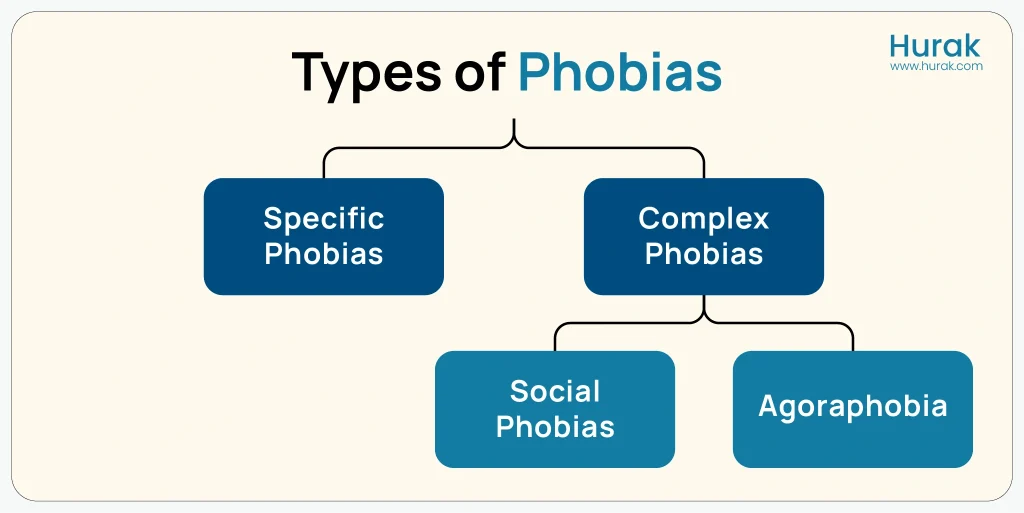
These are the most common types of phobias and involve an intense fear of a particular object, place, or situation. They often develop in childhood and can persist into adulthood if not treated. The trigger is usually easy to identify.
Common examples include:
Animal phobias: fear of spiders, dogs, snakes, insects
Natural environment phobias: fear of heights, storms, water
Situational phobias: fear of flying, driving, tunnels, elevators
Blood-injection-injury phobias: fear of needles, blood, medical procedures
People with specific phobias often avoid the trigger entirely, even if it affects their daily life.
Complex phobias are usually more severe and often develop during adulthood. They involve a combination of emotional, physical, and behavioural symptoms and usually require professional treatment.
Two of the most common complex phobias are:
This phobia involves an intense fear of social situations where someone might feel judged, embarrassed, or evaluated by others. It can make everyday situations overwhelming.
Examples include:
Fear of public speaking
Fear of meeting new people
Fear of being the centre of attention
Fear of eating, writing, or performing tasks in front of others
It often leads to avoidance of social gatherings or work-related interactions.
Agoraphobia is the fear of being in environments where escape may be difficult or help might not be available. People often associate it only with fear of open spaces, but it's much broader.
People with agoraphobia may fear:
Crowded places
Public transport
Shopping malls
Being outside alone
Standing in lines
Enclosed spaces
In severe cases, individuals may avoid leaving their home altogether.
Understanding the different types of phobias helps recognise how varied fear responses can be and why each person's experience is unique. Whether simple or complex, phobias can be overwhelming, but they're also highly manageable with the right support and treatment.
Phobias don't have one single cause. They usually build up over time and are shaped by our experiences, our personality, and sometimes even family history. Here are some of the most common reasons someone might develop a phobia.
Some people are naturally more prone to anxiety due to their genetic makeup. If a close family member has a phobia or an anxiety disorder, the chances of developing one are higher. This doesn't mean phobias are inherited directly, but genetics can influence how strongly a person reacts to fear or stress.
The way the brain regulates fear can also contribute to phobia development. Imbalances in certain neurotransmitters like serotonin and dopamine can heighten anxiety and make someone more reactive to fear triggers.
A frightening or distressing event can trigger a long-lasting fear. Experiences such as being bitten by a dog, getting stuck in a lift, or experiencing turbulence during a flight can create a powerful association that leads to a phobia. Even one intense incident can be enough to form a lasting fear response.
Phobias can develop by observing someone else's fear, especially during childhood. If a parent, sibling, or close one consistently shows fear toward certain animals, situations, or places, a child may adopt the same response. This is known as vicarious learning and is one of the most common pathways through which phobias form. Over time, this learned fear can turn into a phobia.
Chronic medical conditions or sudden health scares can also trigger phobias. For example, someone who has experienced breathing difficulties may develop a fear of confined spaces, or a person with heart problems may fear situations that raise their heart rate.
Phobias often develop slowly and silently, shaped by genetics, experiences, and the way the brain reacts to fear. Acknowledging these causes empowers individuals to seek help and learn healthier ways to cope.
Phobias can trigger a mix of physical, emotional, and behavioural symptoms. These symptoms usually appear when someone is faced with the feared object or situation, and sometimes even when they just think about it
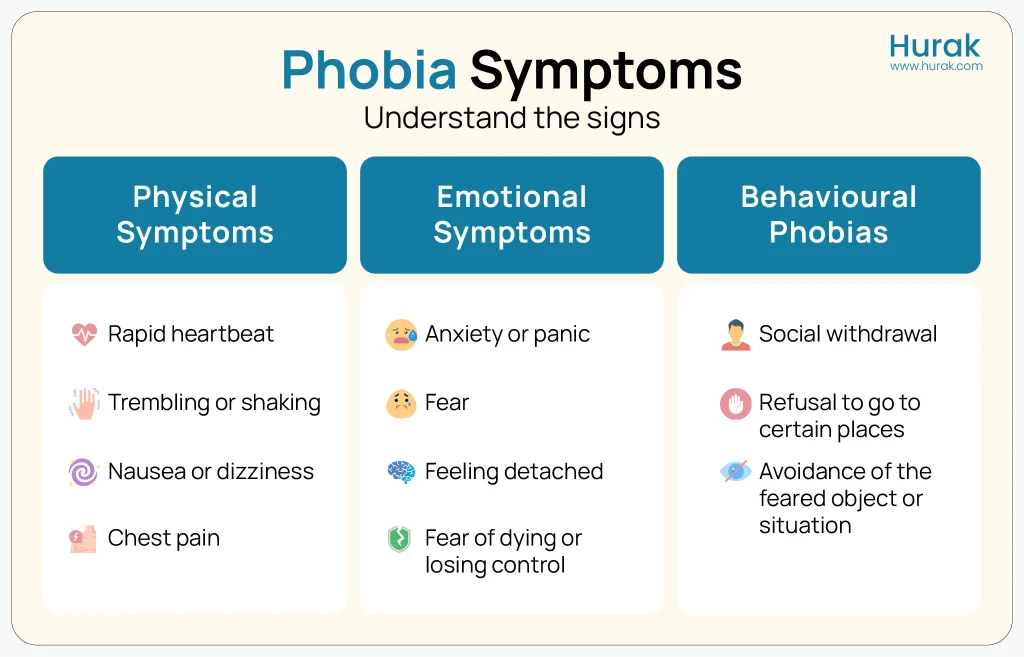
Physical symptoms are the body's automatic reactions when someone encounters a phobia trigger. Essentially, the body reacts as if it's in immediate danger, even when the situation isn't truly harmful.
Rapid heartbeat or chest tightness
Shortness of breath
Sweating or trembling
Feeling faint, dizzy, or lightheaded
Nausea or stomach discomfort
Hot or cold flushes
A sudden urge to escape
Emotional symptoms are the intense feelings and psychological responses a person experiences when confronted with a phobia. They reflect how fear affects the mind, causing distress, tension, or a sense of losing control.
Sudden fear or panic when facing the trigger
Feeling out of control or helpless
Intense anxiety even when the threat isn't real
Dread or worry leading up to situations involving the phobia
Feeling overwhelmed or distressed without a clear reason
Behavioural symptoms are the actions or patterns of behaviour a person shows in response to a phobia. They reflect how fear influences everyday activities, often leading to avoidance of the feared object or situation and changes in routine to prevent exposure.
Avoiding places, objects, or situations linked to the phobia
Needing reassurance or someone to accompany you
Inability to function normally when exposed to the trigger
Feeling the urge to escape the situation immediately
Making lifestyle changes to avoid the fear trigger entirely
The symptoms of phobias show how fear impacts both mind and body. Identifying these signs early can make it easier to manage phobias and reduce their interference with everyday activities.
Be the Calm in Someone’s Fear
Phobias can trigger overwhelming reactions.
Our Mental Health First Aid (MHFA) courses teach you how to assist safely and effectively.
Take the step toward meaningful support.
Phobias can develop around nearly anything, and they range from common fears to rare and unusual ones. A comprehensive list of phobias helps understand the variety of fears people may experience and how these fears are categorised. Presenting phobias alphabetically or in groups makes it easier to read and reference.
CATEGORY | TYPES OF PHOBIAS |
Animal-Related Phobias | Arachnophobia - Fear of spiders Cynophobia - Fear of dogs Ophidiophobia - Fear of snakes Equinophobia - Fear of horses Ornithophobia - Fear of birds |
Environmental Phobias | Hydrophobia - Fear of water Nyctophobia - Fear of the dark Ombrophobia - Fear of rain Chionophobia - Fear of snow Pyrophobia - Fear of fire |
Situational Phobias | Claustrophobia - Fear of enclosed spaces Aerophobia - Fear of flying Elevator Phobia - Fear of lifts Taphophobia - Fear of being buried alive Vehophobia - Fear of driving |
Blood, Injury, and Medical Phobias | Hemophobia - Fear of blood Trypanophobia - Fear of needles or injections Nosocomephobia - Fear of hospitals Traumatophobia - Fear of medical procedures Algophobia - Fear of pain |
Social and Psychological Phobias | Social Phobia (Social Anxiety Disorder) - Fear of social situations or public embarrassment Glossophobia - Fear of public speaking Anthropophobia - Fear of people or social interaction Autophobia - Fear of being alone Sociophobia - Fear of society or social situations |
Other Common Phobias | Globophobia - Fear of balloons Thanatophobia - Fear of death or dying Pogonophobia - Fear of beards Nomophobia - Fear of being without a mobile phone Ergophobia - Fear of work or the workplace Phobophobia - Fear of developing a phobia Ablutophobia - Fear of bathing Galeophobia - Fear of sharks Ailurophobia - Fear of cats Anthophobia - Fear of flowers Dentophobia - Fear of dentists or dental procedures Emetophobia - Fear of vomiting Gamophobia - Fear of marriage Haphephobia - Fear of being touched Mysophobia - Fear of germs or dirt Necrophobia - Fear of dead things or corpses Phasmophobia - Fear of ghosts Xenophobia - Fear of strangers or foreigners |
Phobias are highly treatable, and a combination of therapies, coping strategies, and sometimes medication can help people manage or even overcome their fears. The right treatment depends on the type and severity of the phobia, as well as the individual's needs.
CBT is one of the most effective treatments for phobias. It helps individuals recognise and change the negative thought patterns that trigger fear, and gradually teaches them healthier ways to respond to phobic situations. Patients learn to challenge irrational thoughts and gradually develop healthier ways to respond to the feared object or situation. CBT often includes homework exercises, thought logs, and behavioural experiments to reinforce learning.
Exposure therapy is a type of behavioural therapy where individuals are gradually and systematically exposed to the object or situation they fear. The goal is to desensitise the person to the trigger and reduce the intensity of fear over time.
In vivo exposure: Directly facing the feared situation in real life, such as climbing heights for acrophobia.
Imaginal exposure: Visualising the feared situation in a controlled setting.
Virtual reality (VR) exposure: Using VR technology to simulate the feared environment safely.
Repeated exposure helps the brain learn that the situation is not dangerous, which reduces panic responses and avoidance behaviour.
Relaxation techniques help manage the physical symptoms of phobias, such as rapid heartbeat, sweating, trembling, or shortness of breath. These techniques are often combined with therapy to improve coping during exposure to fear triggers.
Deep breathing exercises to calm the nervous system.
Progressive muscle relaxation to release tension in the body.
Mindfulness meditation to stay present and reduce anticipatory fear.
Self-help strategies are valuable tools that can support therapy or be used as a first step for mild phobias. These include:
Learning about the phobia to understand triggers and symptoms.
Gradual exposure to the feared object or situation at a comfortable pace.
Seeking support from friends, family, or online/self-help groups.
While therapy is the primary treatment, medications may be prescribed in some cases, especially for severe or persistent phobias. Medication does not cure phobias but can help reduce anxiety and panic symptoms, making therapy more effective. Common medications include:
Antidepressants (SSRIs or SNRIs) to reduce overall anxiety.
Benzodiazepines for short-term relief during extreme anxiety episodes.
Beta-blockers are used to manage physical symptoms like a rapid heartbeat or shaking in specific situations.
Medication is usually recommended in combination with therapy rather than as a standalone treatment.
Treatment for phobias is highly effective when tailored to the individual. Combining therapy, exposure techniques, relaxation methods, and sometimes medication helps reduce fear, improve coping skills, and restore normal daily functioning.

Phobias are real and often overwhelming fears that can affect anyone at any stage of life. They range from specific fears like animals or heights to complex fears such as social situations or crowded spaces. These fears often develop due to a combination of genetic factors, past experiences, learned behaviours, and brain chemistry, making them unique to each individual. Recognising the physical, emotional, and behavioural symptoms is crucial for seeking help and taking the first step toward recovery.
Effective treatment options, including Cognitive-Behavioural Therapy (CBT), exposure therapy, relaxation techniques, and sometimes medication, provide hope and practical solutions. With awareness, early intervention, and consistent effort, individuals can overcome their fears, reduce anxiety, and regain control of their daily lives, leading to a healthier and more confident future.
A phobia is an intense and persistent fear of a specific object, situation, or activity that is often disproportionate to the actual danger it poses. It can affect daily life, causing physical, emotional, and behavioural symptoms.
Phobias are generally divided into simple (specific) phobias, such as fear of animals, heights, or flying, and complex phobias, which include social phobia (social anxiety disorder) and agoraphobia.
Phobias can develop due to a combination of factors, including genetics, past trauma, learned behaviour, brain chemistry, stressful life experiences, physical health conditions, or even drug use.
Symptoms include physical reactions like rapid heartbeat or sweating, emotional responses such as fear or panic, and behavioural changes like avoidance of the feared situation or object.
Yes, phobias are highly treatable. Common approaches include Cognitive-Behavioural Therapy (CBT), exposure therapy, relaxation techniques, self-help strategies, and, in some cases, medications, especially when guided by professionals.
You should seek professional help if a phobia interferes with your daily life, causes severe anxiety, or prevents you from performing normal activities. Early intervention can make treatment more effective.
Yes, children can develop phobias, often due to traumatic experiences or learned behaviour. Early recognition and therapy can help prevent phobias from affecting their development and daily life.




Courses
Upskill with job-ready training.
Mock Tests
Measure your learning progress.
Create an online video course, reach students across the globe and earn money