On This Page

July 16, 202610 min read
Thinking of a career as a site manager, but do not know how to get started? The core of any construction project is the site manager, whose role is to lead teams, ensuring safety, managing budgets, and keeping projects on track. This role combines leadership, technical expertise, and problem-solving skills, offering high earning potential.
In this guide, well explain how to become a site manager, highlighting the qualifications you need, key responsibilities, salary expectations, and the career steps to help you succeed in this role.

A site manager, also known as a construction manager, is a person who is in charge of managing all the daily activities of a construction site. Their main goal is to make sure that projects are completed safely, on time, within budget, and to the required quality standards.
Key Responsibilities of a Site Manager
Planning and scheduling daily site activities.
Supervising construction teams, subcontractors, and suppliers.
Ensuring compliance with health and safety regulations.
Monitoring progress and resolving on-site issues.
Managing budgets, resources, and project timelines.
Communicating with clients, architects, and engineers to keep the project on track.
Site managers serve as the link between the construction team and senior management to make sure that there is effective coordination and smooth delivery of every phase of the project.
Theres no single path to becoming a site manager, but most careers in this role combine formal qualifications, practical training, and on-site experience. Here's a simple step-by-step guide:
Most site managers begin with GCSEs (or equivalent) in maths, English and science, which help build the basic knowledge and skills needed to start a career in construction and progress into management roles. Technical subjects, such as design and technology, are also helpful.
There are various ways through which you can begin your career:
Apprenticeships: Combine work and study while gaining practical skills.
Trainee Roles: Start as a trainee construction manager or assistant site manager.
Further Education: Take an HNC, HND or a construction-related course like construction management or civil engineering.
To progress, consider qualifications like:
Chartered Institute of Building (CIOB) courses for professional recognition.
The majority of employers demand that managers possess a CSCS Black Card and complete training such as the SMSTS (Site Management Safety Training Scheme).
Practical experience is key. Progress from roles such as site supervisor or assistant site manager to develop leadership and project management skills.
Tip: Combining an NVQ Level 6 or 7 qualification with a CSCS Black Card can fast-track your promotion into senior site management roles.

There are several routes to becoming a site manager, depending on your education, experience, and career goals. Some professionals may begin as an apprentice or site supervisor and gradually progress; others take formal qualifications to fast-track their way into management roles.
One of the most recognised methods of qualifying as a site manager is by means of NVQs (National Vocational Qualifications)
NVQ Level 4 in Construction Site Supervision: Suited for people starting out in junior management positions.
NVQ Level 6 in Construction Site Management: The standard qualification for site managers.
NVQ Level 7 in Construction Senior Management: For senior or director-level roles.
NVQs are conducted through practical on-site experience and are therefore suitable for individuals already working in the construction industry.
Most employers require site managers to have:
A CSCS Black Card (Manager level) is usually linked to NVQ Level 6 or equivalent qualifications.
SMSTS (Site Management Safety Training Scheme) certification to demonstrate a strong understanding of health and safety.
HNC or HND (Higher National Certificate/Diploma) in construction-related disciplines.
Undergraduate degrees in construction management, civil engineering, or building surveying.
Construction apprenticeships are put together to provide practical training along with academic learning.
Hurak offers accredited construction courses that can help you qualify for site management roles and achieve the CSCS Black Card.
NVQ Level 4 Diploma in Construction Site Supervision: Best for junior management roles.
NVQ Level 6 Diploma in Construction Site Management: Standard qualification for site managers.
NVQ Level 7 Diploma in Construction Senior Management: For senior leadership roles.
NVQ Level 6 Diploma in Construction Contracting Operations Management: For roles in contracting and operations.
SMSTS (Site Management Safety Training Scheme): Industry-required safety certification.
SSSTS (Site Supervisor Safety Training Scheme): Great for supervisors stepping into management roles.
CITB Health and Safety Awareness Course: Foundation-level health & safety knowledge.
First Aid at Work: A must-have certification for safety on-site.
How to Get a CSCS Black Card: Step-by-step guide to obtain the manager-level competency certification.
CSCS Green Card Course (Labourers): Entry-level card for those starting in construction.
Want more options? Browse all NVQ and site management courses on Hurak.
The role of a site manager is challenging and involves a combination of technical knowledge, leadership, and organisational skills. In order to succeed in this role, you should have a team-leading capacity, effective communication and the ability to cope with challenges while ensuring the project stays on track.
Leadership and Communication:
A site manager should motivate and oversee construction teams, subcontractors and suppliers. Effective communication skills will be needed to coordinate with clients, architects, and engineers.
Planning and Organisation:
From scheduling daily tasks to managing budgets and resources, organisational skills help keep projects on track within deadlines and costs.
Technical and Safety Knowledge:
A thorough understanding of construction processes, building regulations, and health and safety standards is essential to ensure smooth site operations.
Problem-Solving and Attention to Detail:
Issues on site can arise unexpectedly, so the ability to find rapid solutions without compromising quality is vital.
Technology Skills:
Awareness of project management tools, software such as MS Project or AutoCAD, and digital reporting is becoming increasingly important in modern construction management.

The salary of a site manager differs, depending on experience, location, and the size of the project or company. In the UK, salaries for site managers are competitive and often increase as you gain experience and take on larger responsibilities. Bonuses, overtime pay, and allowances are also part of the benefits enjoyed by many site managers, particularly when they work on high-value or long-term projects.
Average Site Manager Salary in the UK
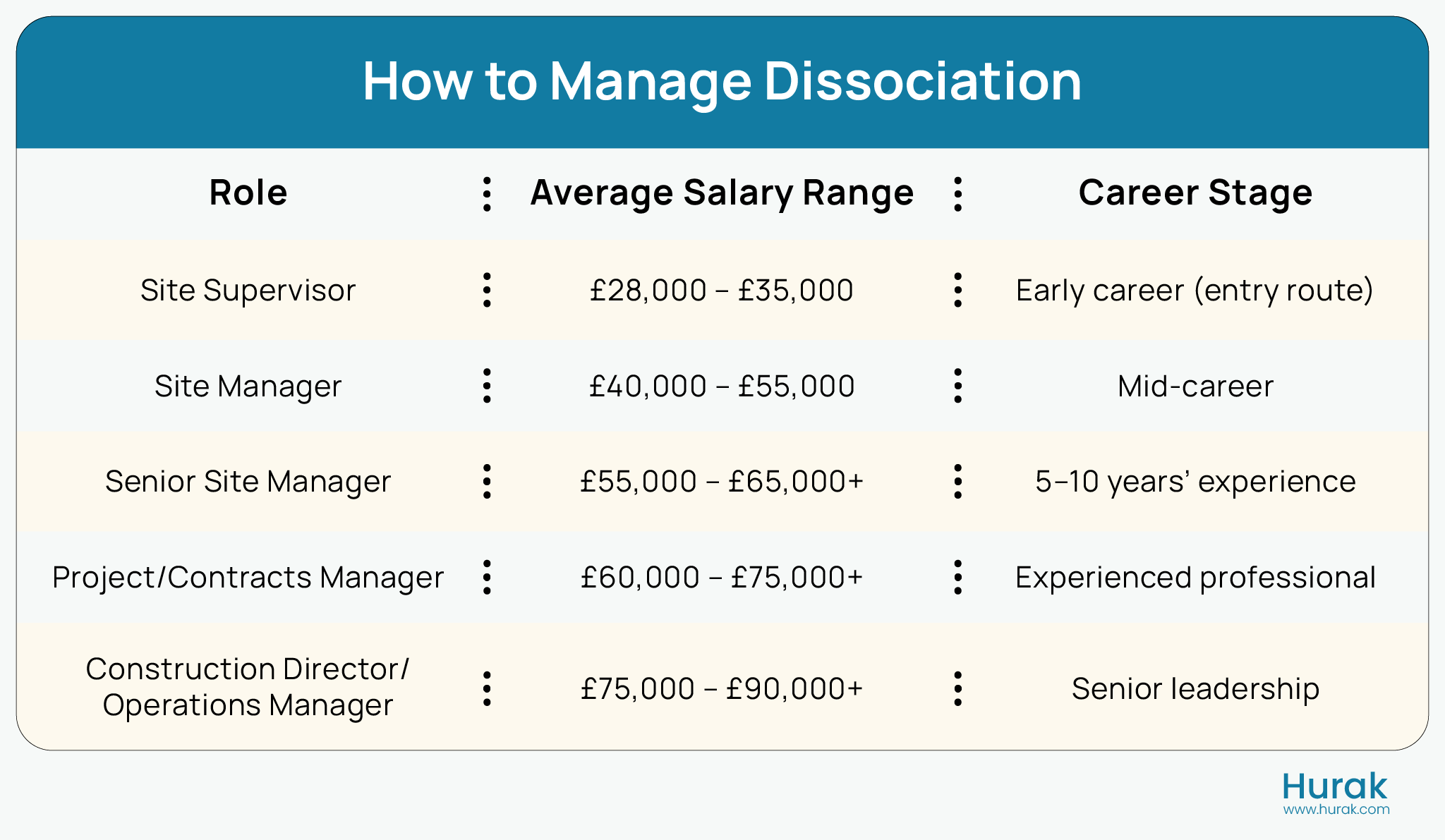
The average salary for a Site Manager in the UK ranges from £45,000 to £52,000. Senior Site Managers who oversee significant developments or commercial projects can earn over £70,000, particularly if they hold chartered status (MCIOB) or an NVQ Level 6 qualification.
Experience Level | Average Annual Salary |
Entry-Level / Trainee(0-2years) | £28,000 - £38,000 |
Mid-Level (3-6 years) | £40,000 - £52,000 |
Senior Site Manager (7+years) | £55,000 - £65,000+ |
A career in site management offers endless opportunities for growth and specialisation. Although most site managers start as apprentices or site supervisors and gradually move up, the right qualifications and experience can put you into high positions at a very rapid pace.
As you gain experience, you can progress to positions like Senior Site Manager, Project Manager, or even Construction Director. Other professionals prefer to specialise in niche areas such as infrastructure projects, health and safety management, or sustainable construction practices.
With ongoing infrastructure development and housing projects across the UK, the demand for skilled site managers continues to rise, making this a career with excellent job security and long-term potential.
Take your construction career to the next level with industry-recognised qualifications that open doors to senior site management roles:
NVQ Level 6 Diploma in Construction Site Management The go-to qualification for site managers aiming to progress.
NVQ Level 7 Diploma in Construction Senior Management For experienced professionals moving toward Project Manager or Construction Director roles.
SMSTS (Site Management Safety Training Scheme) Essential for compliance and career growth.
Explore All Advanced Construction Courses on Hurak.
The qualifications for becoming a site manager are usually an NVQ Level 6 Diploma in Construction Site Management or any other qualification similar to it, which can be either an HNC, HND or a degree in construction-related courses. A CSCS Black Card and SMSTS (Site Management Safety Training Scheme) qualification is also needed by many employers.
Yes, you can become a site manager without a degree. Most professionals begin their careers as apprentices, site supervisors, or tradespeople, and progress through NVQ qualifications (Level 4-7) and experience in the field.
The time required varies based on your starting point. If you're already working in construction, earning an NVQ Level 6 Diploma can take 6 to 12 months. Those who begin as apprentices or trainees may need several years, depending on the selected pathway.
Site managers in the UK earn between £40,000 and £55,000 per year on average, with senior managers earning £55,000 to £65,000+. Entry-level or trainee site managers can expect salaries of £28,000 to £35,000.
Although this is not a legal requirement, SMSTS certification is often mandatory for site managers to comply with health and safety regulations and employer requirements.
A site manager is concerned with day-to-day site operations, team management and safety, whereas a project manager is concerned with the general planning, budgeting and delivery of the project. Site managers often report to project managers.
In order to achieve a CSCS Black Card, one must have a recognised qualification like NVQ Level 6 in Construction Site Management and pass the CITB Health, Safety and Environment test.
Site managers with experience and higher qualifications (e.g., NVQ Level 7) may rise to Senior Site Manager, Project Manager, Contracts Manager, or Construction Director.
Yes, many NVQ Level 6 and Level 7 diplomas can be completed online or through blended learning with on-site assessments. Hurak offers flexible, accredited NVQ pathways for construction professionals.
Being a site manager is a great career option when you love leadership, solving problems, and working on projects that create the built environment. This role is a combination of technical skills, team management, and strategic planning, and it provides great job security and attractive salaries. With the right qualifications, hands-on experience, and certifications such as an NVQ Level 6 or a CSCS Black Card, you can fast-track your path to site management and progress into senior positions, including Project Manager or Construction Director.
When you are willing to make the next step, it is high time to invest in training, improve your skills and create a solid career base. The construction industry is always looking for motivated professionals who can lead projects to success.

Courses
Upskill with job-ready training.
Mock Tests
Measure your learning progress.
Create an online video course, reach students across the globe and earn money