
Fires can start unexpectedly, a spark, a spill, or a forgotten pan and spread within seconds. In such moments, knowing what type of fire you’re facing can make all the difference. Every fire behaves differently depending on its fuel source, and each requires a specific method to extinguish it safely.
In the UK, fires are classified into six main types, known as fire classes. This classification helps identify the proper fire extinguisher and approach to use in an emergency. Using the wrong extinguisher can be hazardous, sometimes even exacerbating the fire.
In this guide, we’ll break down each class of fire (A to F), what causes them, what fuels them, and how to control them effectively. Whether at home, at work, or in public spaces, understanding fire classification is a crucial step in ensuring everyone’s safety.
Be Fire Aware, Stay Fire Safe
Ready to take your health and safety knowledge to the next level. Explore our Fire Marshal / Fire Warden Online Course to gain essential skills in fire prevention and emergency response. For those aiming to manage workplace fire safety at an advanced level, the Fire Safety Manager Advanced Diploma offers in-depth expertise and certification.
Types of Fire Classification
Fire classification is a system that categorises fires based on the type of fuel that’s burning. In the UK and across Europe, the system follows BS EN 2:1992, a standard that defines how fires are grouped according to their combustible material.
Each class represents a different type of fire, for example, solid materials, flammable liquids, or cooking oils, and each requires a specific extinguishing method. Recognising this difference is crucial for safety at work and at home.
Understanding these classifications helps prevent common mistakes, such as using water on oil or electrical fires, which can worsen the situation instead of controlling it.
| Fire Class | Type of Fuel | Common Examples | Extinguisher |
| Class A | Solid materials | Wood, paper, textiles | Water, Foam, Dry Powder |
| Class B | Flammable liquids | Petrol, diesel, paints | Foam, CO₂ |
| Class C | Flammable gases | Propane, methane, LPG | Dry Powder |
| Class D | Combustible metal | Magnesium, titanium | Class D Dry Powder |
| Electrical | Electrical sources | Circuits, plugs, wiring | CO₂, Dry Powder |
| Class F | Cooking oils and fats | Deep-fat fryers, pans | Wet Chemica |
Class A Fire: Solid Materials Like Wood, Paper, and Textiles
Class A fires are the most common type of fire found in homes, offices, and schools across the UK. They involve solid, combustible materials, such as wood, paper, cloth, rubber, and certain types of plastics. Because these materials are present in nearly every environment, Class A fires can start easily and spread rapidly if not handled correctly.
- Potential fuels: Office furniture, paper bins, curtains, fabrics, and cardboard packaging.
- Suitable extinguishers: Use Water, Foam, or Dry Powder extinguishers. These cool the burning material and remove heat, breaking the fire triangle.
- Example scenario: A small office bin fire caused by discarded paper or an overheated plug igniting nearby fabric.
- Safety tip: Avoid using CO₂ extinguishers, as they are ineffective on deep-seated burning materials and may not fully extinguish the flames.
Understanding how to respond to a Class A fire is essential for every workplace and household. Using the correct extinguisher and remaining calm can prevent a minor incident from escalating into a serious emergency.
Class B Fire: Flammable Liquids and Vapours
Class B fires involve flammable liquids such as petrol, diesel, oil, paint, alcohol, and solvents. They are especially dangerous because it’s usually the vapour, not the liquid itself, that ignites. These fires can spread rapidly and produce intense heat, making them one of the most serious hazards in industrial and workshop settings.
- Potential fuels: Vehicle fuels in garages, cleaning solvents and thinners, paints, adhesives, and oils.
- Suitable extinguishers: Use Foam or CO₂ extinguishers. Foam blankets the liquid surface, cutting off oxygen and cooling it down, while CO₂ displaces oxygen to halt combustion.
- Example scenario: A spill of petrol or solvent in a workshop catches fire after exposure to an open flame.
- Safety tip: Under COSHH (Control of Substances Hazardous to Health) regulations, workplaces must store flammable liquids in clearly labelled, closed containers and keep them away from heat or ignition sources.
Because flammable liquids are widely used in garages, factories, and maintenance areas, Class B fires are among the most reported types in industrial environments. Proper handling, safe storage, and knowledge of fire extinguishers are vital to maintaining a safe environment in these spaces.
Class C Fire: Flammable Gases
Class C fires occur when flammable gases such as propane, butane, methane, or LPG ignite. These gases are commonly used in heating systems, laboratories, and industrial equipment, making gas safety a key concern in many workplaces across the UK.
- Potential fuels: Leaking gas cylinders, damaged pipes or valves, and industrial gas installations.
- Suitable extinguishers: First, shut off the gas supply if it’s safe to do so. Then use a Dry Powder extinguisher to smother the flames and interrupt the chemical reaction.
- Example scenario: A leaking propane cylinder in a catering van ignites due to a nearby spark.
- Safety tip: Store gas cylinders upright and in well-ventilated areas. Inspect them regularly and train staff in safe gas handling procedures.
Due to the explosion risk, water or foam extinguishers should never be used on Class C fires. Prevention and proper maintenance are the best defences against gas-related incidents.
Class D Fire: Combustible Metals
Class D fires are rare but extremely dangerous, involving reactive metals such as magnesium, titanium, aluminium, lithium, and sodium. These metals burn at very high temperatures and are commonly found in laboratories, workshops, and manufacturing plants.
- Potential fuels: Fine metal powders, shavings, or residues from metalwork processes.
- Suitable extinguishers: Use a specialist Dry Powder extinguisher (Class D rated). This powder isolates the metal from oxygen, preventing re-ignition.
- Example scenario: Sparks from welding or grinding ignite fine magnesium dust in a workshop.
- Safety tip: Avoid using water or CO₂, as both can react violently with burning metals and cause explosions.
Though not frequent, Class D fires demand specialised training and equipment. Anyone working with reactive metals should be familiar with their properties and have the correct extinguishers readily available.
Electrical Fires (Technically Not a Class but Often Treated Separately)
Electrical fires don’t fall under the official A–F classification, but they are treated as a separate fire type because of their unique risks. They result from faulty wiring, overloaded circuits, damaged plugs, or overheating electrical equipment.
- Suitable extinguishers: Use a CO₂ extinguisher to remove oxygen from the surrounding area or a Dry Powder extinguisher for small electrical fires.
- Example scenario: An overloaded extension lead overheats and ignites, potentially setting fire to surrounding cables or furniture.
- Safety tip: Always disconnect the power source before using an extinguisher, and ensure your workplace carries out regular PAT (Portable Appliance Testing) to prevent electrical faults.
Since most workplaces rely heavily on electrical systems, understanding how to manage these fires safely is essential to prevent severe damage and injuries.
Class F Fire: Cooking Oils and Fats
Class F fires occur in kitchens and involve cooking oils and fats. They typically happen when oil in a fryer or pan overheats and reaches its flash point, the temperature at which it can ignite spontaneously. These fires are hazardous due to the risk of flare-ups and explosions when water is misused.
- Potential fuels: Vegetable oils, animal fats, and commercial deep-fat fryers.
- Suitable extinguishers: Use a Wet Chemical extinguisher, which reacts with the oil to form a soapy barrier (known as saponification) that cools the fire and prevents re-ignition.
- Example scenario: A restaurant fryer overheating or oil catching fire while cooking at home.
- Safety tip: Never use water, as it can cause hot oil to splatter violently and create a fireball effect.
Class F fires replaced the old “Class E” category and are now part of the standard UK fire classification system. Regular kitchen safety training and awareness of fire extinguishers are vital for anyone working in catering or food preparation.
The Fire Triangle and Potential Fuels Explained
Every fire, regardless of its type, requires three key elements to ignite and continue burning: Heat, Fuel, and Oxygen. This concept is known as the Fire Triangle. If any one of these elements is removed, the fire will go out. Understanding this simple principle helps you know why different extinguishers work in different situations.
- Potential fuels: include solids such as wood, paper, and textiles; liquids like petrol, oil, alcohol, and paints; and gases like propane, methane, and LPG. Other potential fuels can even include cooking fats, dust particles, or fine metal shavings found in industrial environments.
- How to stop a fire: remove heat by cooling the burning material with water or foam, remove fuel by cutting off its supply and remove oxygen by smothering it using foam, CO₂, or powder
- Safety tip: Knowing which element to remove helps you choose the proper extinguisher and respond safely to different types of fire.
By remembering the Fire Triangle, you can better understand how fires start and what actions are most effective to stop them, making it a vital part of any UK fire safety training.
Matching Fire Extinguishers to Fire Classes
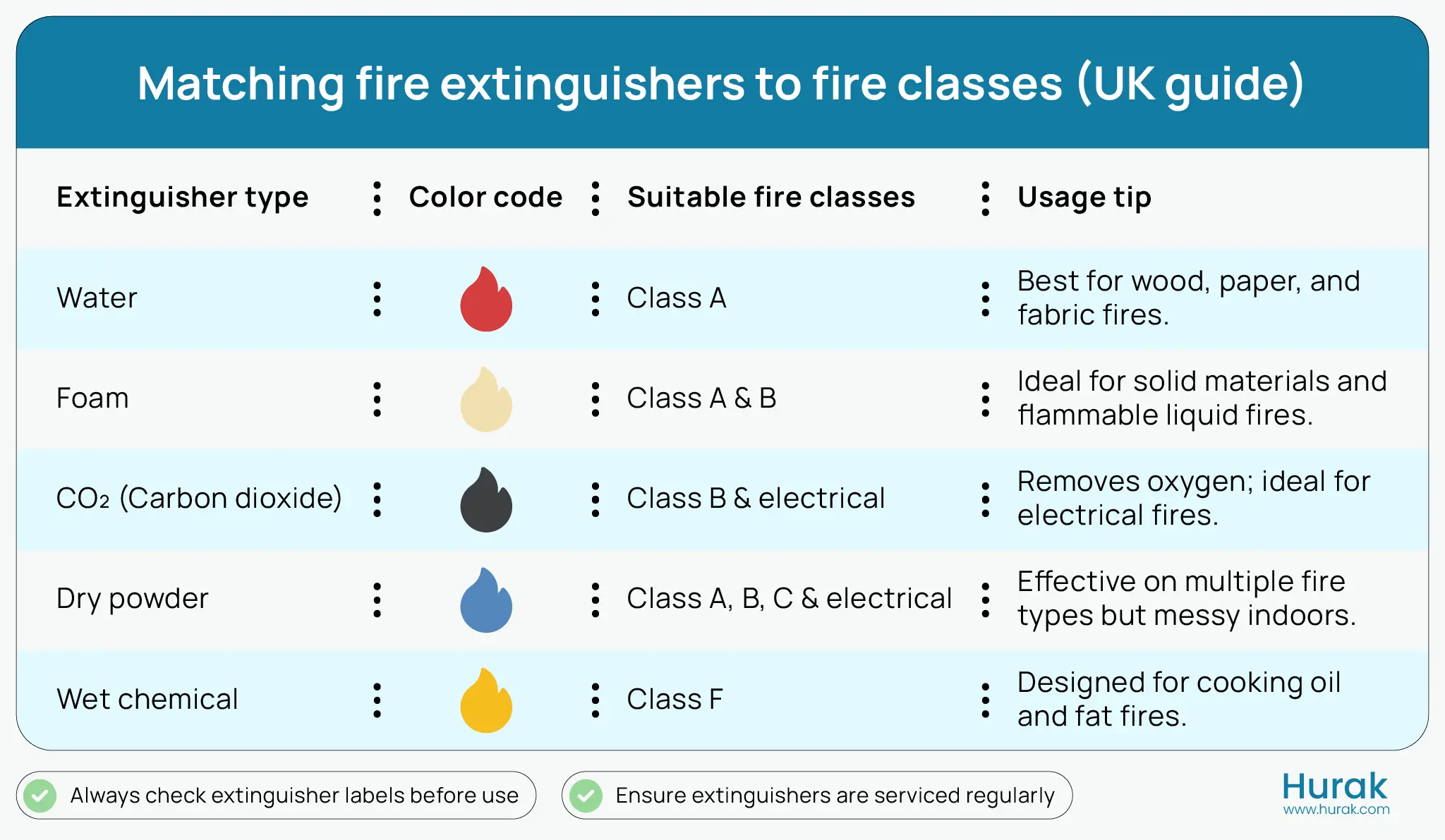
Each type of fire requires a specific extinguisher to ensure safety and effectiveness. In the UK, fire extinguishers are colour-coded to help users quickly identify the right one for each fire class.
Water extinguishers, marked with a red label, are ideal for Class A fires involving solid materials, such as wood, paper, or textiles. Foam extinguishers, featuring a cream band, are effective on both Class A and B fires, making them suitable for solids and flammable liquids. CO₂ (Carbon Dioxide) extinguishers, identified by a black label, are primarily used for Class B and electrical fires, as they remove oxygen without leaving a residue. Dry powder extinguishers, featuring a blue label, can handle multiple types of Class A, B, and C fires, as well as electrical fires, but they can be messy for indoor use. Lastly, wet chemical extinguishers, marked with a yellow band, are designed specifically for Class F fires involving cooking oils and fats.
Before using any extinguisher, always check the label, ensure it’s been serviced recently, and confirm that you’ve received proper fire safety training to handle it correctly.
Common Mistakes to Avoid When Tackling Fires
When faced with a fire, it’s easy to panic and act on instinct, but even well-intentioned actions can make the situation worse. Understanding what not to do is just as important as knowing how to respond correctly. Here are some of the most common mistakes people make when tackling fires, along with tips on how to avoid them.
- Using water on oil or electrical fires: Never use water to put out fires caused by flammable liquids or electrical sources. It can cause the flames to spread rapidly or result in electric shock.
- Forgetting to turn off the gas or electricity before acting: If the fire involves a gas leak or electrical equipment, turn off the main supply (only if safe to do so) before attempting to control the fire.
- Using the wrong extinguisher type: Each extinguisher is designed for specific fire classes. Using the wrong one can worsen the fire or create new hazards. Always check the label before use.
- Trying to fight a spreading fire: If the fire is spreading quickly or producing thick smoke, do not attempt to extinguish it yourself. Evacuate the area immediately and call 999 for emergency assistance.
In an emergency, safety should always come first. The best approach is to remain calm, assess the situation, and act only when you have the necessary equipment and training. When in doubt, evacuate and let the professionals handle it

Conclusion
Understanding the different classes of fire isn’t just theory; it’s a life-saving skill. Recognising what kind of fire you’re dealing with allows you to respond quickly, use an extinguisher, and prevent harm.
Whether you work in an office, factory, or kitchen, fire safety training ensures everyone knows how to act confidently in an emergency.
Frequently Asked Questions
How many classifications of fire are there in the UK?
There are six main classes: A, B, C, D, Electrical, and F.
What is the difference between Class B and Class F fires?
Class B involves flammable liquids, while Class F involves cooking oils and fats.
Which extinguisher should not be used on electrical fires?
Avoid water or foam; use CO₂ or Dry Powder instead.
What is potential fuel for a fire?
Any material that burns, such as wood, paper, fuel, gases, or oils.