On This Page

July 22, 20264 min read
Quality assurance plays an important role in overcoming quality-related concerns within organisations. Quality failures, such as biased assessments, can damage an organisation's reputation. Early detection of issues saves the cost of correcting systematic errors. To become a quality assurer, you must pass relevant qualifications. QA qualifications are of two types: internal and external. A learner must read the course guidelines carefully to choose the right qualification.
Quality assurance is the backbone of maintaining quality standards in products or services. IQA confirms fairness and quality in assessments. Organisations rely on IQAs to oversee assessors' activities. They confirm that all evaluations are impartial and uphold the organisation's reputation for quality.
The responsibilities of an Internal Quality Assurer may include:
Verifying that assessors meet requisite standards
Organising monitoring activities
Collaborating with assessors, trainers, and employers for uniformity in assessment practices
Assessing the performance of trainers and assessors and offering constructive feedback
Assisting trainers and assessors
Reviewing samples of assessment records and decisions
Engaging with learners
Planning the methods and timing of assessor monitoring
Identifying the best practices across the organisation
Internal Quality Assurance (IQA) ensures that institutions offering official qualifications regulated by Awarding Organisations maintain high standards.
Awarding Organisations, Bodies, or Exam Boards issue certificates and set qualification standards. An IQA oversees compliance with Awarding Organisation requirements, which is especially important for assessing candidates' qualification process.
The right quality assurance qualification depends on your goals. Start with the IQA Award Unit 1 for foundational knowledge, or progress to IQA Units 1 and 2 for practical and theoretical skills in monitoring assessments. For leadership roles, the Lead IQA Course prepares you to manage quality assurance teams effectively.
For those looking to work in internal quality assurance for an organisation, there are three IQA qualifications to consider.
The Level 4 Award in Understanding Internal Quality Assurance (Unit 1) is a theory-based course intended to provide learners with the essentials of internal quality assurance.
The Level 4 Award in the Internal Quality Assurance of Assessment Processes and Practice (RQF), comprised of units 1 & 2, is the most popular IQA qualification required. This credential is used for the main IQA roles within organisations and is highly useful for your career in quality assurance.
Upon obtaining the Level 4 Award, individuals may choose the Level 4 Certificate in Leading the Internal Quality Assurance of Assessment Processes and Practice (RQF). This advanced qualification allows individuals to oversee their quality assurance team.
Hurak offers Level 4 Awards and Level 4 Certificate programs. Learners gain access to our 24/7 student portal, which facilitates flexible study options. Visit our course offerings or contact our team for further details.
EQAs represent an awarding organisation rather than directly affiliated with an organisation or assessment centre. They offer advice, support, and assistance to the centre's Internal Quality Assurers (IQAs).
They also help assessors and other staff involved in qualification processes to ensure the fair treatment of candidates.
EQAs verify that qualifications are delivered in compliance with regulatory standards, such as those set by OFQUAL.
This may involve preventing cheating or unethical behaviour, such as plagiarism or impersonation during assessments.
The primary qualification in this field is the Level 4 Award in External Quality Assurance of Assessment Processes and Practice.
It covers the theoretical understanding of the EQA role and the practical aspects of conducting visits, checks, and monitoring.
It is suitable for individuals who oversee assessment quality externally.
The Level 4 Award in Understanding the External Quality Assurance of Assessment Processes and Practice is for EQA beginners who want to understand the principles and methods of external quality assurance without needing practical application.
This qualification's goal is to prepare individuals for roles in the workplace where they are responsible for maintaining assessment quality standards.
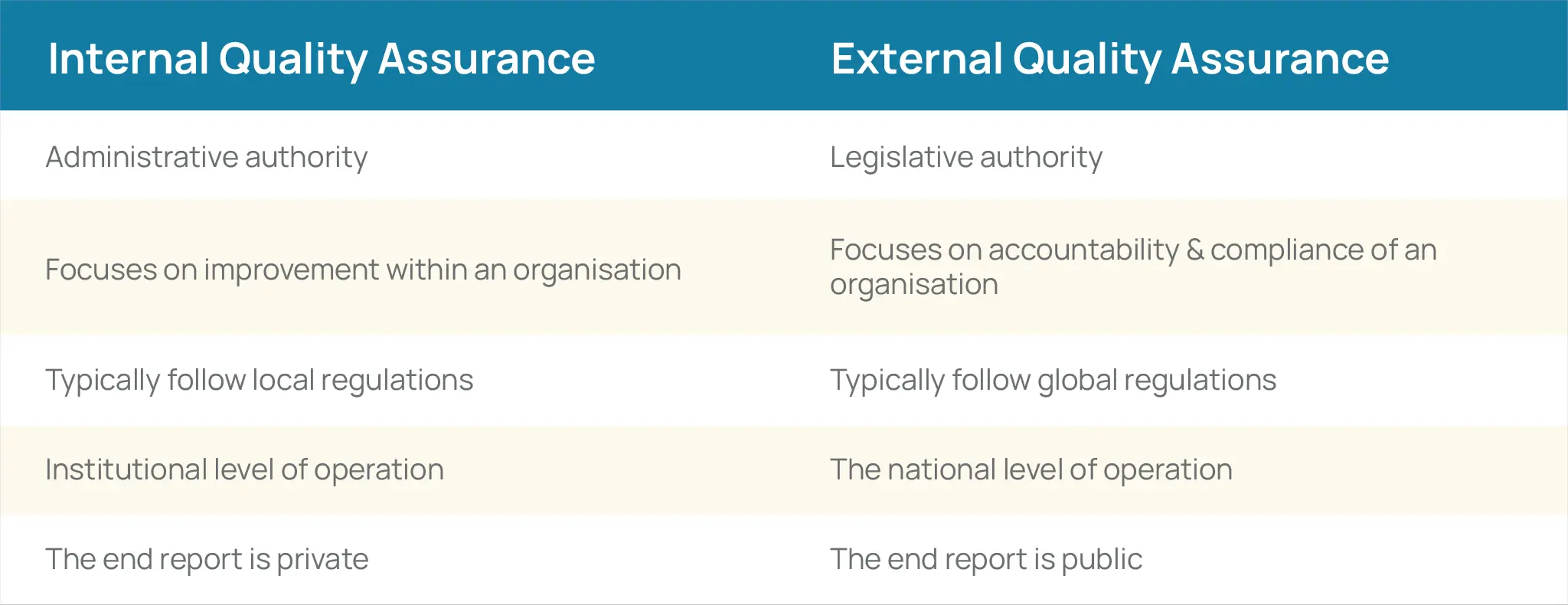
While both IQA and EQA are concerned with upholding the standard of quality, there are differences between their objectives and level of operations.
Courses
Upskill with job-ready training.
Mock Tests
Measure your learning progress.
Create an online video course, reach students across the globe and earn money