On This Page

July 16, 202610 min read
A premises licence is an essential legal requirement for businesses that want to sell alcohol, provide regulated entertainment, or serve food late at night. Whether you're opening a pub, a restaurant, or even hosting events, this licence ensures that your activities comply with the law. In this article, we'll guide you through everything you need to know about premises licences, how to apply for one, and the responsibilities that come with it.
A premises licence applies to permanent venues like bars, restaurants, shops, or event spaces. It permits certain licensable activities, including the sale of alcohol, the provision of late-night refreshments (hot food or drinks served between 11?pm and 5?am), and regulated entertainment.
Regulated entertainment includes live music, dancing, film screenings, indoor sporting events, and playing recorded music to the public. If your venue offers any of these activities, you'll likely need a premises licence.
Before we go any further into the process of getting a premises licence, it's important to know how it differs from a personal licence.
A premises licence allows businesses to carry out activities like selling alcohol, providing entertainment, or offering late-night food. It relates to the venue itself, such as a pub, bar, restaurant, shop, or event space. If you want to host events or run a business involving alcohol, you will need to apply for this licence.
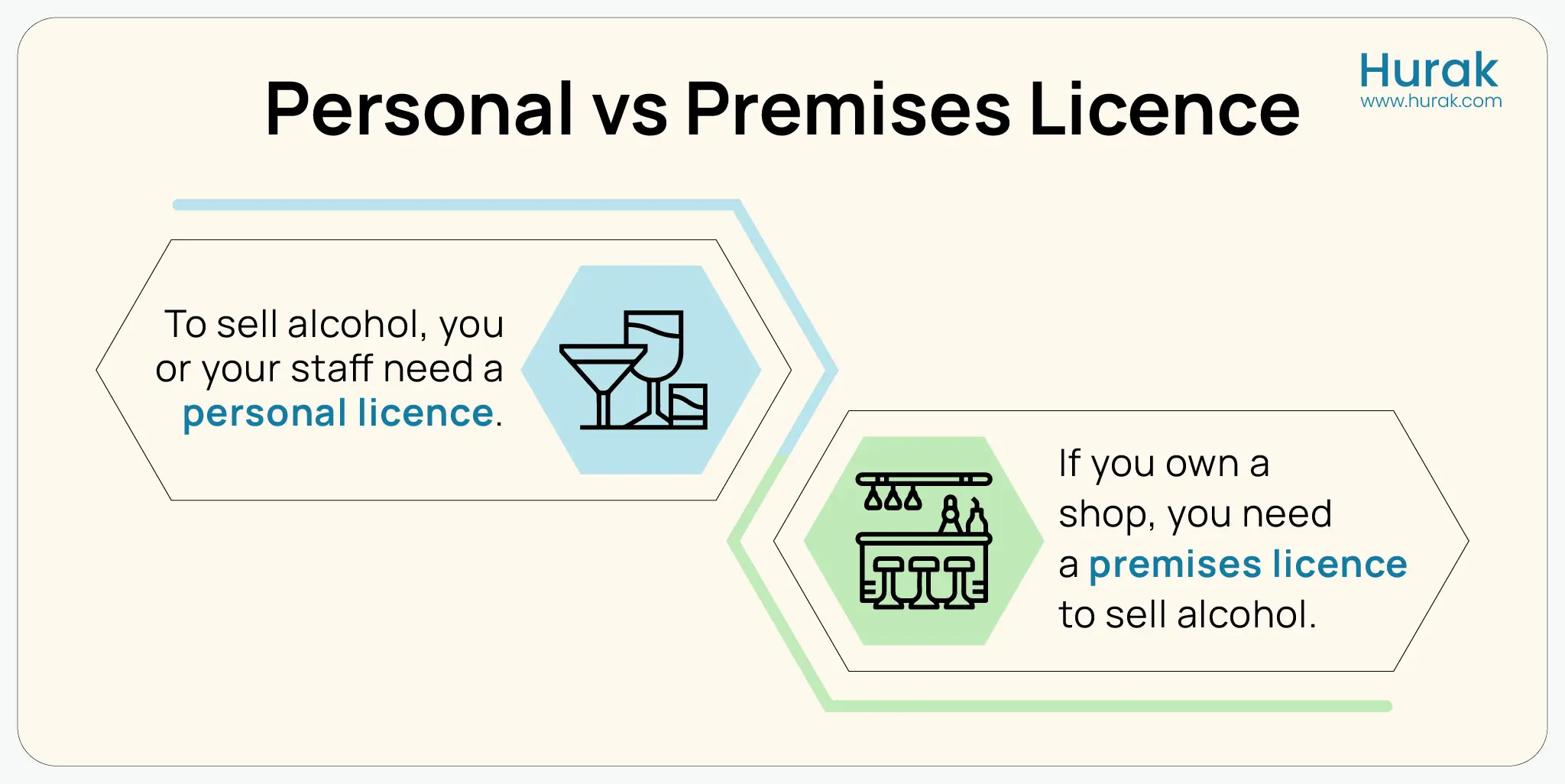
A personal licence is different. It's required for the individual responsible for selling alcohol on the premises. This means that the premises licence relates to the venue, while the personal licence applies to the staff member who handles alcohol sales.
Understanding the differences between personal licence and premises licence is important to staying compliant. This infographic will help you quickly clarify the purpose of both the personal licence and the premises licence
If you're running a business that sells alcohol, offers live entertainment, or serves food late at night, you'll need a premises licence. The idea of applying for one can seem confusing at first, especially if you're doing it for the first time, but once you understand the steps, it becomes much more manageable. Here's a simple explanation of the process, what you'll need, and what to expect at each stage.
Every application begins with filling out the Premises Licence application form. You can get this form from your local council's website or through Gov.uk.This form asks for basic but essential details, including:
Who you are and what your business does
Where your premises is located
What kind of activities you want to offer, such as selling alcohol, playing music, or serving hot food late at night
The days and hours you plan to do those activities.
Some councils let you apply online, while others may ask you to send it by email or post. Either way, the instructions will be on your council's site.
You'll need to send in a simple floor plan of your venue with your application. Don't worry, this isn't a fancy architectural drawing. It just needs to show things like:
Where alcohol will be sold
Seating areas
Toilets, entrances, exits, and emergency exits
The kitchen, if you're selling food
This helps the licensing authority understand how your space is set up and how you plan to operate safely.
Next, you'll be asked to describe how your business will run daily. This is called an "operating schedule."
Here, you'll outline things like:
Your opening hours
When you'll sell alcohol or offer entertainment
How you'll keep the premises safe
How you'll avoid public nuisance (like noise or crowding)
This part shows the council that you understand your responsibilities and have a plan to run things smoothly.
If you plan to sell alcohol, you must name someone as the Designated Premises Supervisor (DPS). This is the person who will be in charge of the premises and make sure alcohol laws are followed.
The DPS needs to hold a personal licence, which proves they're trained and legally allowed to take on that role. If you're the business owner, you can be the DPS yourself, as long as you have (or apply for) your personal licence.
Want to Become a Designated Premises Supervisor?
It all starts with your APLH qualification, which is a legal requirement when applying for a personal licence. Hurak makes it simple, fast, and stress-free. Get Your APLH Qualification | Apply for Your Personal Licence
Once you've filled in the form and prepared everything, you must submit your application to your local council. Along with the form, you'll need to include:
The plan of the premises
A signed consent form from the DPS
Proof that you have the right to work in the UK
The application fee varies depending on the rateable value of your premises. You can check the fee band and get an accurate cost estimate by visiting your local council's website or using the Gov.uk premises licence fee calculator.
Double-check your council's website to make sure you're sending everything to the right place and in the right format.
The law requires informing the public that you're applying for a licence. This gives people a chance to raise any concerns.
You must:
Put up a public notice outside your premises for 28 days, it has to be easy to see and read at all times
Place a notice in a local newspaper within 10 working days of sending your application.
Your council will often provide a template for these notices, so you can get it right the first time.
Once your application is submitted and your notice is up, there's a 28-day consultation period. During this time, people living nearby or responsible bodies like the police, fire service, or environmental health can object to your application if they have concerns.
If there are no objections, your licence is usually approved without a hearing.
If someone does raise a concern, your council may invite you to a hearing where you can explain your plans in more detail before they decide.
If everything goes well, you'll receive:
A Premises Licence certificate
A Licence Summary, which you must display at your premises
You can now legally carry out the activities you applied for, like selling alcohol or hosting events, under the terms of your licence.
From start to finish, the process usually takes 4 to 8 weeks, depending on how quickly you submit everything and whether any objections are raised.It's a good idea to start early, especially if you plan to open a venue or run an event by a specific date.
In case you need a quick refresher, we've put together a simple infographic that breaks down each step of the premises licence application process.
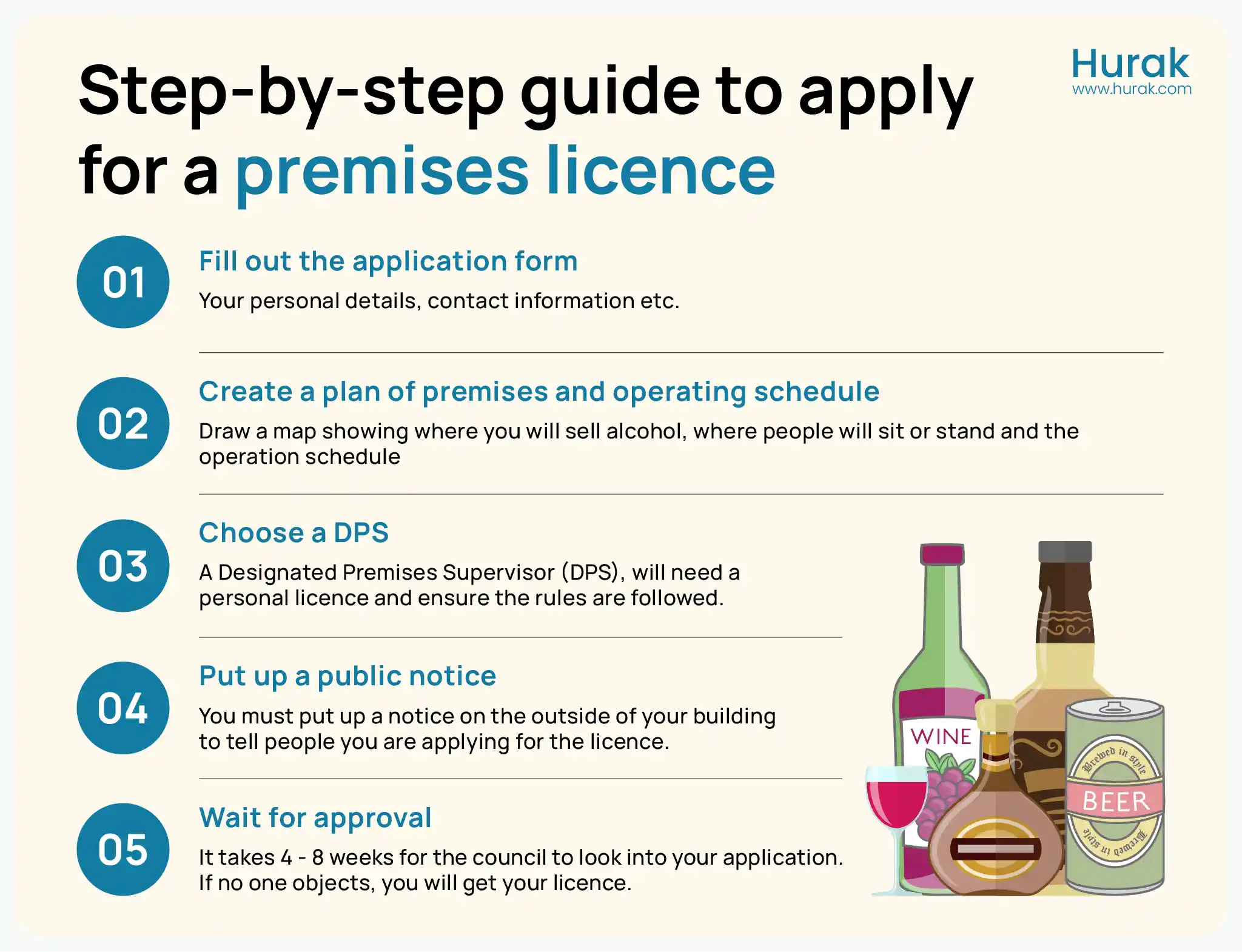
When applying for a premises licence, one of the most important things you'll be asked to consider is how your business will promote the four licensing objectives. These are set out in the Licensing Act 2003 and form the foundation of every licensing decision made by your local authority. You'll need to show that your premises will operate in a responsible way, protecting the public and minimising risk.
The four licensing objectives are:
The prevention of crime and disorder
Public safety
The prevention of public nuisance
The protection of children from harm
Your application should explain what steps you'll take to support each of these objectives. This doesn't mean you need to commit to costly or complex measures, but you should demonstrate that you've thought about potential risks and how you'll manage them.
The table below outlines practical examples you can use to meet each licensing objective:
Licensing Objective | Examples of How to Promote It |
The Prevention of Crime and Disorder | Install CCTV with clear signage Train staff to handle intoxicated customers and de-escalate conflict Have a written policy for refusing service when appropriate |
Public Safety | Keep emergency exits clear and well-marked Carry out regular fire and H&S risk assessments Ensure staff are trained in first aid or emergency procedures |
The Prevention of Public Nuisance | Limit noise after certain hours (e.g. no music after 11 pm) Ask customers to leave quietly and not loiter outside Use bins with lids and schedule waste collection |
The Protection of Children from Harm | Display signage for age-restricted products (e.g. alcohol) Train staff in Challenge 25 ID checks Avoid adult content or unsuitable material during business hours |
Tip: Be realistic. Anything you include may become a condition of your licence, so only commit to actions you can reliably maintain.
A premises licence is a key requirement for any business that wants to sell alcohol, host entertainment, or provide late-night food in the UK. In this guide, we've explained what a premises licence is, who needs one, what activities it allows, how to apply, and the responsibilities it brings. We also explored the difference between a premises licence and a personal licence, and outlined what to expect during the application process.
Still have questions? The FAQs below cover common concerns, from charity events and application costs to what happens if someone objects to your licence.
A premises licence is a legal licence that allows a business or venue to sell alcohol, serve hot food after 11 pm, or provide entertainment like live music or film screenings.
You need one if you run a pub, bar, restaurant, shop, or event space and plan to sell alcohol, serve hot food late at night, or host certain types of entertainment.
A premises licence applies to the venue. A personal licence is for the individual responsible for selling alcohol at that venue.
You apply through your local council. You'll need to complete a form, submit a plan of the premises, name a Designated Premises Supervisor (DPS), and display a public notice.
The application fee is based on the rateable value of your premises. To find the exact cost, you can refer to your local council's website or use the Gov.uk premises licence fee calculator for a detailed estimate.
It usually takes between 4 to 8 weeks, as long as there are no objections.
The local council will review your case at a hearing. They may approve, amend, or reject the application.
Not always. You may be able to apply for a Temporary Event Notice (TEN) instead, which is quicker and cheaper for small, short events like weddings or fundraisers.
Yes. Even free or charitable events need a licence if they include alcohol sales, regulated entertainment, or late-night food.
Yes. Background music, art exhibitions, and film screenings for education or promotion often don't require a licence, as long as no alcohol is sold and it's not for profit.
You could be fined up to 20,000 or face 6 months in prison for unauthorised licensable activities.
Need help with your application?
Apply directly through your local council using the steps above, or reach out to Hurak, and we'll complete the application process on your behalf, quickly and without the stress.
Courses
Upskill with job-ready training.
Mock Tests
Measure your learning progress.
Create an online video course, reach students across the globe and earn money