Need some help?
Need help choosing the right course?
Get help with course requirements, dates, locations, booking options or training for multiple employees.
Get help with course requirements, dates, locations, booking options or training for multiple employees.
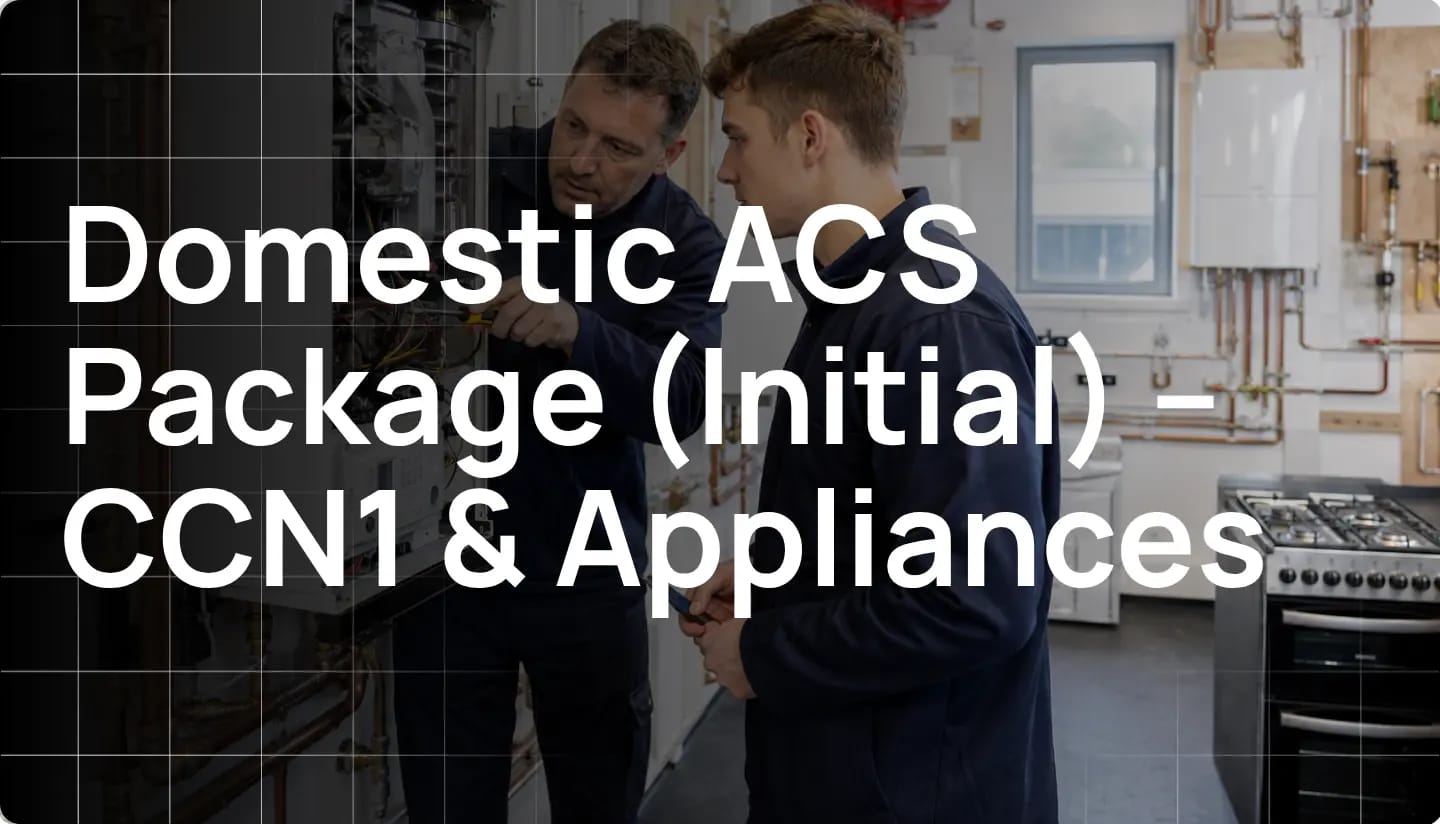
Gain recognised domestic gas safety competence through a 4-day gas course covering core gas safety and relevant appliance competencies. Complete theory and practical assessments and receive an LCL Awards Certificate for Core Domestic Gas Safety (CCN1) and the appliances successfully completed.


The Domestic ACS Package (Initial) – CCN1 & Appliances is designed for candidates working towards initial ACS certification for domestic natural gas work. It combines CCN1 (Core Domestic Gas Safety) with relevant domestic appliance assessments.
The CCN1 gas course covers key areas including gas safety legislation, combustion, gas pressures and rates, pipework, tightness testing, ventilation, flues and unsafe situations. The appliance assessments focus on the specific appliances included in the package.
The initial ACS route requires candidates to demonstrate their knowledge and practical competence through assessment. CCN1 covers core domestic gas safety, while relevant appliance competencies are required for the specific gas work being undertaken.
The Domestic ACS Initial Package includes training and assessment covering some or all of the following competencies:
Please note
If you are adding an appliance competency for the first time, you may need additional practical training in a realistic working environment. Any additional training and associated costs will depend on the appliance competency and your existing experience.
This domestic gas course suits candidates working towards initial ACS certification who need to demonstrate competence in core domestic gas safety and relevant appliances.
This course is designed for candidates with relevant gas training and practical experience. New entrants will normally need to complete the appropriate training pathway before taking an ACS assessment.
You will develop the knowledge and practical skills needed to work safely with domestic gas installations and the appliances covered by your package. You will learn how to:
This CCN1 qualification is suitable for candidates undertaking their initial ACS assessment, including those whose previous ACS qualification has expired for more than 12 months and therefore requires an initial assessment.
Candidates must meet the relevant ACS entry requirements for their route, which may include recognised gas training, qualifications and practical experience. To undertake the assessment, candidates should provide evidence of a recognised training programme and a supporting portfolio of relevant on-site gas work experience, verified by a registered gas engineer.
New entrants will generally need an appropriate training route, such as a Managed Learning Programme (MLP), with supervised on-site experience before progressing to their ACS assessment. Successful ACS certification can support the route to Gas Safe Register registration, but an ACS certificate does not automatically provide Gas Safe registration.
What Do I Need to Bring?
Please bring a passport-sized photograph, formal ID such as a passport or driving licence, and copies of any relevant previous qualifications, including ACS or plumbing certificates.
The Domestic ACS Package (Initial) – CCN1 & Appliances is delivered over 4 days and combines the required training and assessment for the CCN1 and relevant appliance competencies included in the package.
Training is delivered in person, giving candidates the opportunity to develop their practical skills and complete the required theory and practical assessments in a suitable training environment.
The CCN1 assessment consists of practical tests and multiple-choice question papers, allowing candidates to demonstrate both their knowledge and practical competence in domestic gas safety.
On successful completion, candidates will receive the LCL Awards Certificate in Core Domestic Gas Safety (CCN1), along with certification for the appliance competencies they have successfully completed. ACS certificates are normally valid for 5 years.
💡 Candidates will receive the LCL Awards Domestic Gas Safety Training Manual on the first day of the course to support their learning and assessment preparation.
Gas engineers can earn around £25,000 to £45,000 per year, depending on experience, location, employer and level of responsibility. With further experience, additional ACS competencies and progression into specialist or supervisory roles, earning potential can increase.
Self-employed engineers may have different earning potential, but income can vary significantly depending on workload, services offered and operating costs.

We provide our services without any additional charges.

All courses on our platform undergo thorough manual screening to ensure the utmost quality.

Purchases courses for team, family or colleagues. Add a course, and provide student details at checkout.

Choose “Business Customer” at checkout for access to this payment method.
Hear from our past customers
Understand combustion principles and how to check gas pressures and gas rates safely.
Learn about domestic gas pipework, tightness testing and safe purging procedures.
Understand chimney systems and ventilation requirements for safe domestic gas appliance operation.
Learn about gas controls and flue gas analysis as part of combustion performance assessment (CPA1).
Cover the relevant appliance competencies included in your package, including CENWAT, CKR1 and HTR1.
CCN1 is the Core Domestic Gas Safety ACS assessment. It covers the core gas safety competence required for domestic natural gas work and is normally taken alongside relevant appliance assessments.
The CCN1 qualification covers areas such as gas safety legislation, combustion, gas pressures and rates, pipework, tightness testing and purging, ventilation, flues, controls and unsafe situations.
The CCN1 gas course covers training and assessment for core domestic gas safety, including CPA1, together with the relevant appliance competencies included in the package.
No. The course is designed for candidates progressing towards initial ACS assessment. New entrants generally need to complete an appropriate gas training route and gain the required supervised practical experience before undertaking ACS assessment.
ACS CCN1 demonstrates assessed competence in core domestic gas safety. Gas Safe registration is separate, and engineers must meet the registration requirements and hold the relevant competencies for the gas work they intend to undertake.
This initial package is delivered over 4 days, including training and the relevant theory and practical assessments.
The package can include appliance competencies such as CENWAT, CKR1 and HTR1, depending on the package selected. The relevant appliance competency is required for the specific appliance work undertaken.
A CCN1 certificate confirms successful completion of the Core Domestic Gas Safety ACS assessment. Candidates who successfully complete the package receive the LCL Awards certificate for CCN1 and the appliance competencies achieved.
The CCN1 gas course price depends on the package, location and appliance competencies included. Check the current course listing for the latest price and available dates.
ACS certificates are normally valid for 5 years. Candidates can generally take reassessment up to six months before expiry without losing remaining certification time.
If an ACS element has expired by more than 12 months, the candidate must undertake an initial assessment rather than reassessment. If it has expired within 12 months, the applicable reassessment route may still be available, subject to the scheme requirements.