
Need some help?
Need help choosing the right course?
Get help with course requirements, dates, locations, booking options or training for multiple employees.
Get help with course requirements, dates, locations, booking options or training for multiple employees.
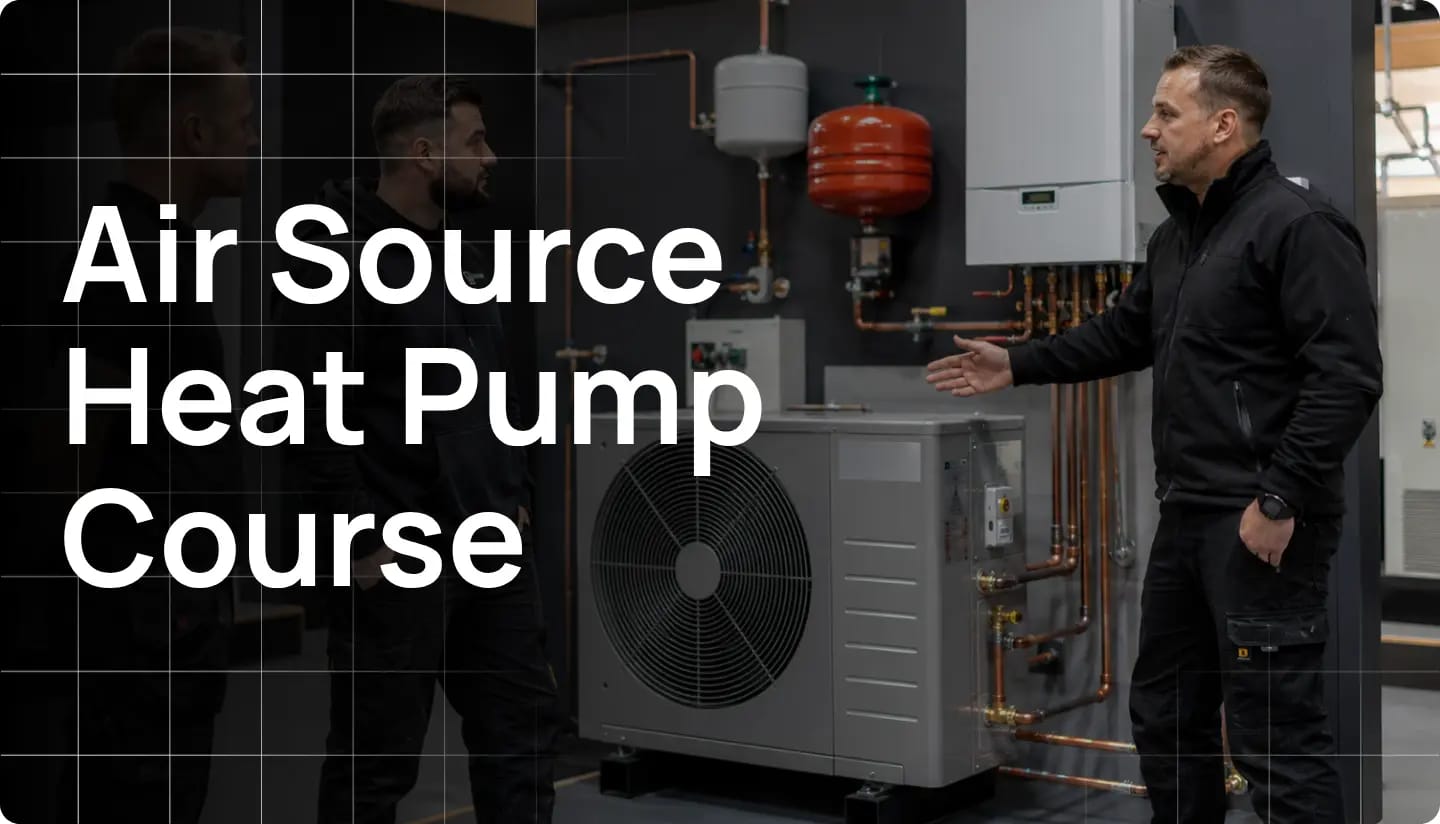
Get qualified to work on domestic and commercial air source heat pumps (up to 16kW). This 3-day course covers installation, commissioning, servicing and fault-finding, and leads to an RQF Level 3 Award from LCL Awards. Training combines classroom learning with hands-on practice on equipment, and suited to engineers with an existing background in plumbing, heating or gas installation.


Air source heat pumps are becoming one of the UK's leading alternatives to gas boilers, and this course teaches engineers how to work with them properly. Rather than just covering theory, it focuses on the practical skills needed to specify, install, commission, service, and fault-find domestic and small commercial ASHP systems up to 16 kW, giving you a well-rounded, real-world understanding of how these systems work from installation through ongoing maintenance.
This air source heat pump training combines technical knowledge with practical skills, helping experienced professionals understand the requirements of heat pump installation, commissioning and maintenance.
The course runs over 3 days, mixing classroom learning with hands-on practice on a fully operational heat pump unit, and finishes with a written and practical assessment on Day 3. Once you pass, you'll walk away with the RQF Level 3 Award in the Installation & Maintenance of Heat Pump Systems (Non-refrigerant Circuits), awarded by LCL Awards.
Did You Know?
Operatives or individuals looking to join the Microgeneration Certification Scheme (MCS) can use this qualification as a key step toward working on renewable heating installations.
This course is aimed at engineers who already work in a related trade and want to add heat pumps to their skills. It suits:
The key learning topics we cover on the course include:
To enrol on the course, you’ll need to demonstrate that you already have relevant plumbing or heating knowledge, skills and experience. There are two ways to meet the entry requirements.
Relevant Vocational Qualification
You can meet the entry criteria if you hold a Level 2 or Level 3 vocational qualification (NVQ/N/SVQ) in a relevant area, such as:
Along with this, you’ll also need current certification in WRAS Water Regulations/Water Byelaws, Hot Water Systems & Safety (Approved Document G3), and Low Temperature Heating and Hot Water Systems in Dwellings
Experienced Installer Route
If you don’t hold one of the qualifications above, you can still qualify as an experienced wet central heating installer if you're registered with:
Alongside this, you'll need current certification in Water Regulations/Water Byelaws, Hot Water Storage Systems & Safety (Approved Document G3), and Low Temperature Heating and Hot Water Systems in Dwellings, where these aren't already covered by your existing qualification.
Please Note
You’ll usually need 3 years of relevant experience for this route. This may be reduced through Recognition of Prior Learning (RPL) if your initial assessment confirms that you already have the required skills and knowledge. Before enrolling, you’ll complete a short initial assessment to check that you meet the course entry requirements. All certifications must be current and valid; expired or revoked certifications will not be accepted.
This is a hands-on, in-person course and is delivered over 3 days. Training combines classroom-based theory with practical work in a fully equipped training room, so you're not just learning from diagrams and slides but working directly with a fully operational heat pump unit throughout the practical sessions. We provide a training manual on Day 1 to support your learning.
This heat pump installation course concludes with an assessment at the end of Day 3 that combines written and practical elements. The written assessment includes multiple-choice questions, while the practical assessment involves a design scenario along with hands-on work on a fully operational heat pump unit, so you're tested on real, applied skills rather than theory alone.
Once you pass, you'll receive the RQF Level 3 Award in the Installation & Maintenance of Heat Pump Systems (Non-refrigerant Circuits), a regulated qualification awarded by LCL Awards.
Operatives or individuals can use this qualification to join the Microgeneration Certification Scheme (MCS), though MCS registration is a separate membership process applied for directly with the scheme, not awarded as part of this course.

We provide our services without any additional charges.

All courses on our platform undergo thorough manual screening to ensure the utmost quality.

Purchases courses for team, family or colleagues. Add a course, and provide student details at checkout.

Choose “Business Customer” at checkout for access to this payment method.
session
Hear from our past customers
You'll cover the health and safety hazards and safe operating systems relevant to ASHP work, along with how a heat pump unit and its components function. This includes learning about the different types of ASHP systems and how hydraulic emitter circuits are arranged.
This stage covers the regulations and standards that apply to ASHP installation, testing, and commissioning, along with the principles of system selection and design. You'll also learn the key design factors that influence how an ASHP system is specified.
You'll learn how to prepare for, organise and carry out an ASHP installation from start to finish, including installing, testing and commissioning the system, and handing it over to the client.
This final stage covers the criteria for inspecting, servicing, and maintaining ASHP systems, as well as how to diagnose and repair faults and failures in systems already in operation.
This ASHP course runs over 3 days, combining classroom theory with hands-on practical training.
You'll receive the RQF Level 3 Award in the Installation & Maintenance of Heat Pump Systems (Non-refrigerant Circuits), awarded by LCL Awards.
This qualification could be used by operatives or individuals looking to join the Microgeneration Certification Scheme (MCS). MCS registration is a separate process, applied for directly with the scheme.
Yes. You'll need an existing Level 2/3 qualification in plumbing, heating & ventilating, oil-fired technical services, or gas installation & maintenance — or equivalent evidenced experience. See our Entry Requirements section for full detail.
The course covers domestic and small commercial air source heat pump systems up to 16kW.
At our Paisley and Dalgety Bay academies. It's delivered in person only — there's no online or remote option.
Through a written assessment (multiple-choice questions) and a practical assessment (a design scenario plus hands-on work on a fully operational heat pump unit), both at the end of Day 3.
Water Regulations/Water Byelaws, Hot Water Storage Systems & Safety (Approved Document G3), and Low Temperature Heating and Hot Water Systems in Dwellings — if you don't already hold these.
No. It's designed for engineers who already hold a relevant trade qualification or equivalent experience, not those with no background in plumbing, heating or gas work.
Yes. Experienced wet central heating installers registered with Gas Safe, OFTEC, MCS, or HETAS may also meet the entry requirements, alongside the relevant additional certifications.
Yes, a training manual is provided on Day 1 to support your learning throughout the course.
Your RQF Level 3 Award could support your route toward MCS registration. If you don't yet hold Water Regulations, G3, or Low Temperature Heating certifications, these are worth completing alongside or after this course.
This course combines classroom learning with hands-on practical work on a fully operational heat pump unit, rather than theory-only training, and leads to a nationally recognised RQF Level 3 qualification.
Plumbing and heating engineers, Gas Safe registered engineers, oil-fired technicians, and renewable energy installers looking to add ASHP installation to their skillset — as well as employers upskilling their teams.
